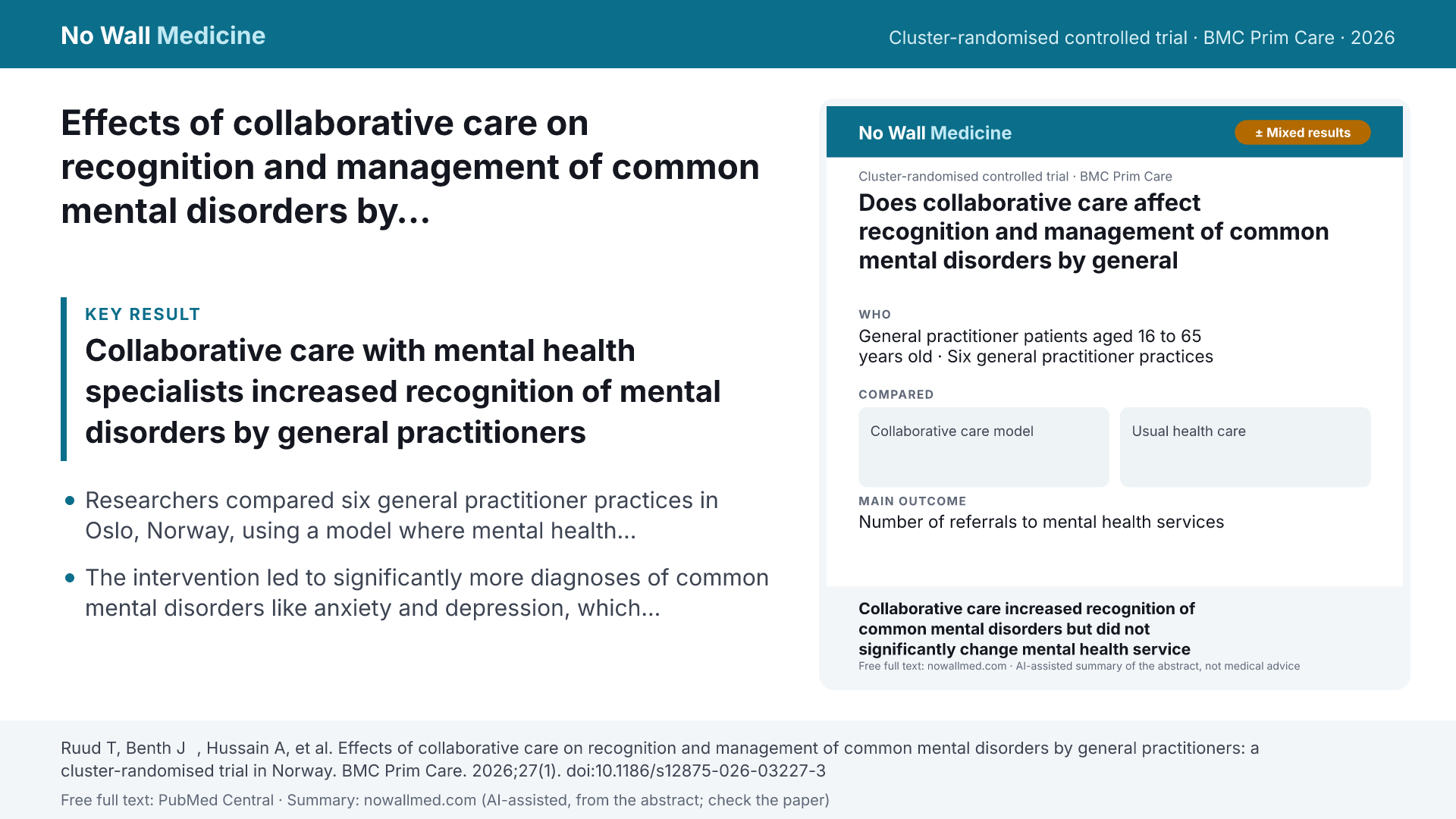
Collaborative care with mental health specialists increased recognition of mental disorders by general practitioners
Effects of collaborative care on recognition and management of common mental disorders by general practitioners: a cluster-randomised trial in Norway
Cluster-randomised controlled trialMixed results
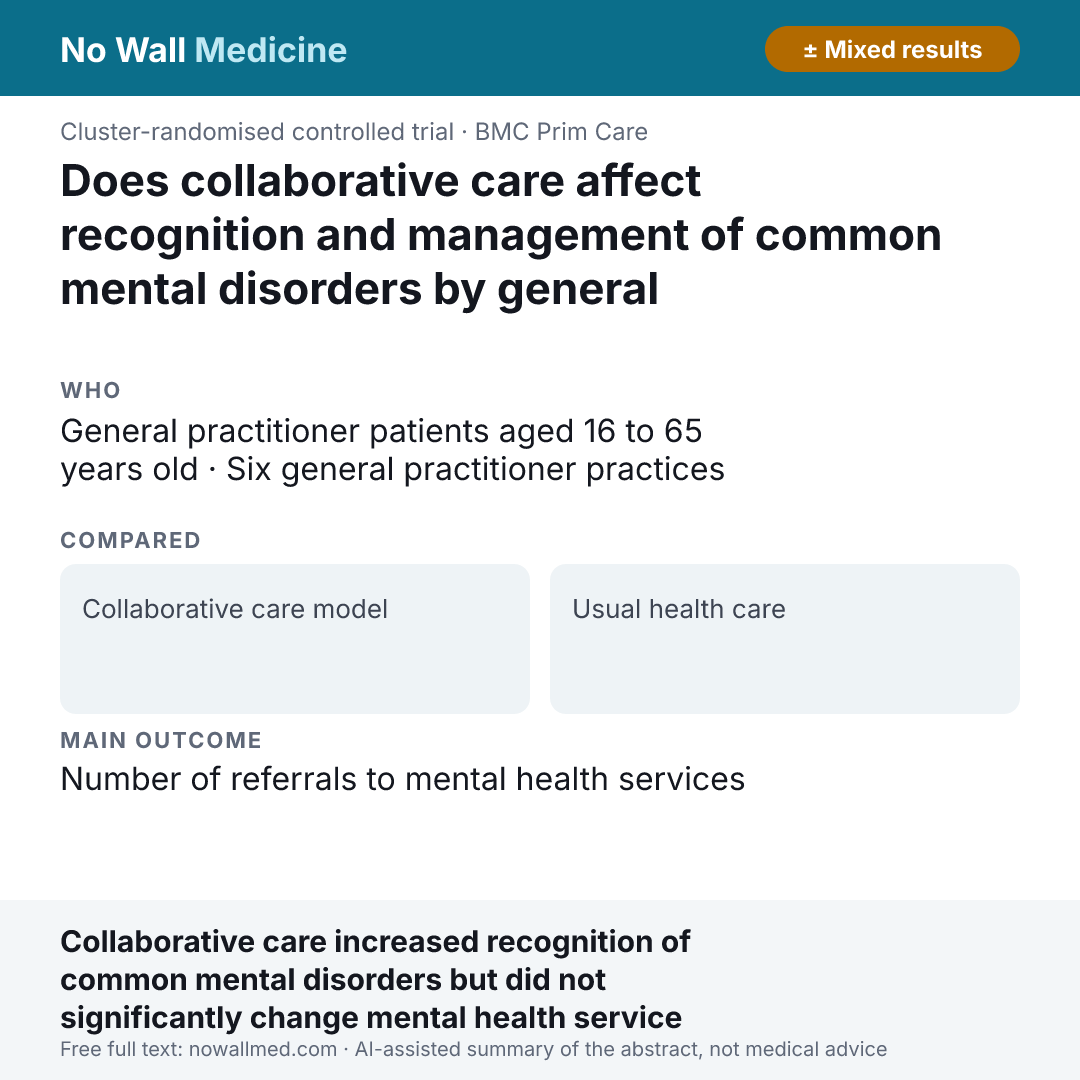
Does collaborative care affect recognition and management of common mental disorders by general practitioners?
Who
General practitioner patients aged 16 to 65 years old · Six general practitioner practices in Oslo, Norway
Compared
Collaborative care model
Usual health care
Main outcome
Number of referrals to mental health services
Bottom line: Collaborative care increased recognition of common mental disorders but did not significantly change mental health service referrals.
Limitation: Lack of structured clinical measurements in electronic patient records meant clinical outcomes were unknown.
BMC Prim Care · 2026-02-26 · Save PNG
Clinical question: Does collaborative care affect recognition and management of common mental disorders by general practitioners?
Key points
- Researchers compared six general practitioner practices in Oslo, Norway, using a model where mental health specialists worked alongside doctors for 18 months.
- The intervention led to significantly more diagnoses of common mental disorders like anxiety and depression, which was associated with fewer unexplained physical symptoms.
- There were no significant differences between the groups regarding referrals to mental health services or the use of outpatient specialized mental health services.
Limitation the authors note: The clinical outcomes of the intervention were unknown due to a lack of structured clinical measurements in the electronic patient records.
Headline and key points written with AI from the paper’s abstract, with every number checked against it. Read the paper before relying on them.
Was this summary helpful?
Subject terms
Headline, design, result, key points, caveat and citation as plain text.
Cite this article
Ruud T, Benth JŠ, Hussain A, et al. Effects of collaborative care on recognition and management of common mental disorders by general practitioners: a cluster-randomised trial in Norway. BMC Prim Care. 2026;27(1). doi:10.1186/s12875-026-03227-3
Spotted a mistake? Suggest a correction