Hyperdense middle cerebral artery sign is associated with worse outcomes after mechanical clot removal in stroke
Effects of Computed Tomography Hyperdense Middle Cerebral Artery Sign on the Efficacy of Endovascular Therapy in Acute Ischemic Stroke With Large Infarcts: A Subgroup Analysis of the ANGEL-ASPECT Trial
Multicenter randomized controlled trial subgroup analysisBenefit found
Does hyperdense middle cerebral artery sign affect endovascular therapy efficacy in large infarct strokes?
Who
432
Acute ischemic stroke patients with anterior-circulation large-vessel occlusion and large infarct cores · China
Compared
Endovascular therapy without hyperdense middle cerebral artery sign: odds ratio 2.78 (95% CI 1.80-4.27)
Endovascular therapy with hyperdense middle cerebral artery sign: adjusted odds ratio 1.69 (95% CI 0.93-3.08)
Main outcome
90-day modified Rankin Scale score
Result: no significant interaction between hyperdense middle cerebral artery sign and treatment (P=0.19)
Bottom line: Endovascular therapy benefits patients with large core infarcts regardless of hyperdense middle cerebral artery sign status.
J Am Heart Assoc · 2026-03-31Download image
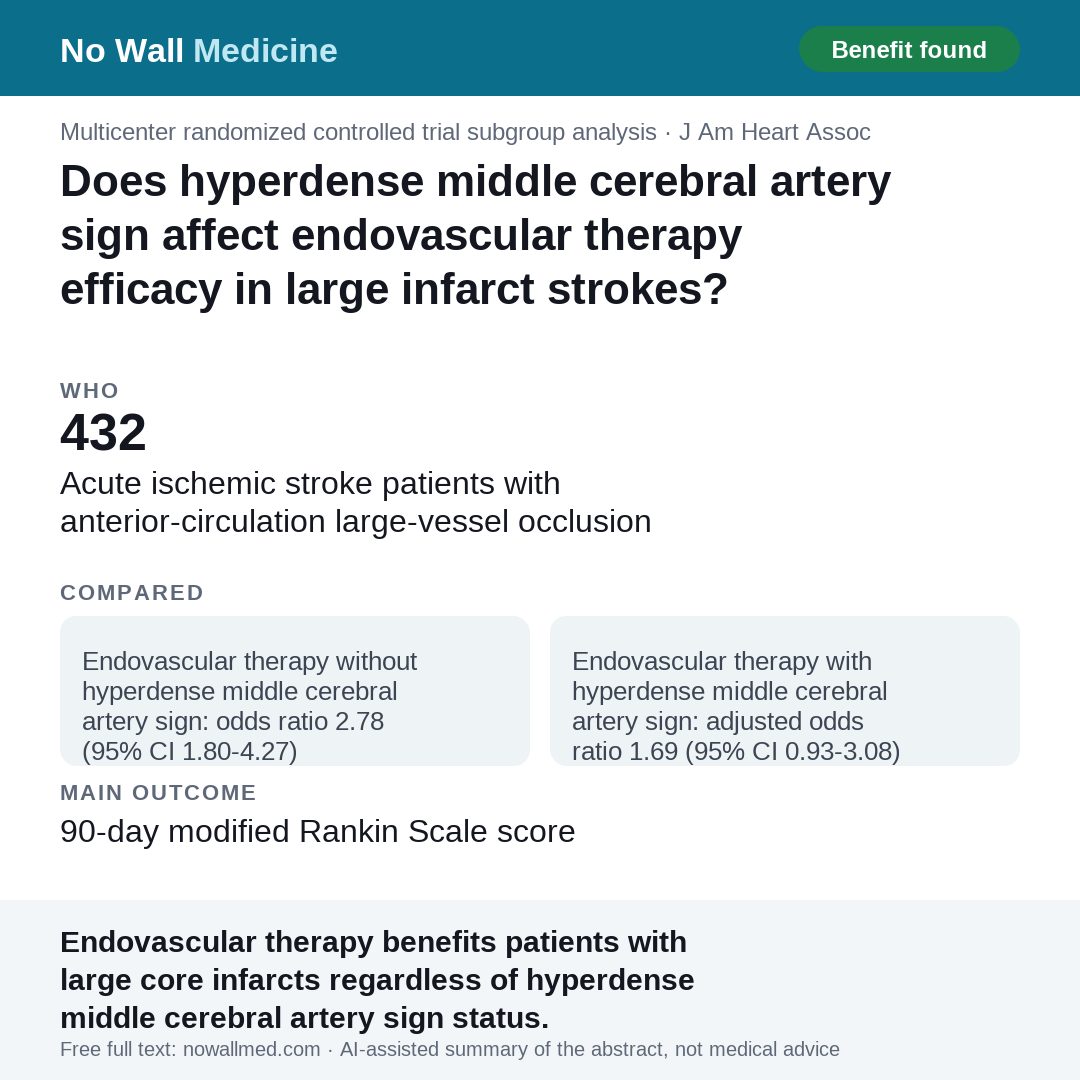
Clinical question: Does hyperdense middle cerebral artery sign affect endovascular therapy efficacy in large infarct strokes?
Why it matters: The impact of the hyperdense middle cerebral artery sign on the effectiveness of mechanical clot removal in patients with large stroke areas remains unclear.
Key points
- Researchers analyzed 432 patients with large ischemic stroke cores to see how a bright sign on a brain scan affected mechanical clot removal results.
- Patients with the hyperdense middle cerebral artery sign had worse functional outcomes and required more attempts to remove the clot than those without the sign.
- Mechanical clot removal was significantly better than medical management for patients without the sign, but this benefit was not statistically significant for those with the sign.
Headline and key points written with AI from the paper’s abstract, with every number checked against it. Read the paper before relying on them.
Topics
Cite this article
Liu C, Wang Z, Wang M, Cai S, Nie X, Huo X. Effects of Computed Tomography Hyperdense Middle Cerebral Artery Sign on the Efficacy of Endovascular Therapy in Acute Ischemic Stroke With Large Infarcts: A Subgroup Analysis of the ANGEL-ASPECT Trial. J Am Heart Assoc. 2026. doi:10.1161/JAHA.125.042473
Spotted a mistake? Suggest a correction