Transcutaneous spinal cord stimulation plus resistance training improved inspiratory pressure most
Effects of different respiratory training methods on respiratory function in patients with spinal cord injury: a network meta-analysis of randomized controlled trials
Network meta-analysisBenefit found
Respiratory training methods for spinal cord injury
Who
625
Patients with spinal cord injury
Compared
tSCS_RRMT
Control
Main outcome
Respiratory function
Result: mean difference 13.25 (95% CrI 7.51 to 18.92) for MIP
Bottom line: Some methods improve respiratory function
Limitation: Irreconcilable heterogeneity and imprecision
Crit Care · 2025-07-07Download image
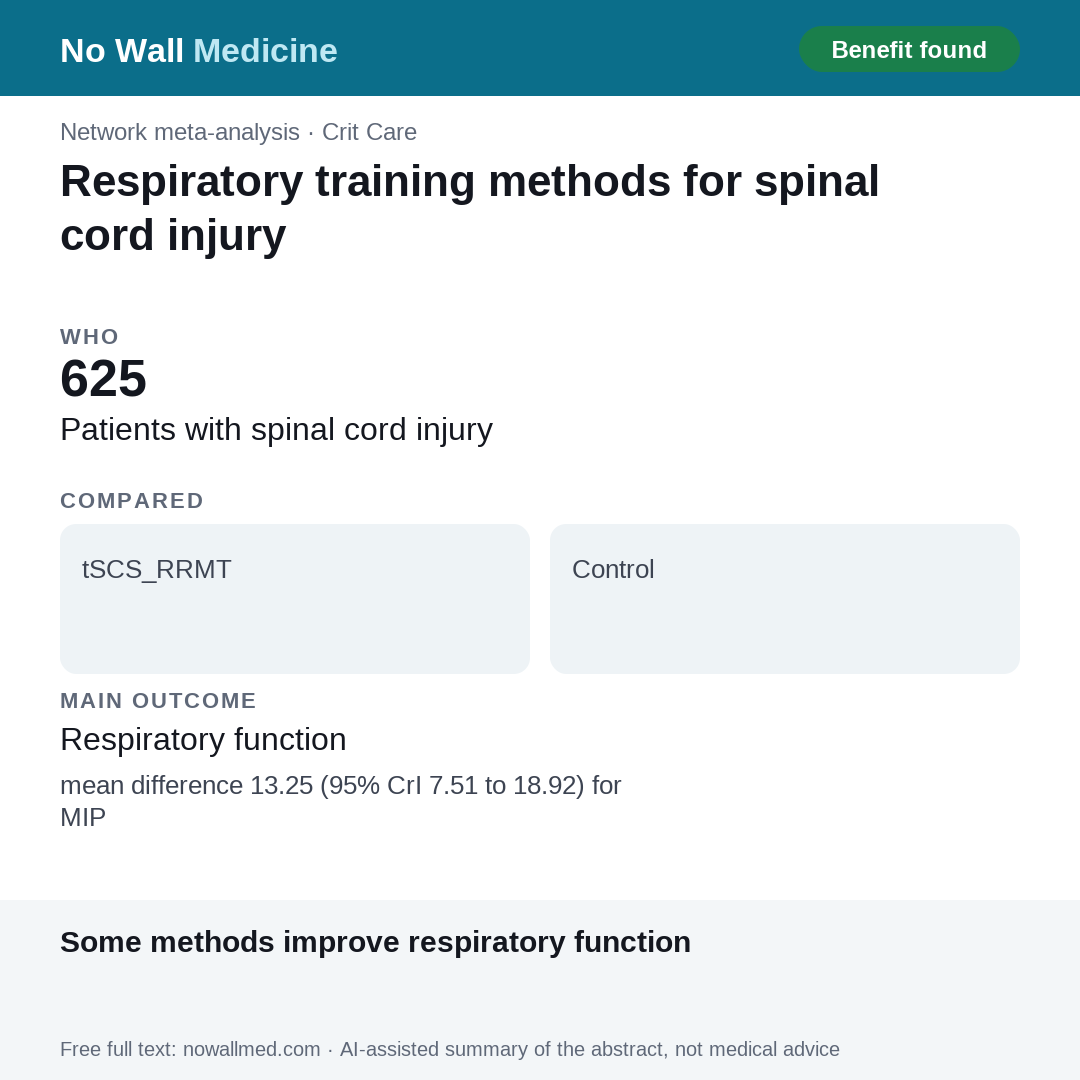
Why it matters: Different respiratory training methods have varying effects on respiratory function in patients with spinal cord injury
Key points
- Seventeen trials with 625 patients compared eight respiratory training methods and one control.
- Transcutaneous spinal cord stimulation plus resistance training had the greatest efficacy for improving maximal inspiratory pressure.
- Incentive spirometry combined with abdominal drawing-in maneuver was most effective for improving forced vital capacity.
Limitation the authors note: The reliability of the evidence is limited due to irreconcilable heterogeneity, indirectness, imprecision, and incoherence
Headline and key points written with AI from the paper’s abstract, with every number checked against it. Read the paper before relying on them.
Topics
Cite this article
Chen J, Chen T, Wang X, Tang X, Yang S, Lyu K. Effects of different respiratory training methods on respiratory function in patients with spinal cord injury: a network meta-analysis of randomized controlled trials. Crit Care. 2025. doi:10.1186/s13054-025-05535-z
Spotted a mistake? Suggest a correction