Enhanced adsorption haemofiltration and haemoadsorption showed no difference in reducing endotoxin levels in septic shock
Effects of enhanced adsorption haemofiltration versus haemoadsorption in severe, refractory septic shock with high levels of endotoxemia: the ENDoX bicentric, randomized, controlled trial
Multiarm, randomized, controlled trialNo clear difference
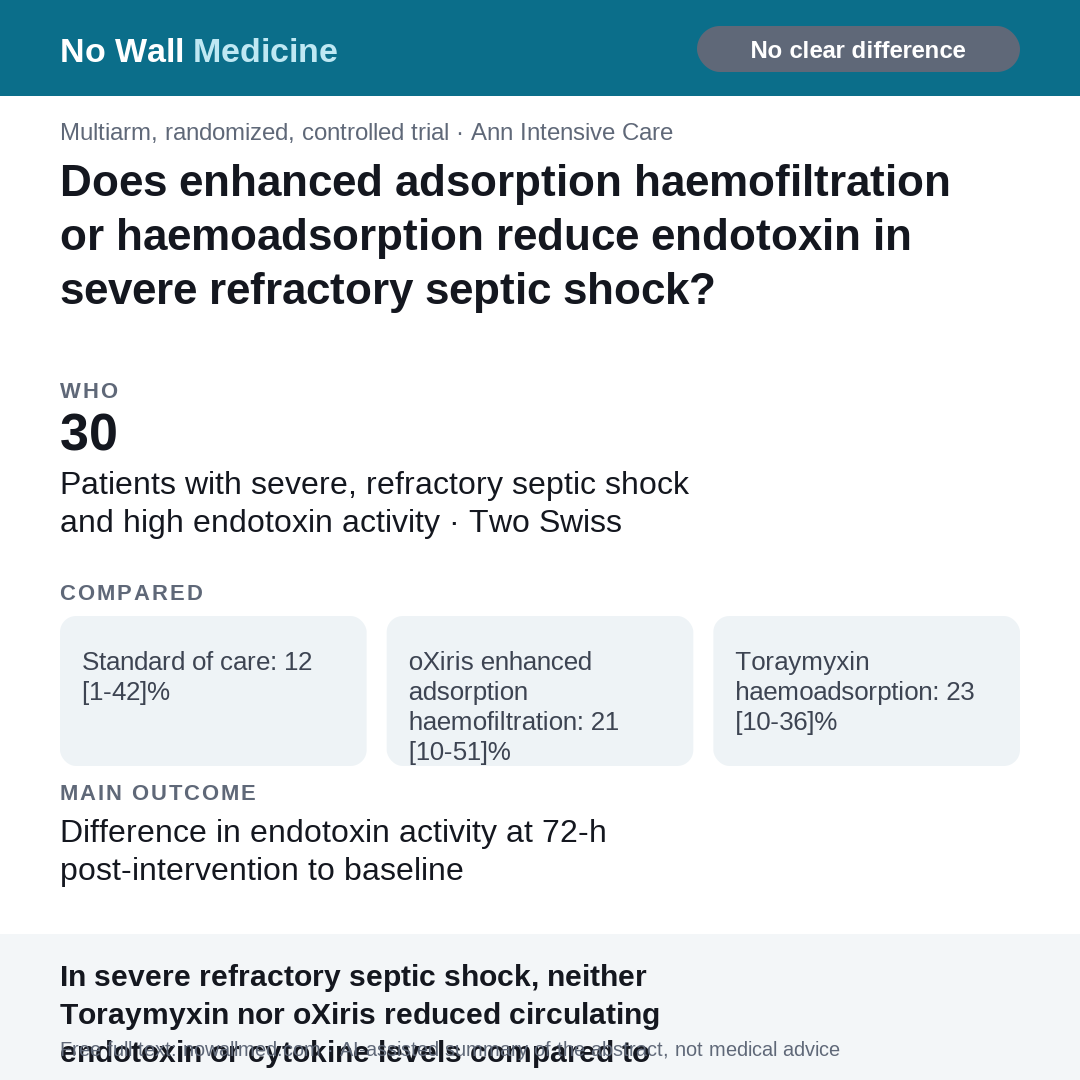
Does enhanced adsorption haemofiltration or haemoadsorption reduce endotoxin in severe refractory septic shock?
Who
30
Patients with severe, refractory septic shock and high endotoxin activity · Two Swiss intensive care units
Compared
Standard of care: 12 [1-42]%
oXiris enhanced adsorption haemofiltration: 21 [10-51]%
Toraymyxin haemoadsorption: 23 [10-36]%
Main outcome
Difference in endotoxin activity at 72-h post-intervention to baseline
Bottom line: In severe refractory septic shock, neither Toraymyxin nor oXiris reduced circulating endotoxin or cytokine levels compared to standard care.
Ann Intensive Care · 2023-12-14Download image
Clinical question: Does enhanced adsorption haemofiltration or haemoadsorption reduce endotoxin in severe refractory septic shock?
Why it matters: Conflicting results exist regarding the effective capacity of different devices to reduce circulating endotoxin and inflammatory cytokine levels in patients with severe septic shock.
Key points
- Researchers randomized 30 patients with severe, refractory septic shock to receive standard of care, oXiris enhanced adsorption haemofiltration, or Toraymyxin haemoadsorption.
- At 72-h post-intervention, endotoxin reduction did not differ between standard of care at 12 [1-42]%, oXiris at 21 [10-51]%, and Toraymyxin at 23 [10-36]%.
- No differences were observed between the groups regarding inflammatory cytokine levels, vasopressor weaning, or reversal of organ injury.
Headline and key points written with AI from the paper’s abstract, with every number checked against it. Read the paper before relying on them.
Was this summary helpful?
Cite this article
Wendel-Garcia PD, Eberle B, Kleinert EM, Hilty MP, Blumenthal S, Spanaus K. Effects of enhanced adsorption haemofiltration versus haemoadsorption in severe, refractory septic shock with high levels of endotoxemia: the ENDoX bicentric, randomized, controlled trial. Ann Intensive Care. 2023. doi:10.1186/s13613-023-01224-8
Spotted a mistake? Suggest a correction
Top studies every Monday
The week’s key trials and guidelines in your specialties, plus any topics you follow. By email, free.
Get the weekly digest