Effects of exercise on bone density and physical performance in postmenopausal women: A systematic review and meta-analysis
Systematic review and meta-analysisMixed results
Does adding exercise to medicine or supplements benefit postmenopausal women?
Who
1249
Postmenopausal women
Compared
Additional exercise and medicine/supplements
Medicine/supplements alone
Main outcome
Bone mineral density and physical performance
Bottom line: Exercise improves physical performance and quality of life, and combining multiple exercise types may improve lumbar spine bone mineral density.
Limitation: The quality level of the evidence was between low to very low.
PM R · 2024-07-20Download image
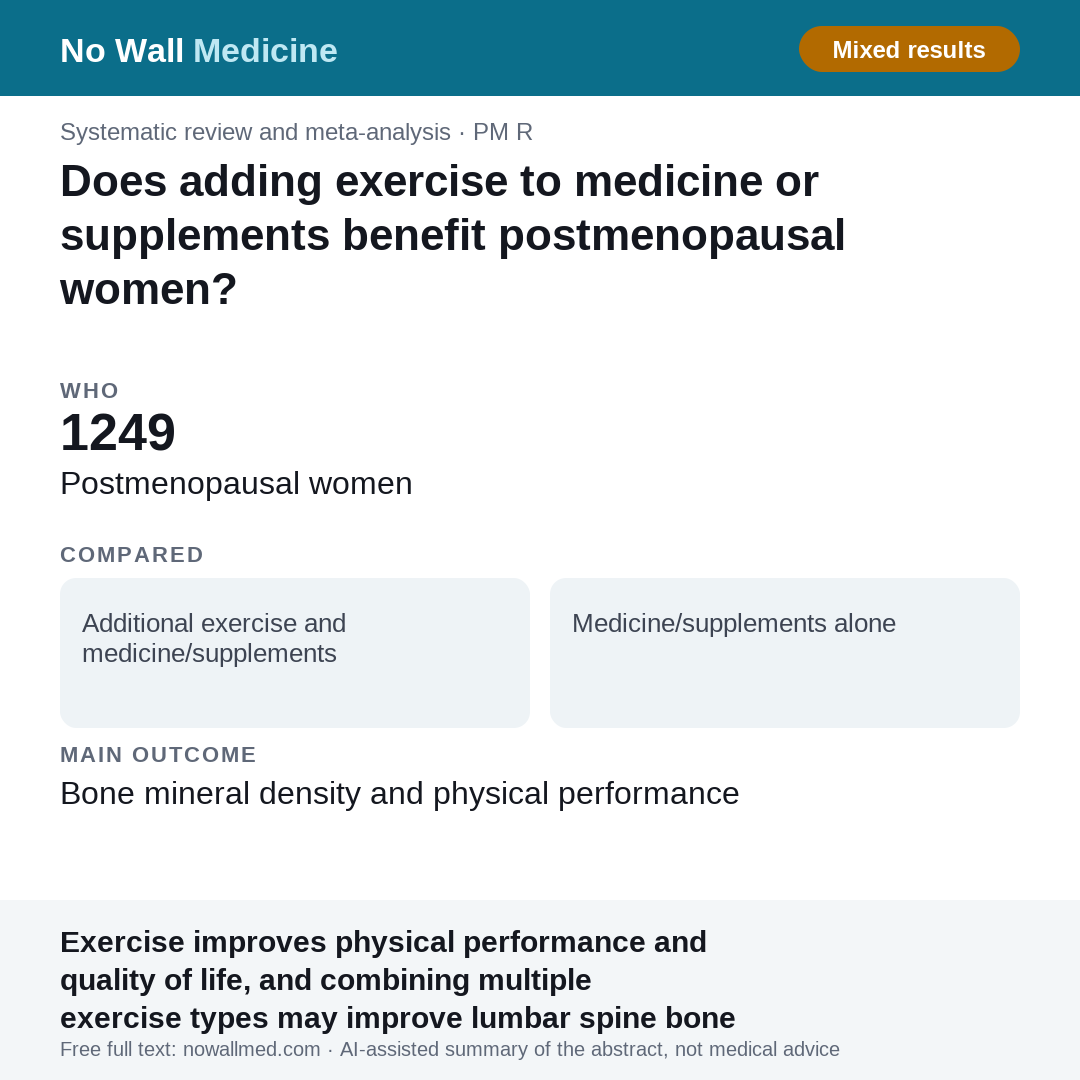
Clinical question: Does adding exercise to medicine or supplements benefit postmenopausal women?
Abstract
Background
Postmenopausal bone loss and decreased physical performance are commonly presented issues. This study aimed through systematic review and meta-analysis to examine the benefits of adding exercise to medicine/supplements in postmenopausal women. Methods
A systematic search was conducted of four electronic databases for articles published from inception to December 2023. Clinical controlled trials comparing the effect of additional exercise and medicine/supplements alone in postmenopausal women were included. The outcomes studied were bone mineral density (BMD) and physical performance. The quality of evidence was evaluated by the Grading of Recommendations, Assessment, Development, and Evaluation (GRADE). Results
Nineteen articles with 1249 participants were included in this study for systematic review and meta-analysis. The results showed that additional exercise was not associated with significantly improved BMD at the lumbar spine and hip joint compared with medicine/supplements only. However, results of subgroup analysis of exercise types showed a significant improvement in lumbar spine BMD by combining multiple types of exercise training (SMD = 0.37; 95% confidence interval [CI] = 0.01-0.72; p = .04). Furthermore, additional exercise significantly improved lower extremity muscle strength (Standard Mean Difference [SMD] = 1.77; 95% CI = 0.56-2.98; p = .004), Berg's Balance Scale (SMD = 0.72; 95% CI = 0.12-1.32; p = .02), Timed Up and Go (SMD = -1.07; 95% CI = -1.35--0.78; p < .001), fear of falling (SMD = 1.32; 95% CI = 0.89-1.75; p < .001), and the quality of life (SMD = 1.39; 95% CI = 0.74-2.05; p < .001). The quality level of the evidence was between low to very low. Conclusions
The significant value of the exercise was demonstrated through enhancing physical performance and quality of life. Moreover, combining various exercise training programs has shown a positive effect on BMD at the lumbar spine. Therefore, for postmenopausal women, combining exercise with medicine/supplements is recommended to further improve physical function and specific areas of BMD. (PROSPERO: CRD42023390633).
Topics
Cite this article
Hsu HH, Chiu CY, Chen WC, Yang YR, Wang RY. Effects of exercise on bone density and physical performance in postmenopausal women: A systematic review and meta-analysis. PM R. 2024. doi:10.1002/pmrj.13206
Spotted a mistake? Suggest a correction
Top studies every Monday
The week’s key trials and guidelines in your specialties, plus any topics you follow. By email, free.
Get the weekly digest