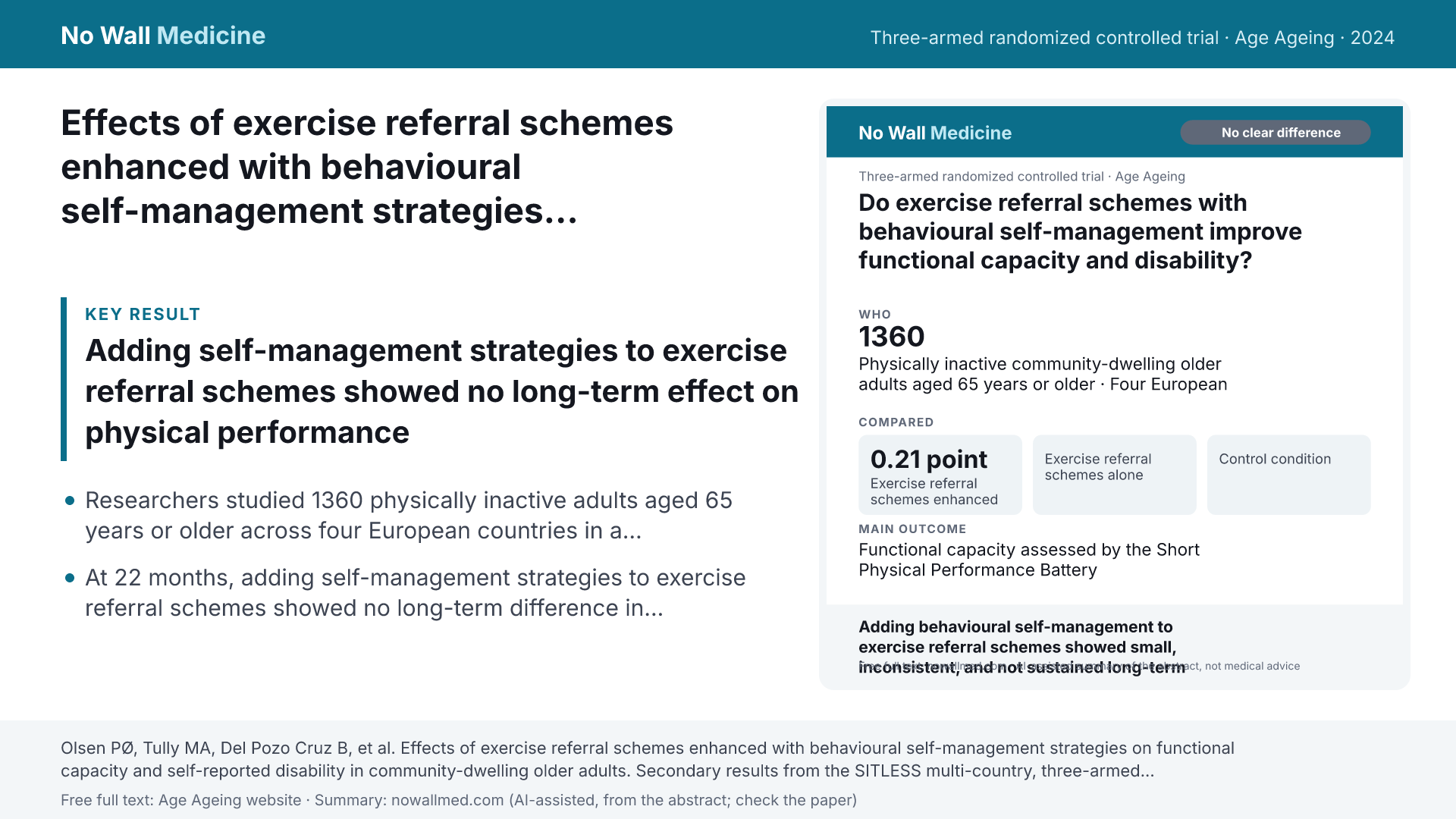
Adding self-management strategies to exercise referral schemes showed no long-term effect on physical performance
Effects of exercise referral schemes enhanced with behavioural self-management strategies on functional capacity and self-reported disability in community-dwelling older adults. Secondary results from the SITLESS multi-country, three-armed randomized controlled trial
Three-armed randomized controlled trialNo clear difference
Do exercise referral schemes with behavioural self-management improve functional capacity and disability?
Who
1360
Physically inactive community-dwelling older adults aged 65 years or older · Four European countries
Compared
0.21 pointExercise referral schemes enhanced with behavioural self-management (95% CI -0.04 to 0.46)
Exercise referral schemes alone
Control condition
Main outcome
Functional capacity assessed by the Short Physical Performance Battery
Result: 0.21 point, 95% CI [-0.04, 0.46]
Bottom line: Adding behavioural self-management to exercise referral schemes showed small, inconsistent, and not sustained long-term effects on functional capacity.
Age Ageing · 2024-10-29Download image
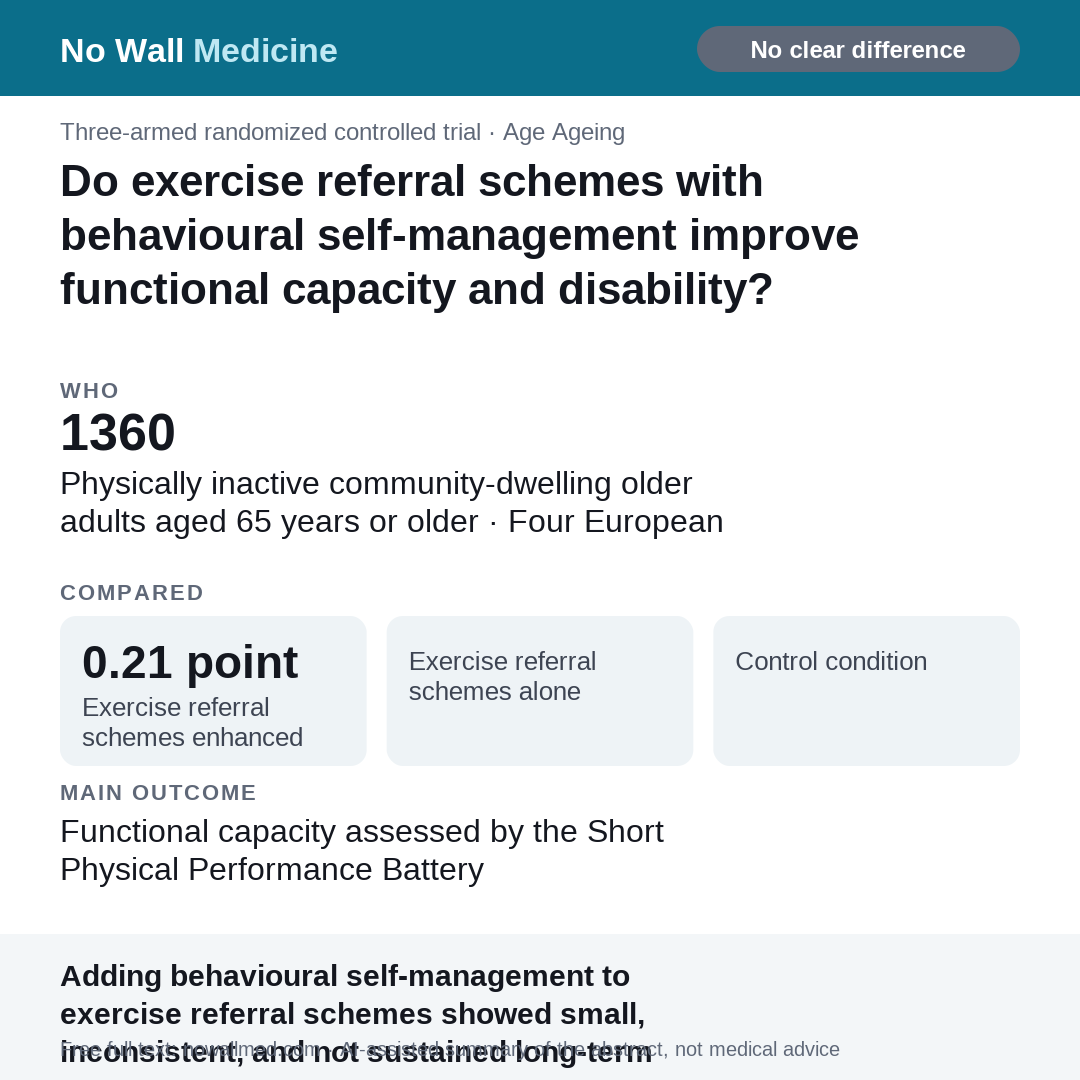
Clinical question: Do exercise referral schemes with behavioural self-management improve functional capacity and disability?
Why it matters: It was unknown if adding behavioral self-management strategies to exercise referral schemes could preserve functional capacity and prevent disability in older adults over the long term.
Key points
- Researchers studied 1360 physically inactive adults aged 65 years or older across four European countries in a randomized trial.
- At 22 months, adding self-management strategies to exercise referral schemes showed no long-term difference in physical performance scores compared to exercise referral alone.
- At 4 months, the group receiving both exercise referral and self-management strategies had higher physical performance scores than the control group by 0.51 point.
Headline and key points written with AI from the paper’s abstract, with every number checked against it. Read the paper before relying on them.
Was this summary helpful?
Subject terms
Cite this article
Olsen PØ, Tully MA, Del Pozo Cruz B, Giné-Garriga M, Coll-Planas L, Roqué M. Effects of exercise referral schemes enhanced with behavioural self-management strategies on functional capacity and self-reported disability in community-dwelling older adults. Secondary results from the SITLESS multi-country, three-armed randomized controlled trial. Age Ageing. 2024. doi:10.1093/ageing/afae225
Spotted a mistake? Suggest a correction