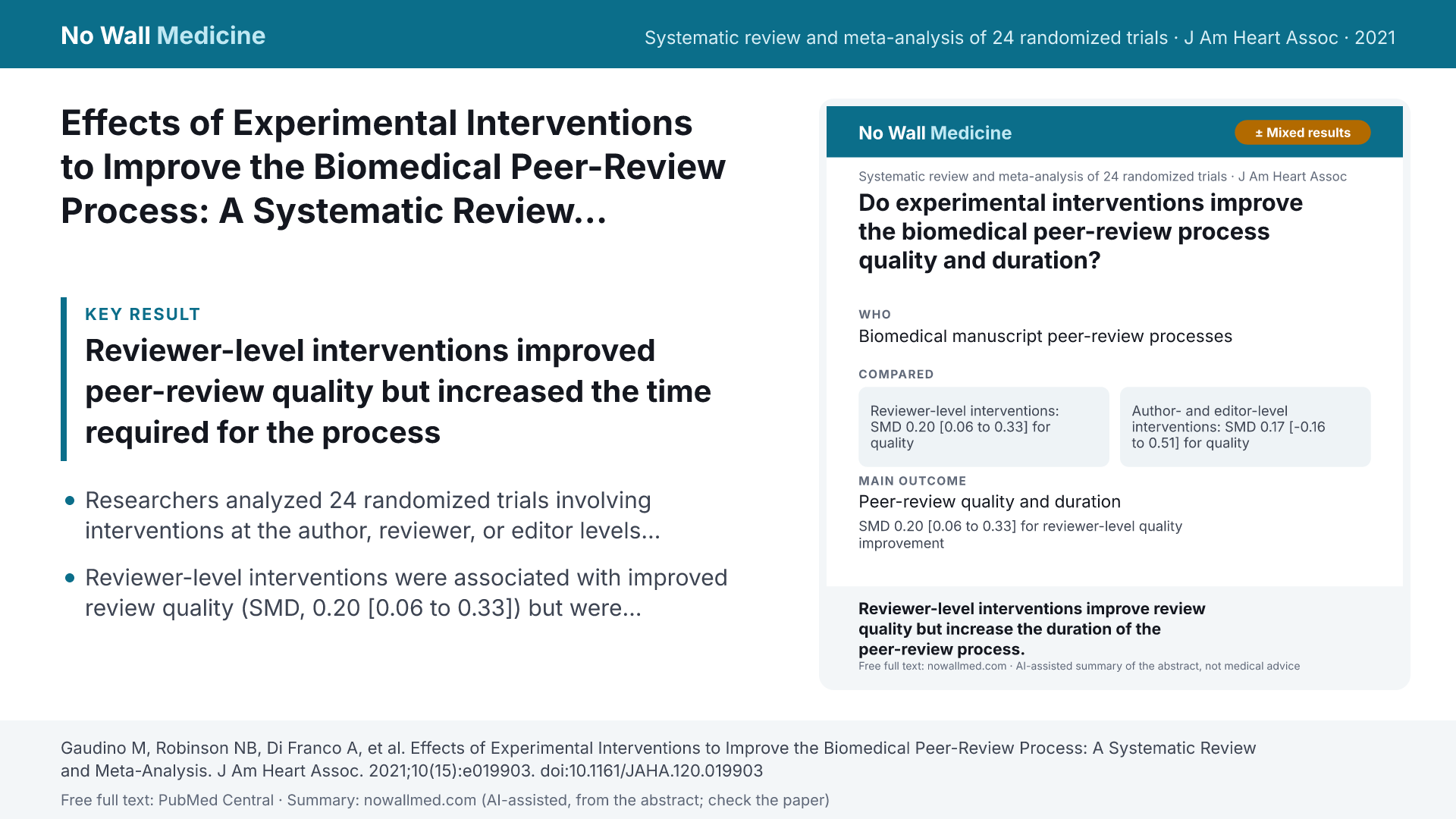
Reviewer-level interventions improved peer-review quality but increased the time required for the process
Effects of Experimental Interventions to Improve the Biomedical Peer-Review Process: A Systematic Review and Meta-Analysis
Systematic review and meta-analysis of 24 randomized trialsMixed results
Do experimental interventions improve the biomedical peer-review process quality and duration?
Who
24
Biomedical manuscript peer-review processes
Compared
Reviewer-level interventions: SMD 0.20 [0.06 to 0.33] for quality
Author- and editor-level interventions: SMD 0.17 [-0.16 to 0.51] for quality
Main outcome
Peer-review quality and duration
Result: SMD 0.20 [0.06 to 0.33] for reviewer-level quality improvement
Bottom line: Reviewer-level interventions improve review quality but increase the duration of the peer-review process.
J Am Heart Assoc · 2021-07-19Download image
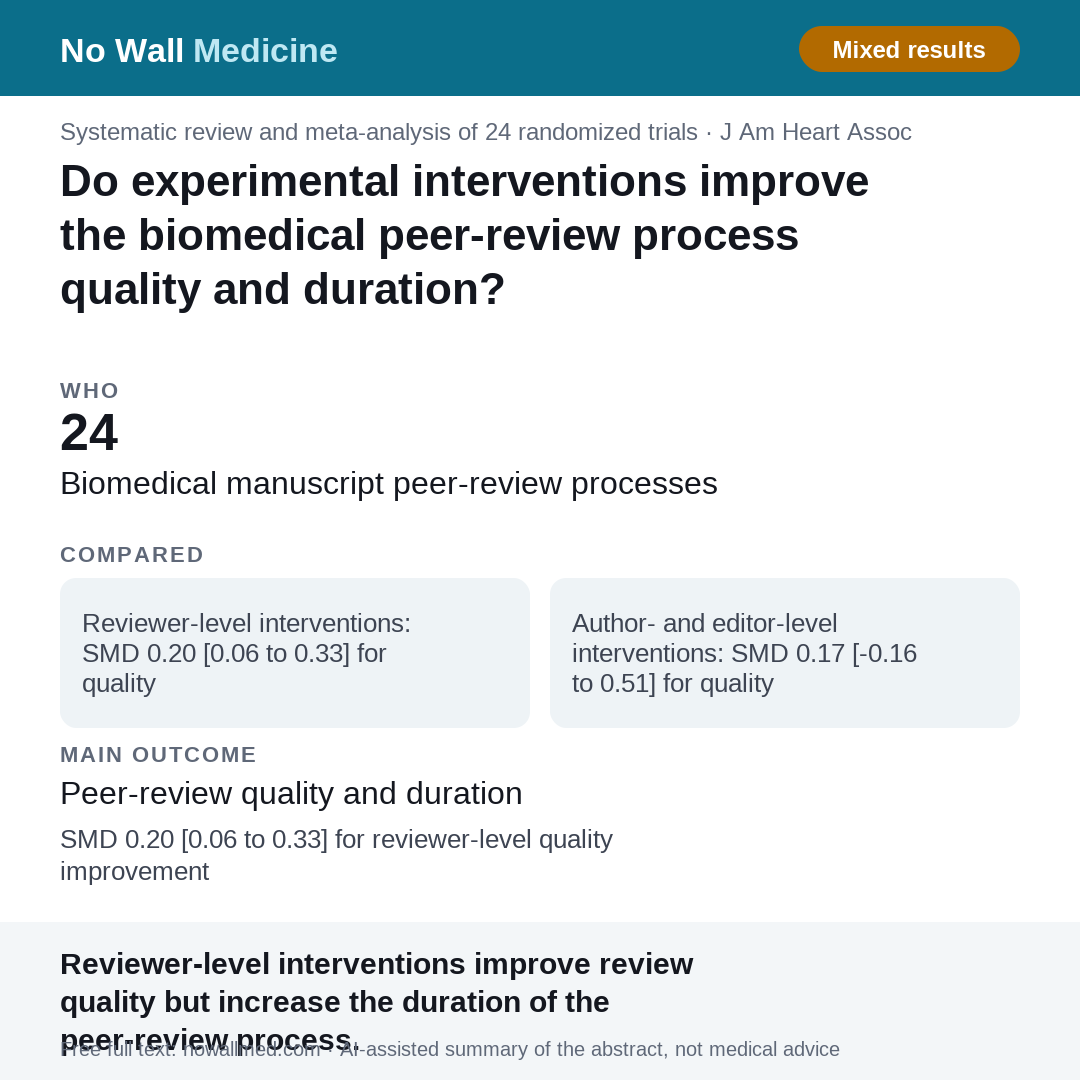
Clinical question: Do experimental interventions improve the biomedical peer-review process quality and duration?
Why it matters: The quality of the peer-review process has only been tested in small studies, leaving the effectiveness of various interventions unknown.
Key points
- Researchers analyzed 24 randomized trials involving interventions at the author, reviewer, or editor levels to assess changes in the peer-review process.
- Reviewer-level interventions were associated with improved review quality (SMD, 0.20 [0.06 to 0.33]) but were also associated with increased duration (SMD, 0.15 [0.01 to 0.29]).
- Interventions targeting authors or editors did not significantly impact the quality or the duration of the peer-review process.
Headline and key points written with AI from the paper’s abstract, with every number checked against it. Read the paper before relying on them.
Was this summary helpful?
Subject terms
Cite this article
Gaudino M, Robinson NB, Di Franco A, Hameed I, Naik A, Demetres M. Effects of Experimental Interventions to Improve the Biomedical Peer-Review Process: A Systematic Review and Meta-Analysis. J Am Heart Assoc. 2021. doi:10.1161/JAHA.120.019903
Spotted a mistake? Suggest a correction
Top studies every Monday
The week’s key trials and guidelines in your specialties, plus any topics you follow. By email, free.
Get the weekly digest