Effects of Immersive Virtual Reality Interventions on Symptom Management in Patients With Gastrointestinal Cancer: Systematic Review and Meta-Analysis of Randomized Controlled Trials
Systematic review and meta-analysis of randomized controlled trialsBenefit found
Do immersive virtual reality interventions improve symptom management in gastrointestinal cancer patients?
Who
837
Adults with colorectal, liver, esophageal, gastric, pancreatic, and biliary tract cancers
Compared
Immersive virtual reality
Routine care or nonimmersive alternatives
Main outcome
Anxiety, pain, and quality of life
Result: anxiety SMD -0.58 (95% CI -0.95 to -0.20); pain SMD -0.75 (95% CI -1.48 to -0.03)
Bottom line: Immersive virtual reality significantly reduces anxiety and pain in gastrointestinal cancer patients, though evidence certainty is moderate to very low.
Limitation: Moderate to high heterogeneity, substantial risk of bias, and low to very low evidence certainty.
J Med Internet Res · 2026-07-02Download image
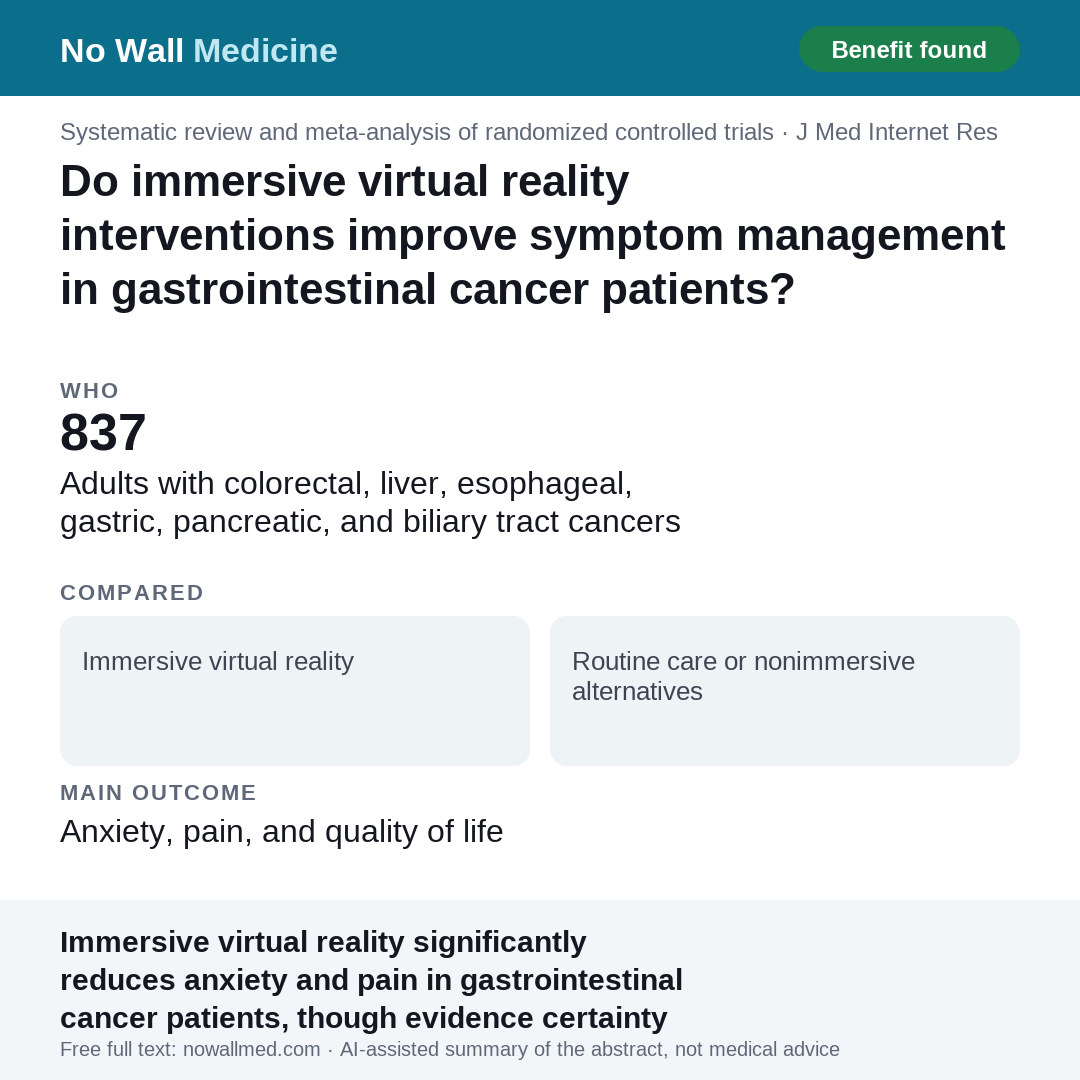
Clinical question: Do immersive virtual reality interventions improve symptom management in gastrointestinal cancer patients?
Abstract
Background
Patients with gastrointestinal cancers experience a broad range of symptoms, including anxiety, pain, and reduced quality of life. Although immersive virtual reality (IVR) has emerged as a potential intervention, its efficacy specifically in patients with gastrointestinal cancer remains unclear. Objective
This systematic review and meta-analysis of randomized controlled trials (RCTs) evaluated the effects of IVR on symptom management in patients with gastrointestinal cancer. Methods
Twelve databases and 1 gray literature source were searched from inception to April 30, 2026. RCTs comparing IVR interventions to routine care or nonimmersive alternatives for symptom management in adults (≥18 years) with gastrointestinal cancer were eligible. Two reviewers independently screened records, extracted data, and assessed risk of bias using the Cochrane RoB 2 tool. The evidence certainty was evaluated using the Grading of Recommendations, Assessment, Development, and Evaluation (GRADE) approach. Random-effects meta-analyses were performed for primary outcomes (anxiety, pain, quality of life) and secondary outcomes (knowledge, length of stay, vital signs, safety). Heterogeneity was explored using subgroup analyses and meta-regression. Results
Fourteen RCTs were included, comprising individuals (N=837) with colorectal, liver, esophageal, gastric, pancreatic, and biliary tract cancers. IVR interventions-including immersive scenes, interactive games, anatomical models, and cognitive behavioral modules-were primarily delivered during perioperative and chemotherapy periods. Meta-analysis showed that IVR significantly reduced anxiety (standardized mean difference [SMD] -0.58, 95% CI -0.95 to -0.20; P=.01; 95% prediction interval [PI] -1.36 to 0.21) and pain (SMD -0.75, 95% CI -1.48 to -0.03; P=.04; 95% PI -2.21 to 0.71). Subgroup analysis revealed that the anxiolytic effect was more pronounced when IVR was administered during active treatment and when single sessions lasted ≥20 minutes. Hospital stay was significantly shorter in the IVR group (mean difference -4.11 days, 95% CI -7.39 to -0.82; P=.03; 95% PI -13.82 to 5.60 days). No significant effects were detected for quality of life, knowledge acquisition, or vital signs. The evidence certainty was moderate to very low, with common limitations including risk of bias and imprecision. Conclusions
This meta-analysis provides evidence that IVR is an effective nonpharmacological adjunct for symptom management in patients with gastrointestinal cancer, significantly reducing anxiety and pain when implemented during active treatment for at least 20 minutes. However, these findings should be interpreted with caution due to moderate to high heterogeneity, substantial risk of bias in the included studies, and low to very low GRADE evidence certainty. While the 95% CIs indicate a statistically significant average effect, the wide 95% PIs suggest that the true effect in future clinical settings may vary considerably, ranging from marked benefit to negligible impact. These results support the integration of IVR into perioperative and chemotherapy care pathways while underscoring the need for larger, more rigorously designed trials to establish definitive conclusions.
Topics
Spotted a mistake? Suggest a correction