Supervised walking program implementation was associated with lower odds of discharge to skilled-nursing facilities
Effects of Implementation of a Supervised Walking Program in Veterans Affairs Hospitals : A Stepped-Wedge, Cluster Randomized Trial
Stepped-wedge, cluster randomized trialBenefit found
Does implementing the STRIDE supervised walking program affect discharge to skilled-nursing facilities?
Who
Community dwelling patients aged 60 years or older admitted to medicine wards · 8 Veterans Affairs hospitals
Compared
13%pre-STRIDE time periods
8%post-STRIDE time periods
Main outcome
discharge to a skilled-nursing facility
Result: odds ratio 0.6 (95% CI, 0.5 to 0.8)
Bottom line: The STRIDE walking program implementation was associated with lower odds of discharge to a skilled-nursing facility.
Limitation: Direct program reach was low.
Funded by: U.S. Department of Veterans Affairs Quality Enhancement Research Initiative
Ann Intern Med · 2023-06-06Download image
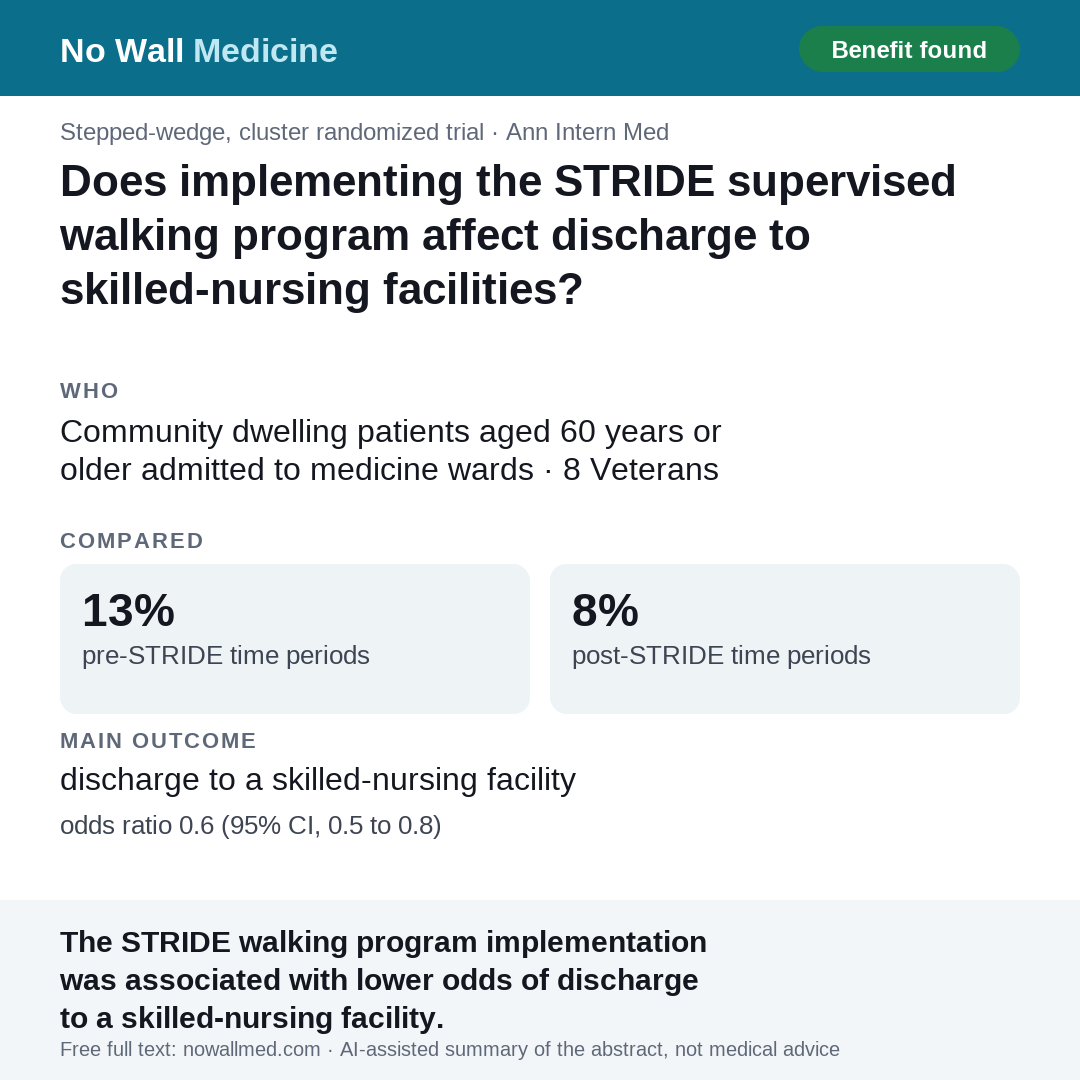
Clinical question: Does implementing the STRIDE supervised walking program affect discharge to skilled-nursing facilities?
Why it matters: Little evidence exists regarding whether hospital walking programs are effective when implemented under routine practice conditions.
Key points
- Researchers studied 6722 patients in pre-program periods and 6141 patients in post-program periods across 8 Veterans Affairs hospitals.
- The odds of discharge to a skilled-nursing facility were lower in the post-program period with an odds ratio of 0.6 (95% CI, 0.5 to 0.8).
- There were no differences found in length of stay or the occurrence of inpatient falls.
Limitation the authors note: Direct program reach was low.
Headline and key points written with AI from the paper’s abstract, with every number checked against it. Read the paper before relying on them.
Topics
Cite this article
Hastings SN, Stechuchak KM, Choate A, Van Houtven CH, Allen KD, Wang V. Effects of Implementation of a Supervised Walking Program in Veterans Affairs Hospitals : A Stepped-Wedge, Cluster Randomized Trial. Ann Intern Med. 2023. doi:10.7326/M22-3679
Spotted a mistake? Suggest a correction