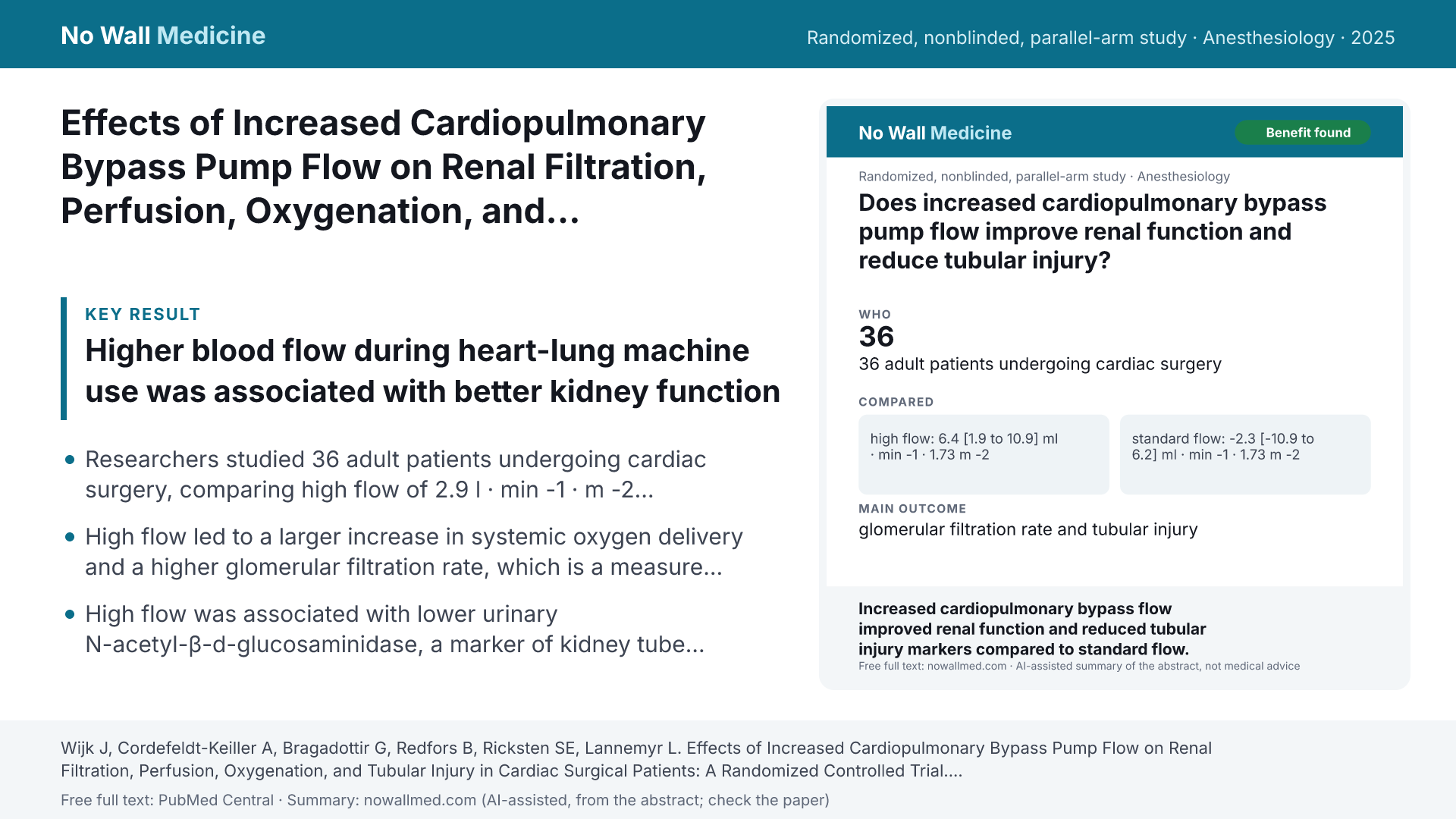
Higher blood flow during heart-lung machine use was associated with better kidney function
Effects of Increased Cardiopulmonary Bypass Pump Flow on Renal Filtration, Perfusion, Oxygenation, and Tubular Injury in Cardiac Surgical Patients: A Randomized Controlled Trial
Randomized, nonblinded, parallel-arm studyBenefit found
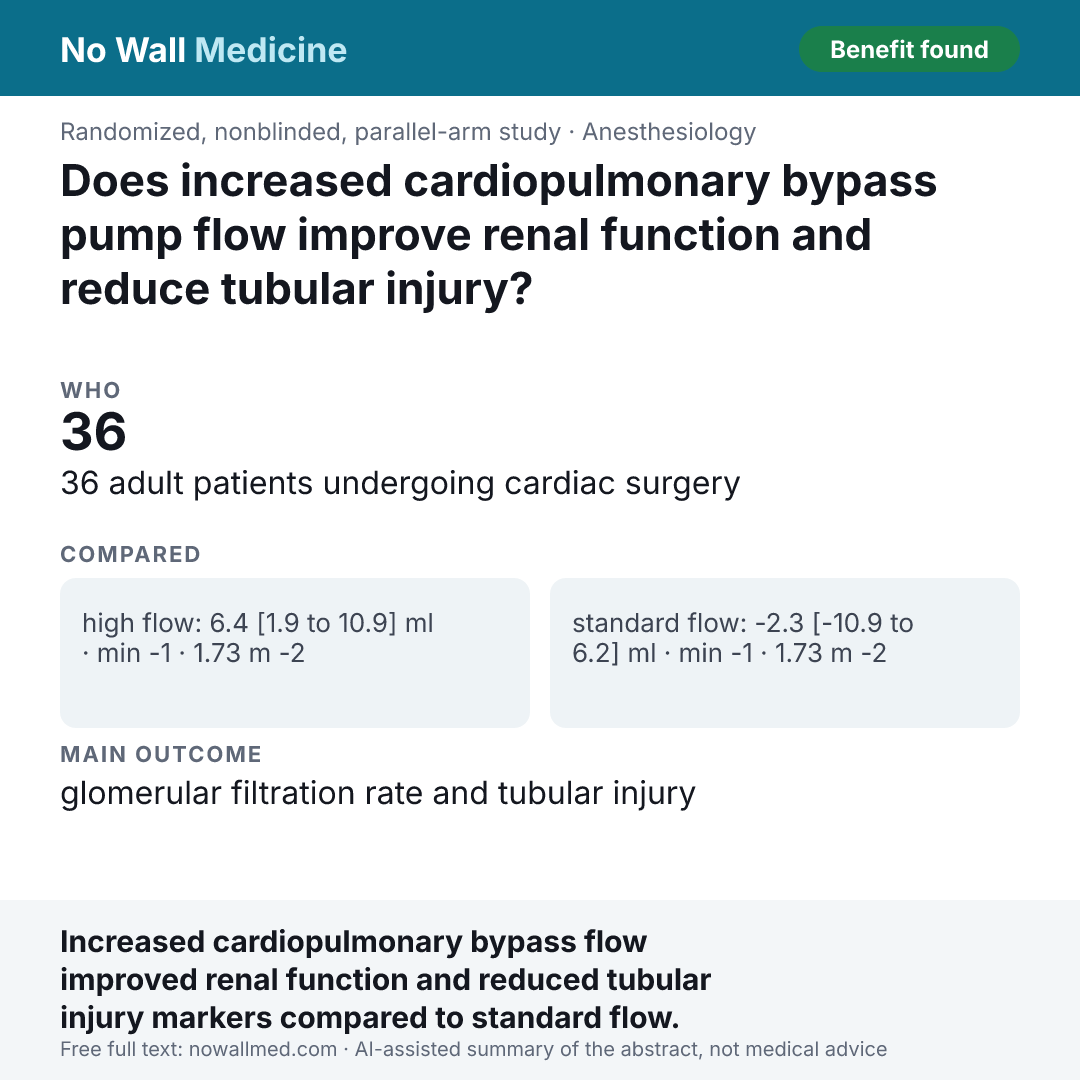
Does increased cardiopulmonary bypass pump flow improve renal function and reduce tubular injury?
Who
36
36 adult patients undergoing cardiac surgery
Compared
high flow: 6.4 [1.9 to 10.9] ml · min -1 · 1.73 m -2
standard flow: -2.3 [-10.9 to 6.2] ml · min -1 · 1.73 m -2
Main outcome
glomerular filtration rate and tubular injury
Bottom line: Increased cardiopulmonary bypass flow improved renal function and reduced tubular injury markers compared to standard flow.
Anesthesiology · 2025-07-07 · Save PNG
Clinical question: Does increased cardiopulmonary bypass pump flow improve renal function and reduce tubular injury?
Why it matters: Cardiac surgery using a heart-lung machine is associated with impaired kidney oxygenation and acute kidney injury, but it is unclear if increasing blood flow improves kidney function.
Key points
- Researchers studied 36 adult patients undergoing cardiac surgery, comparing high flow of 2.9 l · min -1 · m -2 to standard flow of 2.4 l · min -1 · m -2 during cardiopulmonary bypass.
- High flow led to a larger increase in systemic oxygen delivery and a higher glomerular filtration rate, which is a measure of kidney function, compared to standard flow.
- High flow was associated with lower urinary N-acetyl-β-d-glucosaminidase, a marker of kidney tube injury, but showed no difference in renal blood flow or oxygen extraction.
Headline and key points written with AI from the paper’s abstract, with every number checked against it. Read the paper before relying on them.
Was this summary helpful?
Subject terms
Headline, design, result, key points, caveat and citation as plain text.
Cite this article
Wijk J, Cordefeldt-Keiller A, Bragadottir G, Redfors B, Ricksten SE, Lannemyr L. Effects of Increased Cardiopulmonary Bypass Pump Flow on Renal Filtration, Perfusion, Oxygenation, and Tubular Injury in Cardiac Surgical Patients: A Randomized Controlled Trial. Anesthesiology. 2025;143(4):906-916. doi:10.1097/ALN.0000000000005648
Spotted a mistake? Suggest a correction