Effects of intermittent (5:2) or continuous energy restriction on basal and postprandial metabolism: a randomised study in normal-weight, young participants
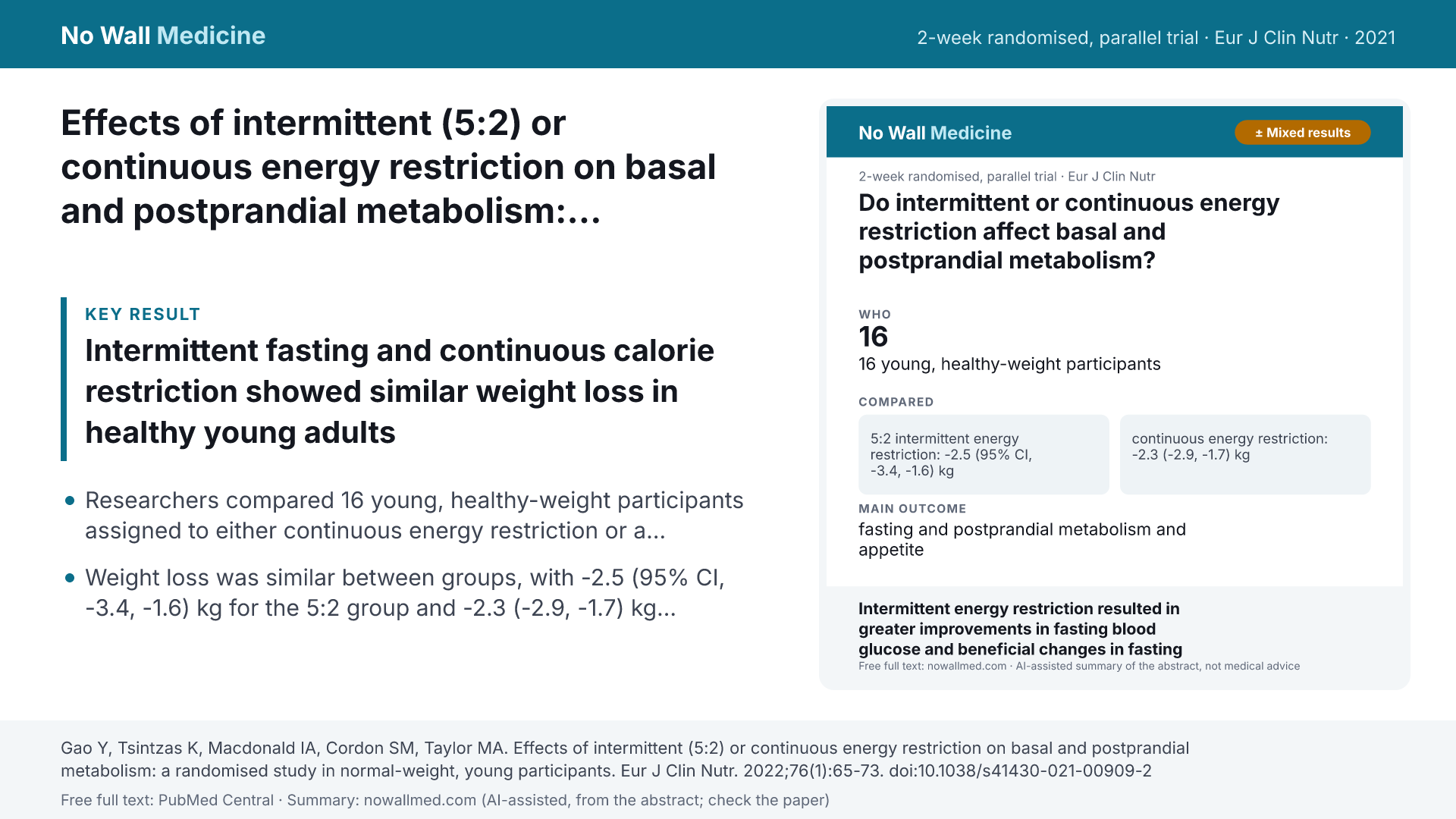
Key result: Intermittent fasting and continuous calorie restriction showed similar weight loss in healthy young adults
2-week randomised, parallel trialMixed results
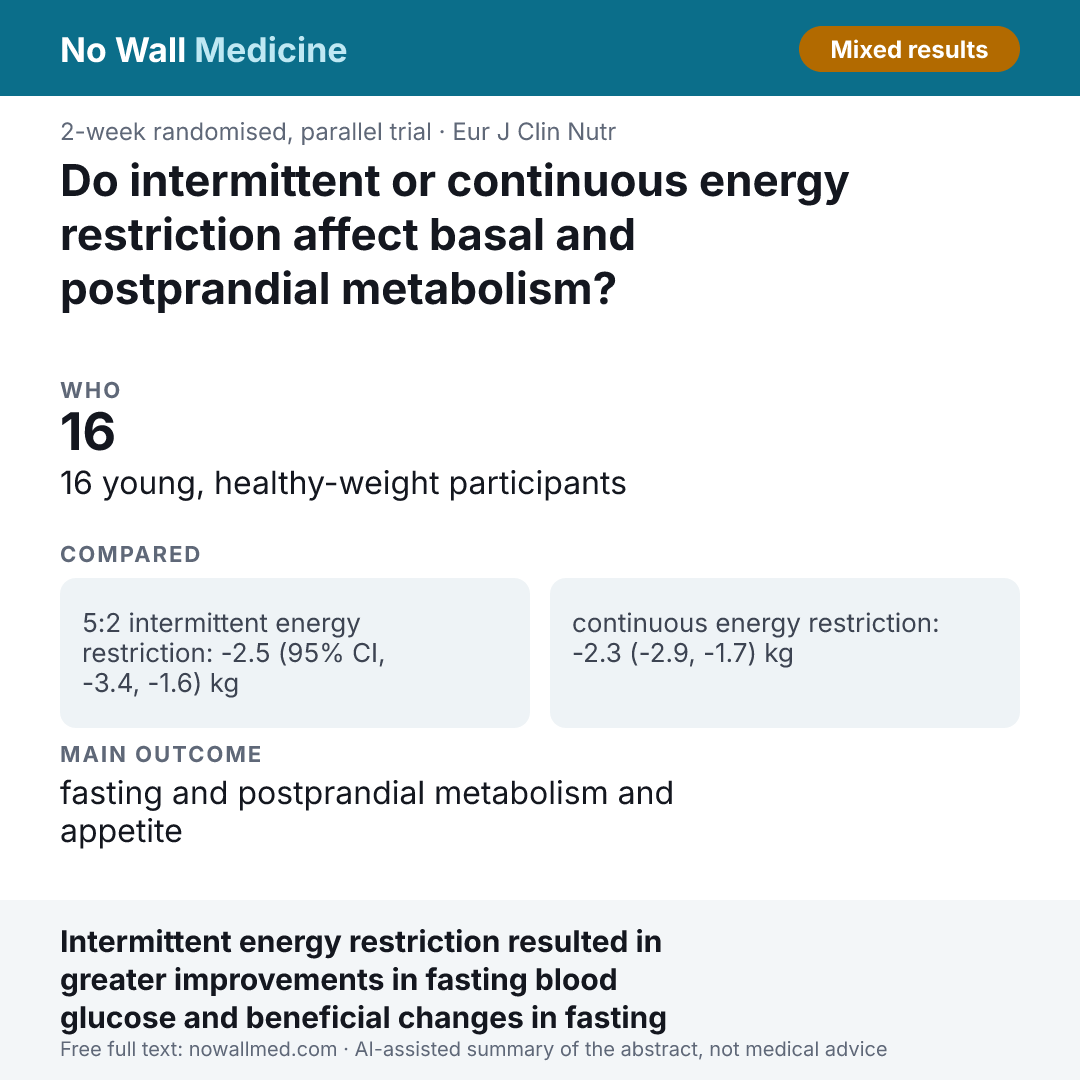
Do intermittent or continuous energy restriction affect basal and postprandial metabolism?
Who
16
16 young, healthy-weight participants
Compared
5:2 intermittent energy restriction: -2.5 (95% CI, -3.4, -1.6) kg
continuous energy restriction: -2.3 (-2.9, -1.7) kg
Main outcome
fasting and postprandial metabolism and appetite
Bottom line: Intermittent energy restriction resulted in greater improvements in fasting blood glucose and beneficial changes in fasting appetite scores.
Eur J Clin Nutr · 2021-05-26 · Save PNG
Key points
- Researchers compared 16 young, healthy-weight participants assigned to either continuous energy restriction or a 5:2 intermittent energy restriction for 2 weeks.
- Weight loss was similar between groups, with -2.5 (95% CI, -3.4, -1.6) kg for the 5:2 group and -2.3 (-2.9, -1.7) kg for the continuous group.
- The 5:2 group showed greater changes in fasting blood glucose and fasting subjective appetite scores compared to the continuous energy restriction group.
Discussion prompts
- Would these patients look like yours? Who was left out?
- Is the main outcome one that matters to patients?
- Is the difference large enough to change what you do?
Cite: Gao Y, Tsintzas K, Macdonald IA, Cordon SM, Taylor MA. Effects of intermittent (5:2) or continuous energy restriction on basal and postprandial metabolism: a randomised study in normal-weight, young participants. Eur J Clin Nutr. 2022;76(1):65-73. doi:10.1038/s41430-021-00909-2
Free full text: PubMed Central · Summary and visual abstract: nowallmed.com/a/effects-of-intermittent-5-2-or-continuous-energy-restriction-on-basal-1fkwxiy/ (AI-assisted from the abstract; check the paper before relying on it).