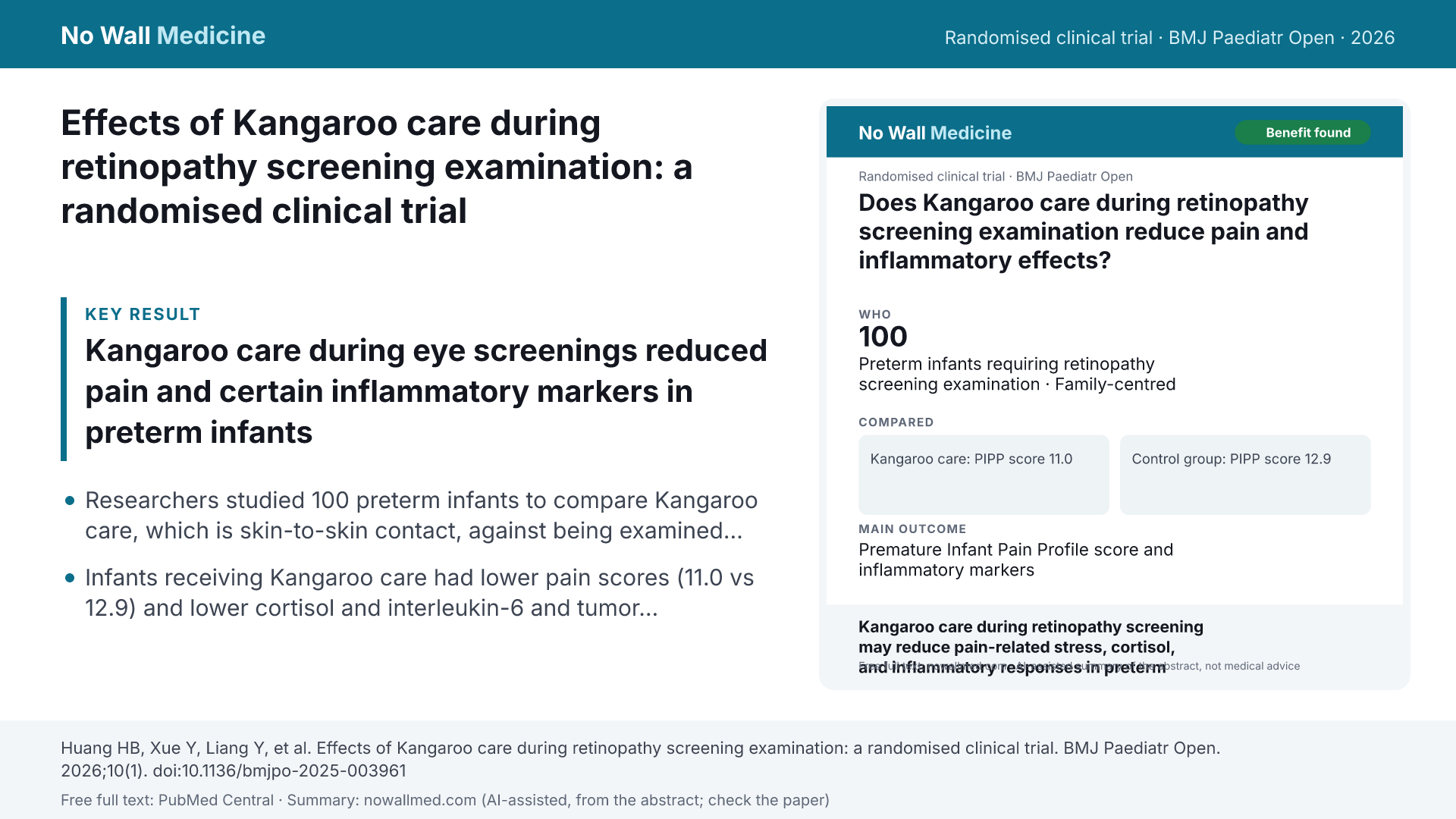
Kangaroo care during eye screenings reduced pain and certain inflammatory markers in preterm infants
Effects of Kangaroo care during retinopathy screening examination: a randomised clinical trial
Randomised clinical trialBenefit found
Does Kangaroo care during retinopathy screening examination reduce pain and inflammatory effects?
Who
100
Preterm infants requiring retinopathy screening examination · Family-centred neonatal intensive care unit
Compared
Kangaroo care: PIPP score 11.0
Control group: PIPP score 12.9
Main outcome
Premature Infant Pain Profile score and inflammatory markers
Bottom line: Kangaroo care during retinopathy screening may reduce pain-related stress, cortisol, and inflammatory responses in preterm infants.
BMJ Paediatr Open · 2026-01-06 · Save PNG
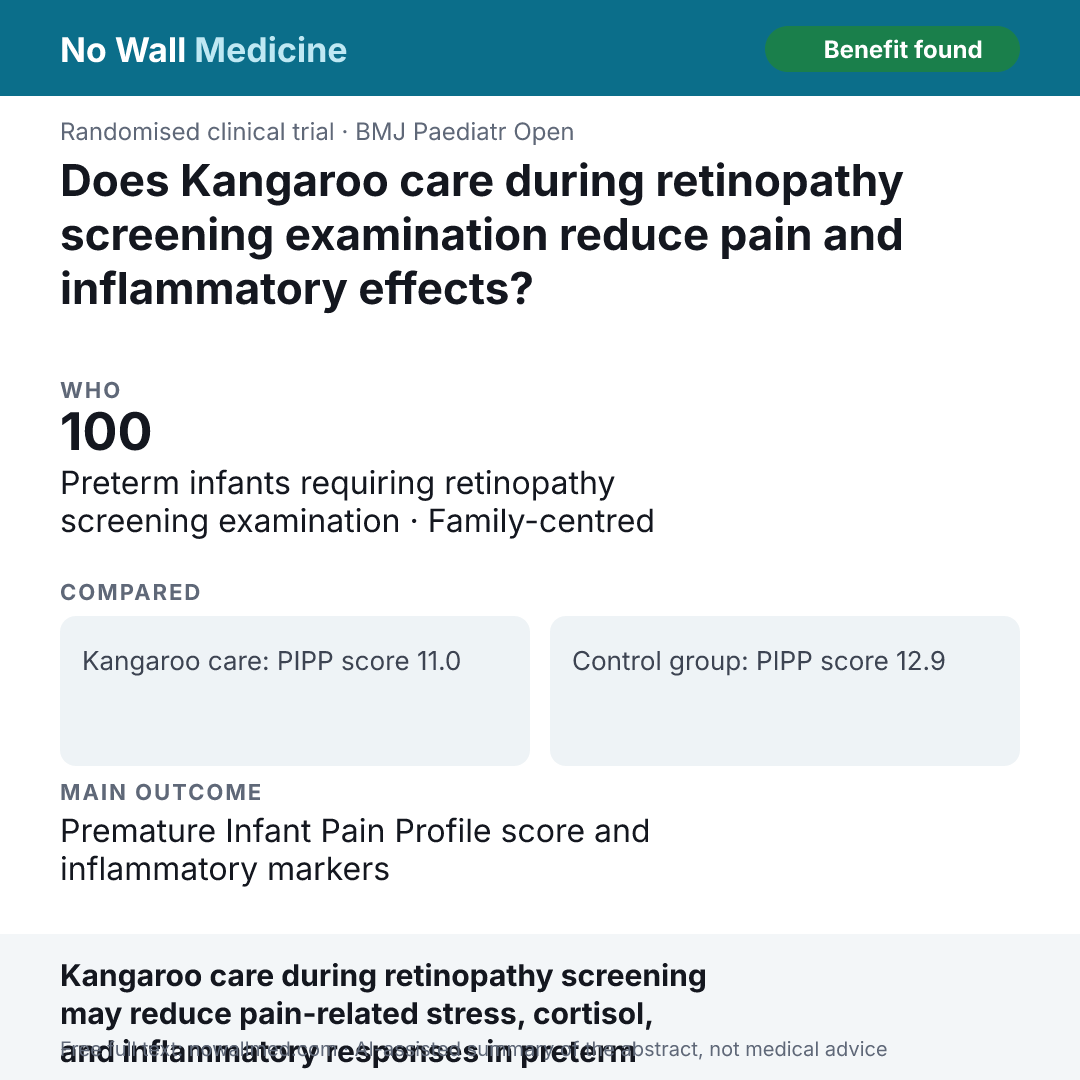
Clinical question: Does Kangaroo care during retinopathy screening examination reduce pain and inflammatory effects?
Key points
- Researchers studied 100 preterm infants to compare Kangaroo care, which is skin-to-skin contact, against being examined on a table during eye screenings.
- Infants receiving Kangaroo care had lower pain scores (11.0 vs 12.9) and lower cortisol and interleukin-6 and tumor necrosis factor-alpha levels after the procedure.
- The study found no significant difference in interleukin-1β levels between the Kangaroo care group and the control group at 6-8 hours after the screening.
Headline and key points written with AI from the paper’s abstract, with every number checked against it. Read the paper before relying on them.
Was this summary helpful?
Abstract
Objective
Providing Kangaroo care (K-care) helps comfort infants through painful and stressful procedures including retinopathy screening examination (RSE) for retinopathy of prematurity. We examined the early pain-related and delayed inflammatory effects of K-care during the first RSE in preterm infants. Design
Randomised clinical trial. Setting
In a family-centred neonatal intensive care unit between 1 March 2023 and 31 August 2024. Patients
Preterm infants (gestation <34+0 weeks and/or birth weight <2000 g) who required RSEs. Interventions
Patients were randomly assigned to K-care provided by mother or father during RSE or control group on an examination table (n=50/group). Main outcome measures
The Premature Infant Pain Profile (PIPP) score within the first minute of RSE was measured. Salivary samples (>110 uL) were collected before, at 1 and 6-8 hours after RSE for assays of cortisol, interleukin-1β, interleukin-6 and tumour necrosis factor-alpha (TNF-α) levels by ELISA methods in a blinded fashion. Results
100 infants (mean±SD gestational age: 31.1±2.4 weeks; birth weight: 1496±452 g, 58% males) were enrolled. Compared with controls (n=50), infants of the K-care group (n=50) had significantly lower PIPP score (11.0 vs 12.9; p=0.002); salivary cortisol levels (4.9 vs 6.9 ng/mL; p=0.001) at 1 hour after RSE, interleukin-6 (31.9 vs 34.7 pg/mL; p=0.01) and TNF-α (53.9 vs 58.6 pg/mL; p=0.02), but not interleukin-1β (50.4 vs 53.0 pg/mL; p=0.46), levels at 6-8 hour after RSE. Conclusions
Providing K-care during RSE in preterm infants may potentially reduce pain-related stress, cortisol and inflammatory responses.
Abstract reproduced under the article’s CC BY NC licence.
Subject terms
Headline, design, result, key points, caveat and citation as plain text.
Cite this article
Huang HB, Xue Y, Liang Y, et al. Effects of Kangaroo care during retinopathy screening examination: a randomised clinical trial. BMJ Paediatr Open. 2026;10(1). doi:10.1136/bmjpo-2025-003961
Spotted a mistake? Suggest a correction