Lifestyle interventions in pregnancy were associated with lower rates of gestational diabetes in several analyses
Effects of lifestyle interventions in pregnancy on gestational diabetes: individual participant data and network meta-analysis
Individual participant data and network meta-analysisBenefit found
Do lifestyle interventions in pregnancy reduce gestational diabetes risk?
Who
35993
35,993 women in randomized trials
Compared
Lifestyle interventions: odds ratio 0.80 (95% CI 0.73 to 0.88)
Control
Main outcome
gestational diabetes defined by any criteria
Result: odds ratio 0.80 (95% CI 0.73 to 0.88)
Bottom line: Lifestyle interventions likely prevent gestational diabetes, especially when using physical activity and group formats.
BMJ · 2026-01-06 · Save PNG
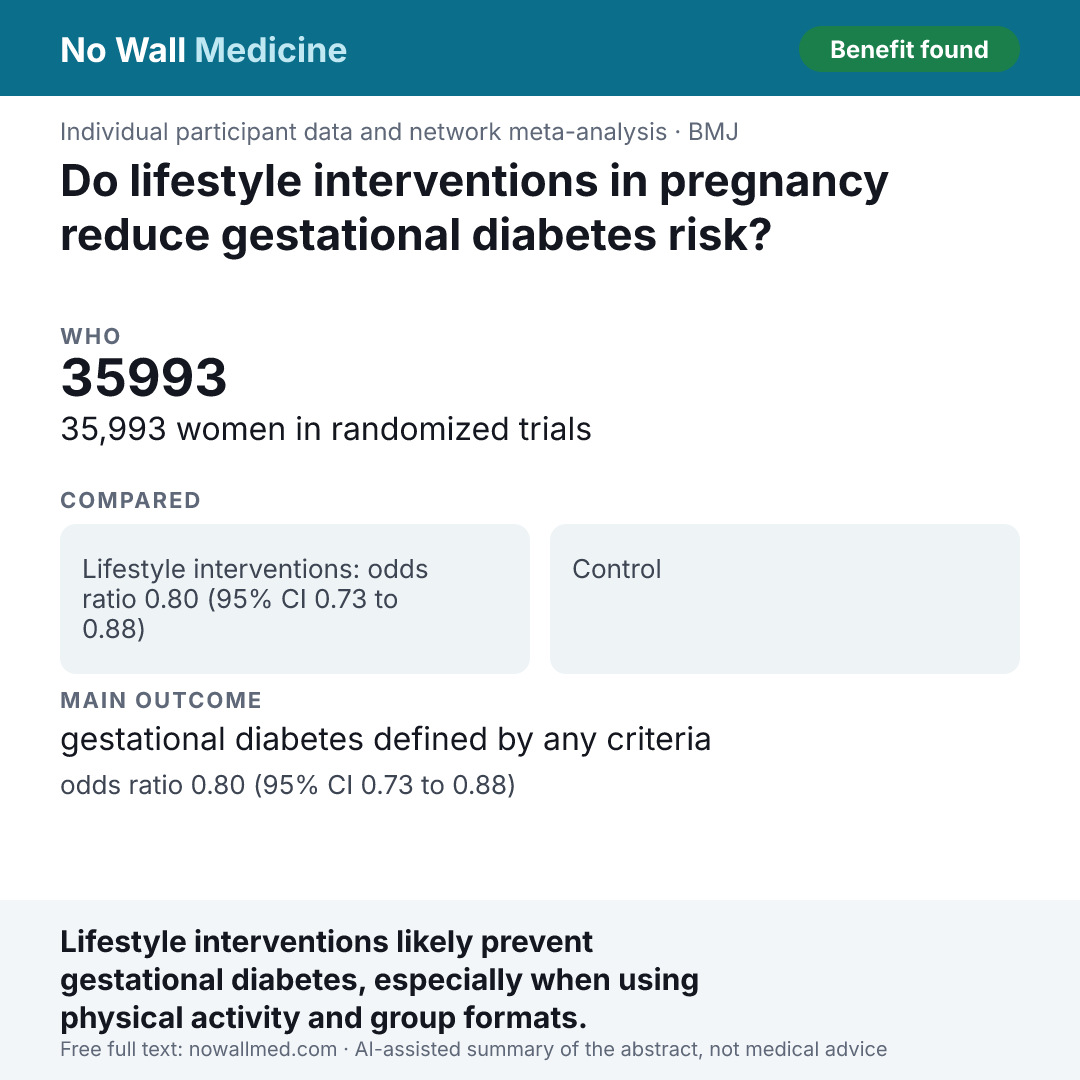
Clinical question: Do lifestyle interventions in pregnancy reduce gestational diabetes risk?
Key points
- Researchers analyzed 104 randomized trials involving 35,993 women to evaluate how diet, physical activity, or mixed lifestyle changes affect gestational diabetes.
- When combining individual participant data and non-individual participant data, lifestyle interventions were associated with a 20% reduction in gestational diabetes by any criteria.
- Physical activity based interventions ranked highest for prevention, and benefits were less in women with low education compared to those with middle or high education.
Headline and key points written with AI from the paper’s abstract, with every number checked against it. Read the paper before relying on them.
Was this summary helpful?
Abstract
Objectives
To assess the effects of lifestyle interventions on gestational diabetes, determine whether the effects vary by maternal body mass index, age, parity, ethnicity, education level, or intervention, and rank interventions by effectiveness. Design
Individual participant data (IPD) and network meta-analysis. Data sources
Major electronic databases (January 1990 to April 2025). Methods
This meta-analysis included randomised trials on the effects of lifestyle interventions (physical activity based, diet based, or mixed) in pregnancy on gestational diabetes. Main outcomes were gestational diabetes defined by any criteria and by UK NICE (National Institute for Health and Care Excellence) criteria; other outcomes included IADPSG (International Association of Diabetes in Pregnancy Study Group) and modified IADPSG defined gestational diabetes. A two stage IPD meta-analysis estimated summary odds ratios and 95% confidence intervals and interactions (subgroup effects), along with absolute risk reduction estimates. Aggregate data from non-IPD trials were added to the meta-analysis when possible. Intervention effects were ranked using network meta-analysis. Results
104 randomised trials (35 993 women) were included, with IPD for 68% of participants (24 391 women; 54 studies). Lifestyle interventions reduced gestational diabetes defined by any criteria by 10% in IPD trials (odds ratio 0.90, 95% confidence interval (CI) 0.80 to 1.02; absolute risk reduction 1.3%, 95% CI -0.3% to 2.6%), and by 20% when combining IPD and non-IPD trials (odds ratio 0.80, 95% CI 0.73 to 0.88; absolute risk reduction 2.6%, 95% CI 1.6% to 3.6%), and no reduction was observed using NICE criteria (odds ratio 0.98, 95% CI 0.84to 1.13). Lifestyle interventions reduced gestational diabetes defined using IADPSG criteria by 14% in IPD trials (odds ratio 0.86, 95% CI 0.75 to 0.97; absolute risk reduction 2.7%, 95% CI 0.6% to 5.0%) and by 18% when combining IPD and non-IPD trials (odds ratio 0.82, 95% CI 0.72 to 0.93; absolute risk reduction 3.5%, 95% CI 1.3% to 5.7%). Effects did not vary by maternal characteristics, except for education. Although women of all educational levels benefited from the intervention, the benefit was less in those with low education (low v middle interaction: odds ratio 0.68, 95% CI 0.51 to 0.90; low v high interaction: odds ratio 0.71, 95% CI 0.54 to 0.93). Benefits did not vary by intervention characteristics, except for greater effectiveness with group format (odds ratio 0.81, 95% CI 0.68 to 0.97; absolute risk reduction 2.5%, 95% CI 0.4% to 4.3%) and newly trained facilitators (odds ratio 0.82, 95% CI 0.69 to 0.96; absolute risk reduction 2.4%, 95% CI 0.5% to 4.2%). Physical activity based interventions ranked highest (mean rank 1.1, 95% CI 1 to 2) in preventing gestational diabetes. Conclusions
Lifestyle interventions in pregnancy are likely to prevent gestational diabetes, with effects varying according to diagnostic criteria. Implementation strategies should address inequalities by maternal education, and consider group formats, provider training, and physical activity based interventions to prevent gestational diabetes. Study registration
PROSPERO CRD42020212884.
Abstract reproduced under the article’s CC BY licence.
Subject terms
Headline, design, result, key points, caveat and citation as plain text.
Cite this article
Allotey J, Coomar D, Ensor J, et al. Effects of lifestyle interventions in pregnancy on gestational diabetes: individual participant data and network meta-analysis. BMJ. 2026;392:e084159. doi:10.1136/bmj-2025-084159
Spotted a mistake? Suggest a correction