Effects of mirror therapy in post-traumatic complex regional pain syndrome type-1: a randomized controlled study
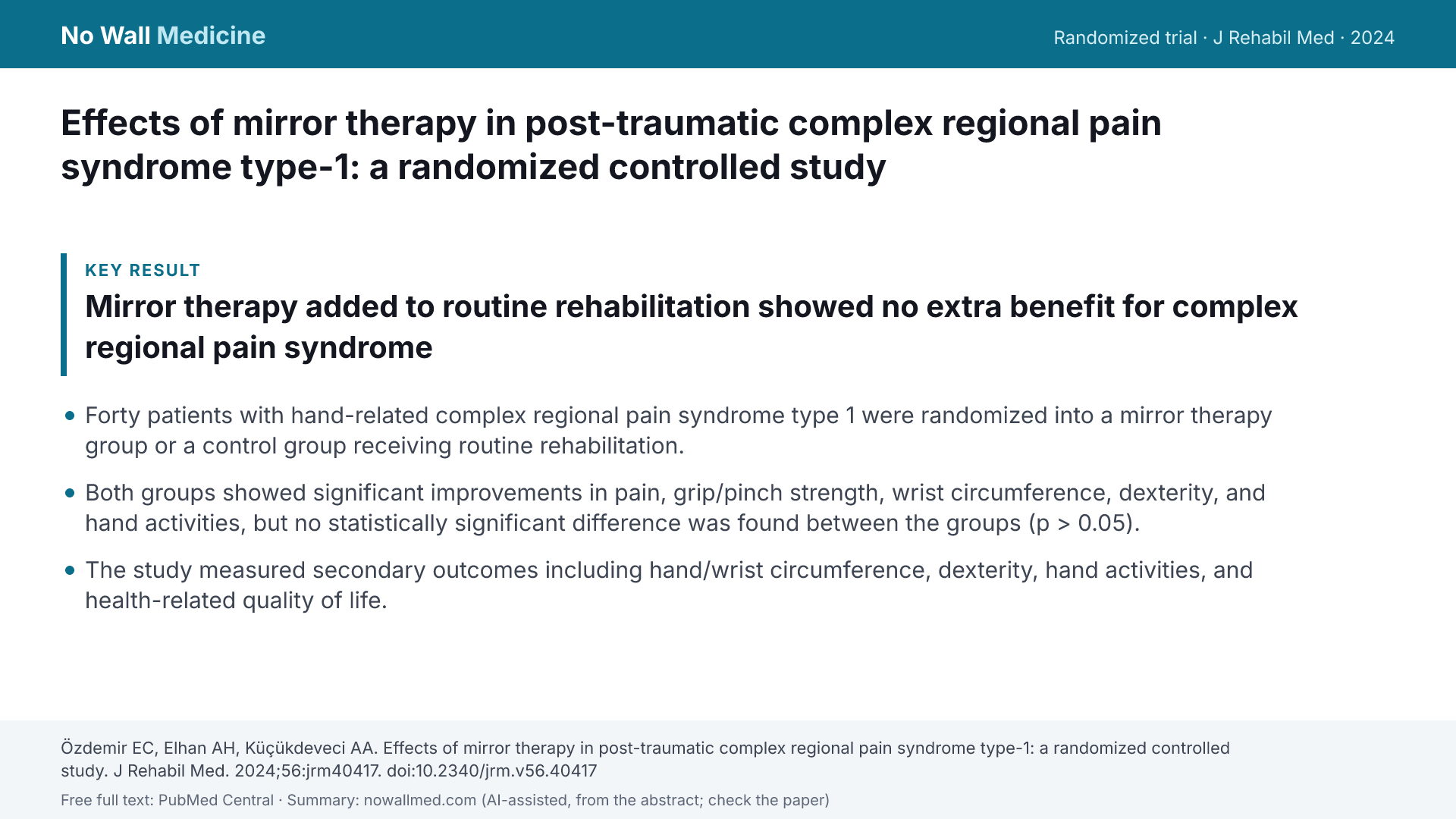
Key result: Mirror therapy added to routine rehabilitation showed no extra benefit for complex regional pain syndrome
Key points
- Forty patients with hand-related complex regional pain syndrome type 1 were randomized into a mirror therapy group or a control group receiving routine rehabilitation.
- Both groups showed significant improvements in pain, grip/pinch strength, wrist circumference, dexterity, and hand activities, but no statistically significant difference was found between the groups (p > 0.05).
- The study measured secondary outcomes including hand/wrist circumference, dexterity, hand activities, and health-related quality of life.
Discussion prompts
- Would these patients look like yours? Who was left out?
- Is the main outcome one that matters to patients?
- Is the difference large enough to change what you do?
Cite: Özdemir EC, Elhan AH, Küçükdeveci AA. Effects of mirror therapy in post-traumatic complex regional pain syndrome type-1: a randomized controlled study. J Rehabil Med. 2024;56:jrm40417. doi:10.2340/jrm.v56.40417
Free full text: PubMed Central · Summary and visual abstract: nowallmed.com/a/effects-of-mirror-therapy-in-post-traumatic-complex-regional-pain-1xoo5o4/ (AI-assisted from the abstract; check the paper before relying on it).