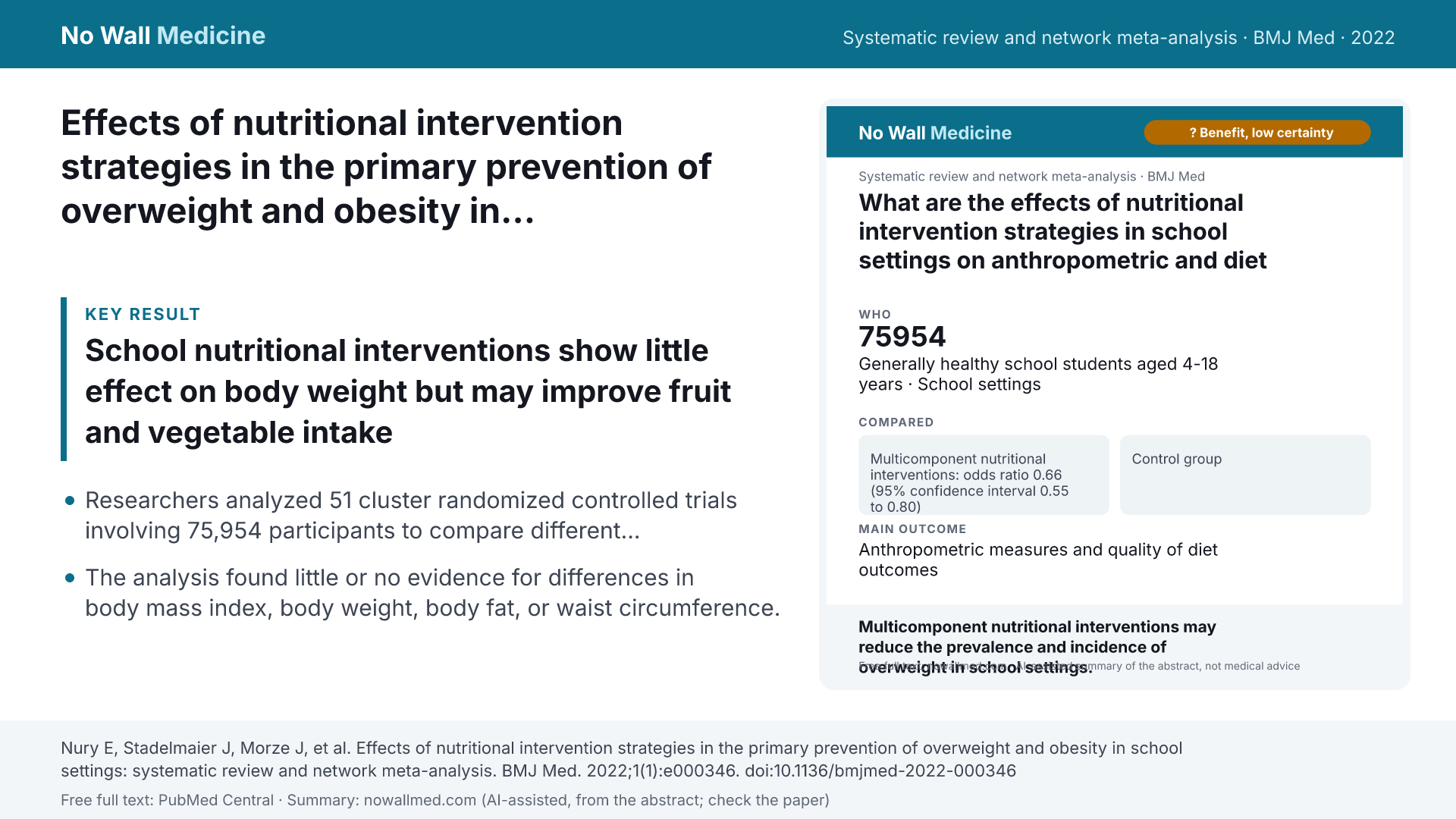
School nutritional interventions show little effect on body weight but may improve fruit and vegetable intake
Effects of nutritional intervention strategies in the primary prevention of overweight and obesity in school settings: systematic review and network meta-analysis
Systematic review and network meta-analysisBenefit, low certainty
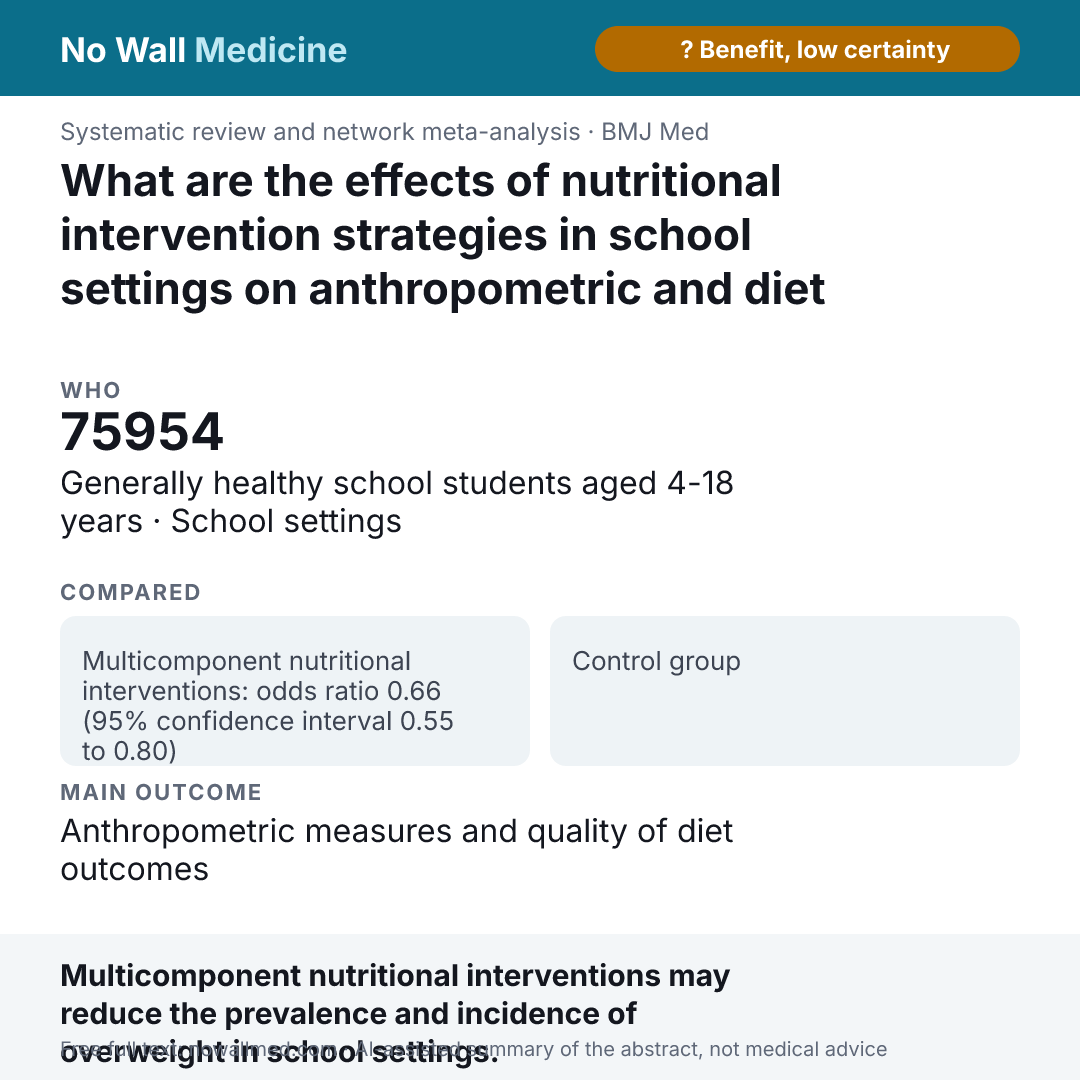
What are the effects of nutritional intervention strategies in school settings on anthropometric and diet quality outcomes?
Who
75954
Generally healthy school students aged 4-18 years · School settings
Compared
Multicomponent nutritional interventions: odds ratio 0.66 (95% confidence interval 0.55 to 0.80)
Control group
Main outcome
Anthropometric measures and quality of diet outcomes
Result: odds ratio 0.66 (95% confidence interval 0.55 to 0.80)
Bottom line: Multicomponent nutritional interventions may reduce the prevalence and incidence of overweight in school settings.
Limitation: The certainty of evidence was often rated as low.
BMJ Med · 2022-12-23 · Save PNG
Clinical question: What are the effects of nutritional intervention strategies in school settings on anthropometric and diet quality outcomes?
Key points
- Researchers analyzed 51 cluster randomized controlled trials involving 75,954 participants to compare different nutritional strategies in schools.
- The analysis found little or no evidence for differences in body mass index, body weight, body fat, or waist circumference.
- Multicomponent interventions were associated with a lower prevalence (odds ratio 0.66, 95% confidence interval 0.55 to 0.80) and incidence (0.67, 0.47 to 0.96) of overweight.
Limitation the authors note: The certainty of evidence was often rated as low.
Headline and key points written with AI from the paper’s abstract, with every number checked against it. Read the paper before relying on them.
Was this summary helpful?
Abstract
Objective
To examine the effects of different nutritional intervention strategies in the school setting on anthropometric and quality of diet outcomes by comparing and ranking outcomes in a network meta-analysis. Design
Systematic review and network meta-analysis. Data sources
PubMed, Cochrane Central Register of Controlled Trials (CENTRAL), Web of Science, Education Resources Information Centre (ERIC), PsycInfo, CAB Abstracts, Campbell Library, Evidence for Policy and Practice Information and Co-ordinating Centre (EPPI-Centre) BiblioMap, Australian Education Index, Joanna Briggs Institute Evidence-Based Practice (JBI EBP) database, Practice-based Evidence in Nutrition (PEN) database, ClinicalTrials.gov, Current Controlled Trials, and World Health Organization International Clinical Trials Registry Platform. Eligibility criteria for selecting studies
A systematic literature search was performed from inception to 2 May 2022. Cluster randomised controlled trials meeting these study criteria were included: generally healthy school students aged 4-18 years; intervention with ≥1 nutritional components in a school setting; and studies that assessed anthropometric measures (eg, body mass index, body fat) or measures related to the quality of diet (eg, intake of fruit and vegetables), or both. Random effects pairwise meta-analyses and network meta-analyses were performed with a frequentist approach. P scores, a frequentist analogue to surface under the cumulative ranking curve, ranging from 0 to 1 (indicating worst and best ranked interventions, respectively) were calculated. Risk of bias was assessed with Cochrane's RoB 2 tool. The Grading of Recommendations Assessment, Development, and Evaluation (GRADE) framework was used to rate the certainty of evidence. Results
51 cluster randomised controlled trials involving 75 954 participants and seven intervention nodes were included. Inconsistency could not be assessed (except for intake of fruit and vegetables) because the network meta-analyses were based mainly on star shaped networks with no direct evidence for specific pairs of nutritional interventions. Overall, little or no evidence was found to support a difference in body mass index, body weight, body fat, or waist circumference and moderate improvements in intake of fruit and vegetables with nutritional interventions in a school setting. Low to moderate certainty of evidence further suggested that multicomponent nutritional interventions likely reduced the prevalence (odds ratio 0.66, 95% confidence interval 0.55 to 0.80) and incidence (0.67, 0.47 to 0.96) of overweight compared with a control group. Based on low certainty of evidence, nutrition education and multicomponent interventions may be more effective than a control group (ie, usual practice) for increasing intake of fruit and vegetables. Multicomponent nutritional interventions were ranked the most effective for reducing body mass index (P score 0.76) and intake of fat (0.82). Nutrition education was ranked as best for body mass index z score (0.99), intake of fruit and vegetables (0.82), intake of fruit (0.92), and intake of vegetables (0.88). Conclusions
The findings suggest that nutritional interventions in school settings may improve anthropometric and quality of diet measures, potentially contributing to the prevention of overweight and obesity in childhood and adolescence. The findings should be interpreted with caution because the certainty of evidence was often rated as low. The results of the network meta-analysis could be used by policy makers in developing and implementing effective, evidence based nutritional intervention strategies in the school setting. Systematic review registration
PROSPERO CRD42020220451.
Abstract reproduced under the article’s CC BY NC licence.
Headline, design, result, key points, caveat and citation as plain text.
Cite this article
Nury E, Stadelmaier J, Morze J, et al. Effects of nutritional intervention strategies in the primary prevention of overweight and obesity in school settings: systematic review and network meta-analysis. BMJ Med. 2022;1(1):e000346. doi:10.1136/bmjmed-2022-000346
Spotted a mistake? Suggest a correction