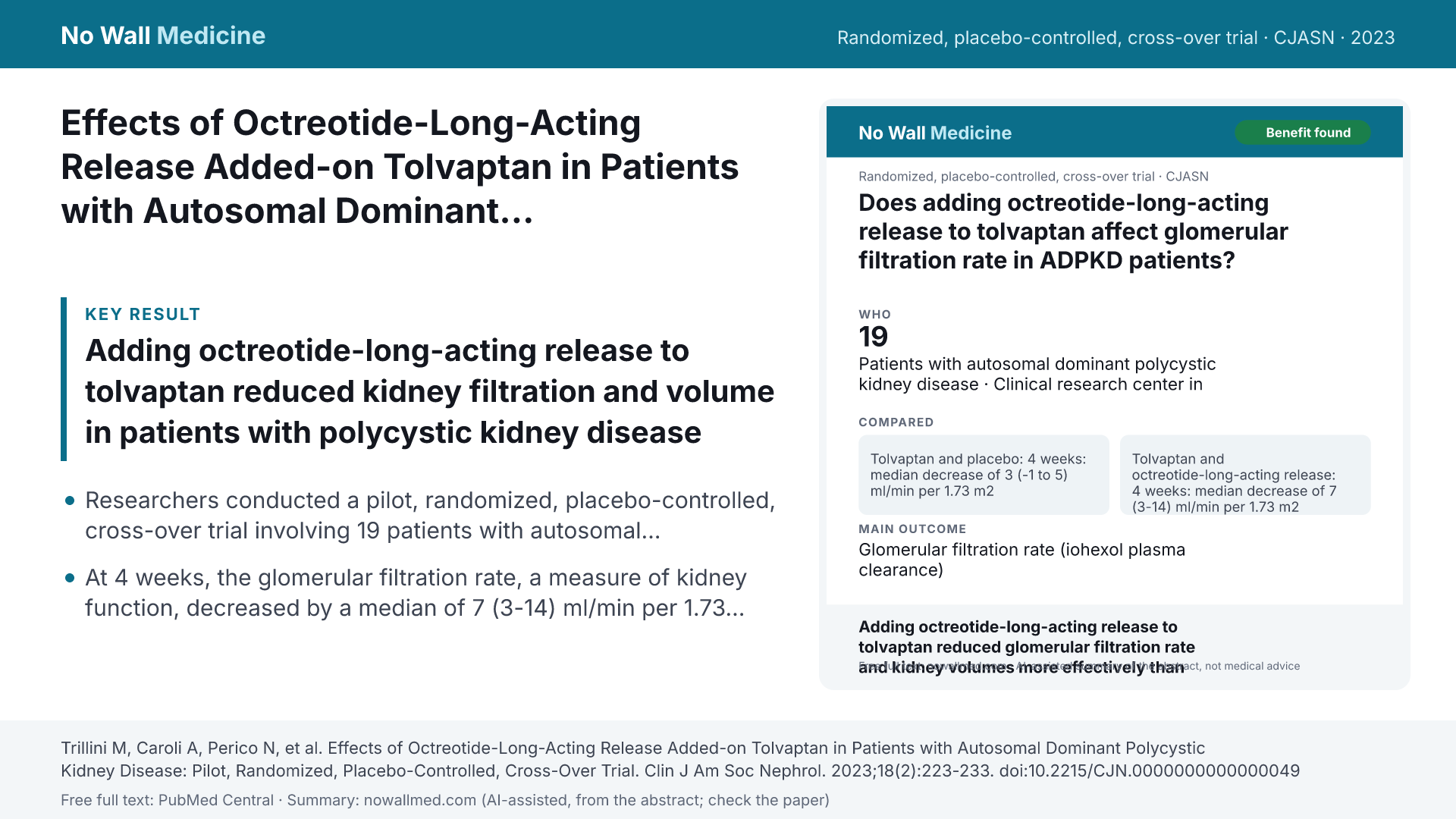
Adding octreotide-long-acting release to tolvaptan reduced kidney filtration and volume in patients with polycystic kidney disease
Effects of Octreotide-Long-Acting Release Added-on Tolvaptan in Patients with Autosomal Dominant Polycystic Kidney Disease: Pilot, Randomized, Placebo-Controlled, Cross-Over Trial
Randomized, placebo-controlled, cross-over trialBenefit found
Does adding octreotide-long-acting release to tolvaptan affect glomerular filtration rate in ADPKD patients?
Who
19
Patients with autosomal dominant polycystic kidney disease · Clinical research center in Italy
Compared
Tolvaptan and placebo: 4 weeks: median decrease of 3 (-1 to 5) ml/min per 1.73 m2
Tolvaptan and octreotide-long-acting release: 4 weeks: median decrease of 7 (3-14) ml/min per 1.73 m2
Main outcome
Glomerular filtration rate (iohexol plasma clearance)
Bottom line: Adding octreotide-long-acting release to tolvaptan reduced glomerular filtration rate and kidney volumes more effectively than placebo.
CJASN · 2023-02-08 · Save PNG
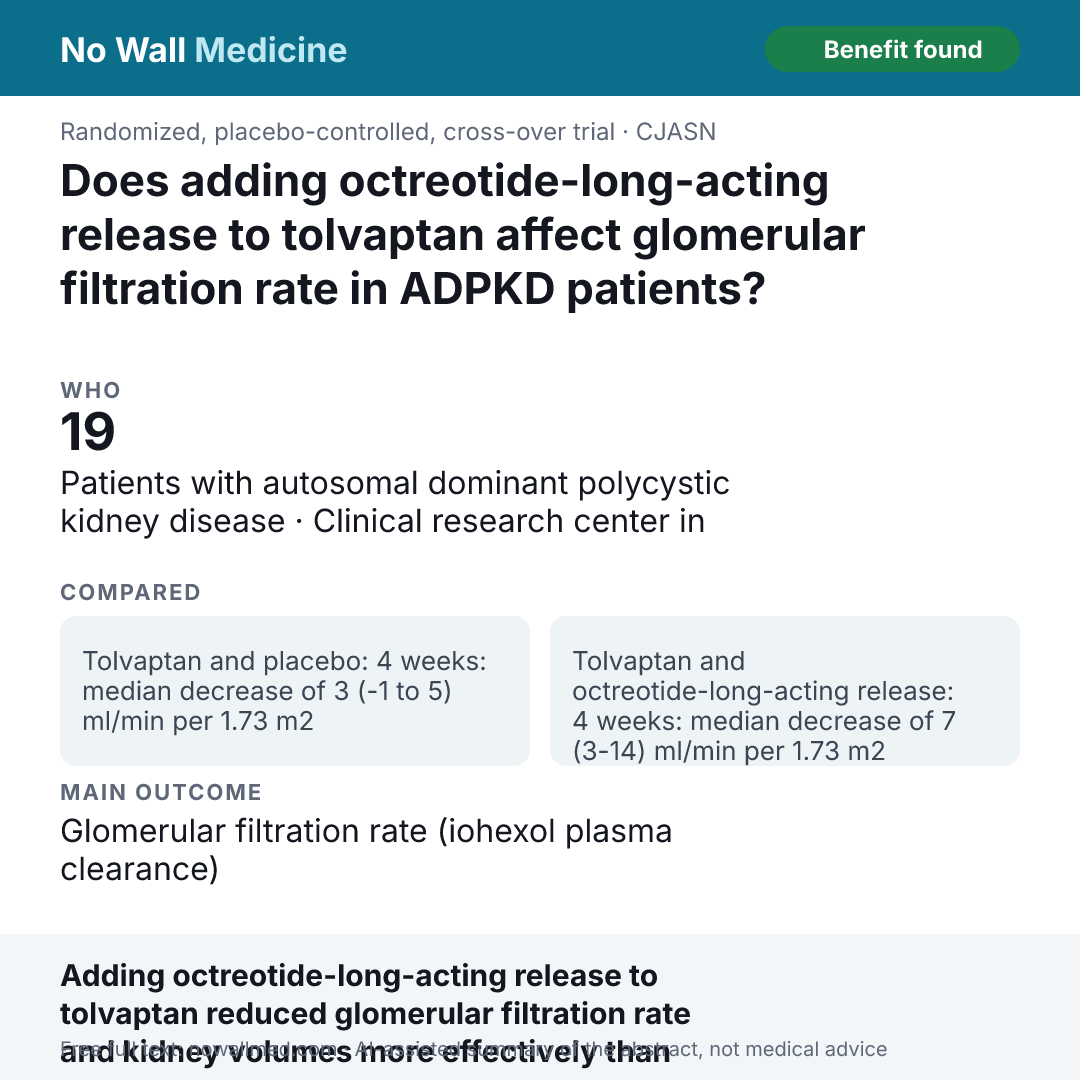
Clinical question: Does adding octreotide-long-acting release to tolvaptan affect glomerular filtration rate in ADPKD patients?
Key points
- Researchers conducted a pilot, randomized, placebo-controlled, cross-over trial involving 19 patients with autosomal dominant polycystic kidney disease.
- At 4 weeks, the glomerular filtration rate, a measure of kidney function, decreased by a median of 7 (3-14) ml/min per 1.73 m2 with tolvaptan and octreotide-long-acting release compared to 3 (-1 to 5) ml/min per 1.73 m2 with tolvaptan and placebo.
- Octreotide-long-acting release was associated with a significant decrease in total kidney volume of 41 (25-77) ml compared to a non-significant change of 4 (-48 to 23) ml with placebo.
Headline and key points written with AI from the paper’s abstract, with every number checked against it. Read the paper before relying on them.
Was this summary helpful?
Subject terms
Headline, design, result, key points, caveat and citation as plain text.
Cite this article
Trillini M, Caroli A, Perico N, et al. Effects of Octreotide-Long-Acting Release Added-on Tolvaptan in Patients with Autosomal Dominant Polycystic Kidney Disease: Pilot, Randomized, Placebo-Controlled, Cross-Over Trial. Clin J Am Soc Nephrol. 2023;18(2):223-233. doi:10.2215/CJN.0000000000000049
Spotted a mistake? Suggest a correction