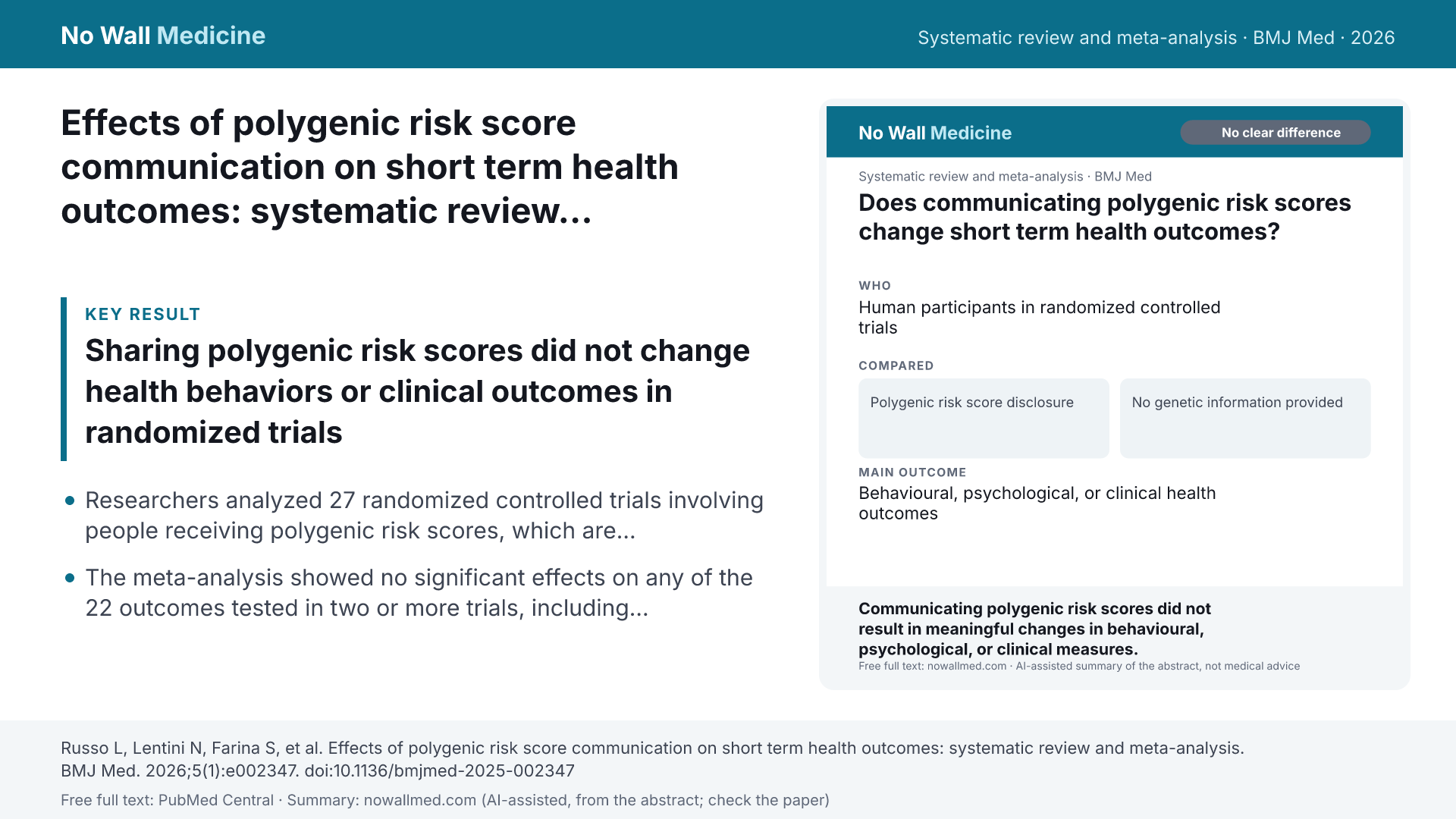
Sharing polygenic risk scores did not change health behaviors or clinical outcomes in randomized trials
Effects of polygenic risk score communication on short term health outcomes: systematic review and meta-analysis
Systematic review and meta-analysisNo clear difference
Does communicating polygenic risk scores change short term health outcomes?
Who
Human participants in randomized controlled trials
Compared
Polygenic risk score disclosure
No genetic information provided
Main outcome
Behavioural, psychological, or clinical health outcomes
Bottom line: Communicating polygenic risk scores did not result in meaningful changes in behavioural, psychological, or clinical measures.
Limitation: High risk of bias in nine trials and significant heterogeneity.
BMJ Med · 2026-06-12 · Save PNG
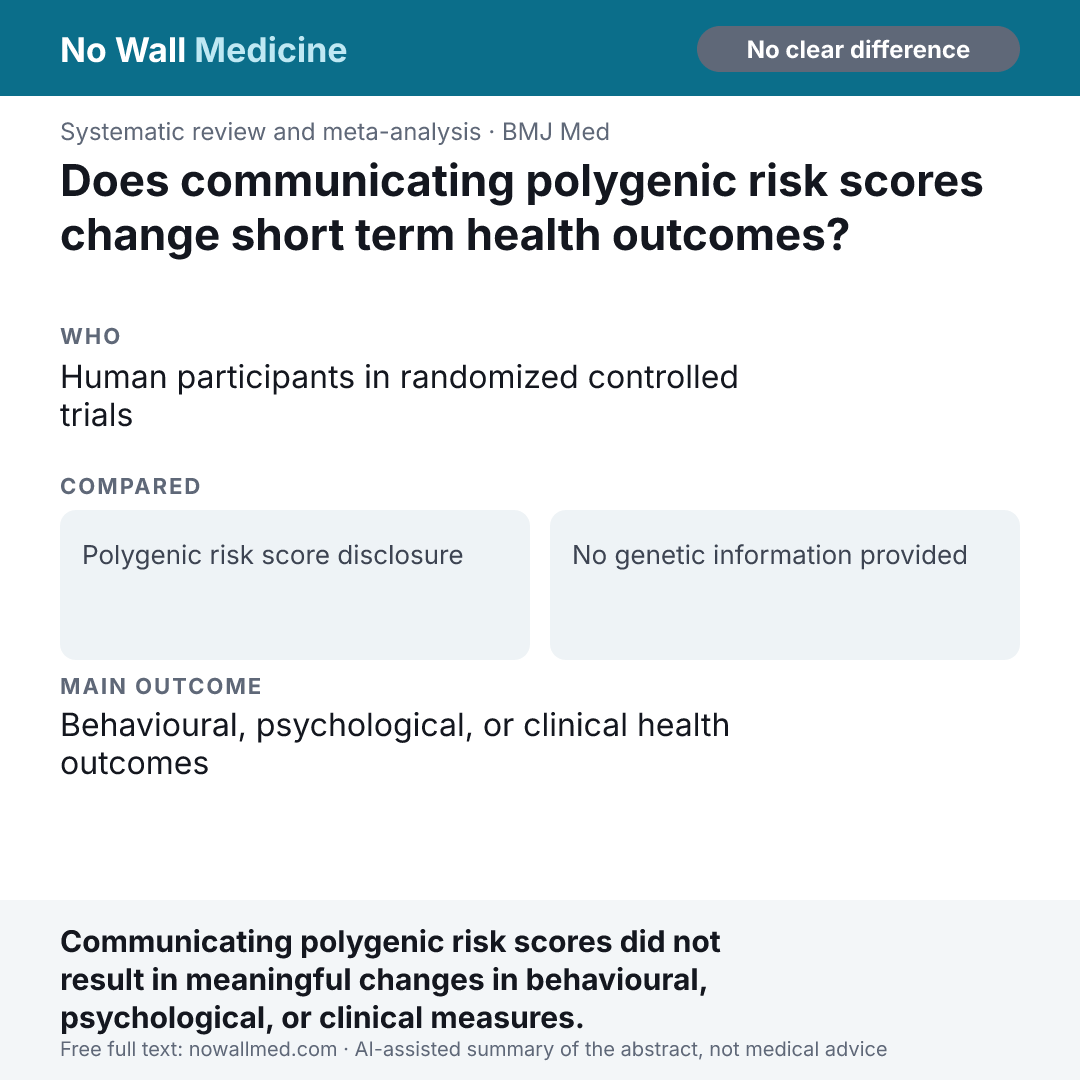
Clinical question: Does communicating polygenic risk scores change short term health outcomes?
Key points
- Researchers analyzed 27 randomized controlled trials involving people receiving polygenic risk scores, which are calculations of genetic risk, compared to those receiving no genetic information.
- The meta-analysis showed no significant effects on any of the 22 outcomes tested in two or more trials, including diet, physical activity, and psychological health.
- Clinical measures such as blood pressure, cholesterol, and body mass index showed no significant differences between the groups.
Limitation the authors note: The authors noted high heterogeneity and methodological limitations, including the fact that nine of the 27 randomized controlled trials had a high risk of bias.
Headline and key points written with AI from the paper’s abstract, with every number checked against it. Read the paper before relying on them.
Was this summary helpful?
Abstract
Objective
To summarise the evidence so far from all randomised controlled trials on the efficacy of communication of polygenic risk scores in changing health outcomes. Design
Systematic review and meta-analysis. Data sources
Cochrane Central Register of Controlled Trials (CENTRAL) and Pubmed, from inception to 1 March 2025. Eligibility criteria for selecting studies
Randomised controlled trials in human participants; articles published or accepted for publication in peer reviewed journals, or with available results on ClinicalTrials.gov, without time restriction in any language; and randomised controlled trials comparing the disclosure of inherited genetic risk obtained through the polygenic risk score for any phenotype (intervention group) with scenarios where no genetic information was provided (comparator group). Results
Of 7830 articles retrieved, 27 randomised controlled trials were eligible for inclusion in the analysis. Polygenic risk scores mainly predicted risks for cancer (n=9 randomised controlled trials), cardiovascular diseases (n=8), and diabetes (n=6). 21 randomised controlled trials targeted mainly healthy populations, three targeted at-risk populations, and three trials targeted individuals who had already developed a disease and the polygenic risk score predicted complications. Most randomised controlled trials (15/27) concluded in their abstracts with favourable claims about the polygenic risk score, with only 5/15 trials justifying the score with any significant results. Nine of the 27 randomised controlled trials had a high risk of bias. Meta-analysis showed no significant effects on any of the 22 outcomes tested in two or more trials. Standardised mean differences for dietary outcomes were -0.11 (95% confidence interval (CI) -0.22 to 0.01) for daily energy intake, 0.03 (-0.18 to 0.25) for daily fat intake, and -0.11 (-0.28 to 0.06) for alcohol consumption. For physical activity, standardised mean difference was -0.01 (95% CI -0.13 to 0.11). Relative risks were 1.12 (95% CI 0.77 to 1.61) for screening attendance, 1.50 (0.98 to 2.29) for use of statins, and 0.95 (0.32 to 2.79) for incidence of disease. For psychological outcomes, standardised mean differences were -0.02 (95% CI -0.13 to 0.08) for anxiety, -0.06 (-0.23 to 0.10) for worry, -0.04 (-0.21 to 0.13) for perceived risk, and -0.05 (-0.23 to 0.13) for depression. For clinical outcomes, mean differences were -2.01 (95% CI -8.27 to 4.26) for total cholesterol, -3.64 (-7.88 to 0.60) for low density lipoprotein cholesterol, -0.21 (-2.65 to 2.23) for high density lipoprotein cholesterol, -1.88 (-4.17 to 0.42) for diastolic blood pressure, -1.26 (-4.44 to 1.92) for systolic blood pressure, -0.12 (-0.63 to 0.39) for body mass index, and -0.33 (-0.87 to 0.20) for weight. 80 outcomes were reported across multiple studies, with each outcome reported in a single trial only. 19 of 80 were primary outcomes, and of these two had significant results (P<0.05), as did three secondary outcomes. Conclusions
Overall, despite frequent promising claims, disclosure of polygenic risk scores did not result in meaningful changes in behavioural, psychological, or clinical measures for the outcomes examined. Although when interpreting the findings the heterogeneity and methodological limitations of the available trials should be considered, communication of polygenic risk scores did not show consistent improvements in preventive behaviours or risk factor modification. Systematic review registration
Open Science Framework doi.org/10.17605/OSF.IO/28V6J.
Abstract reproduced under the article’s CC BY NC licence.
Headline, design, result, key points, caveat and citation as plain text.
Cite this article
Russo L, Lentini N, Farina S, et al. Effects of polygenic risk score communication on short term health outcomes: systematic review and meta-analysis. BMJ Med. 2026;5(1):e002347. doi:10.1136/bmjmed-2025-002347
Spotted a mistake? Suggest a correction