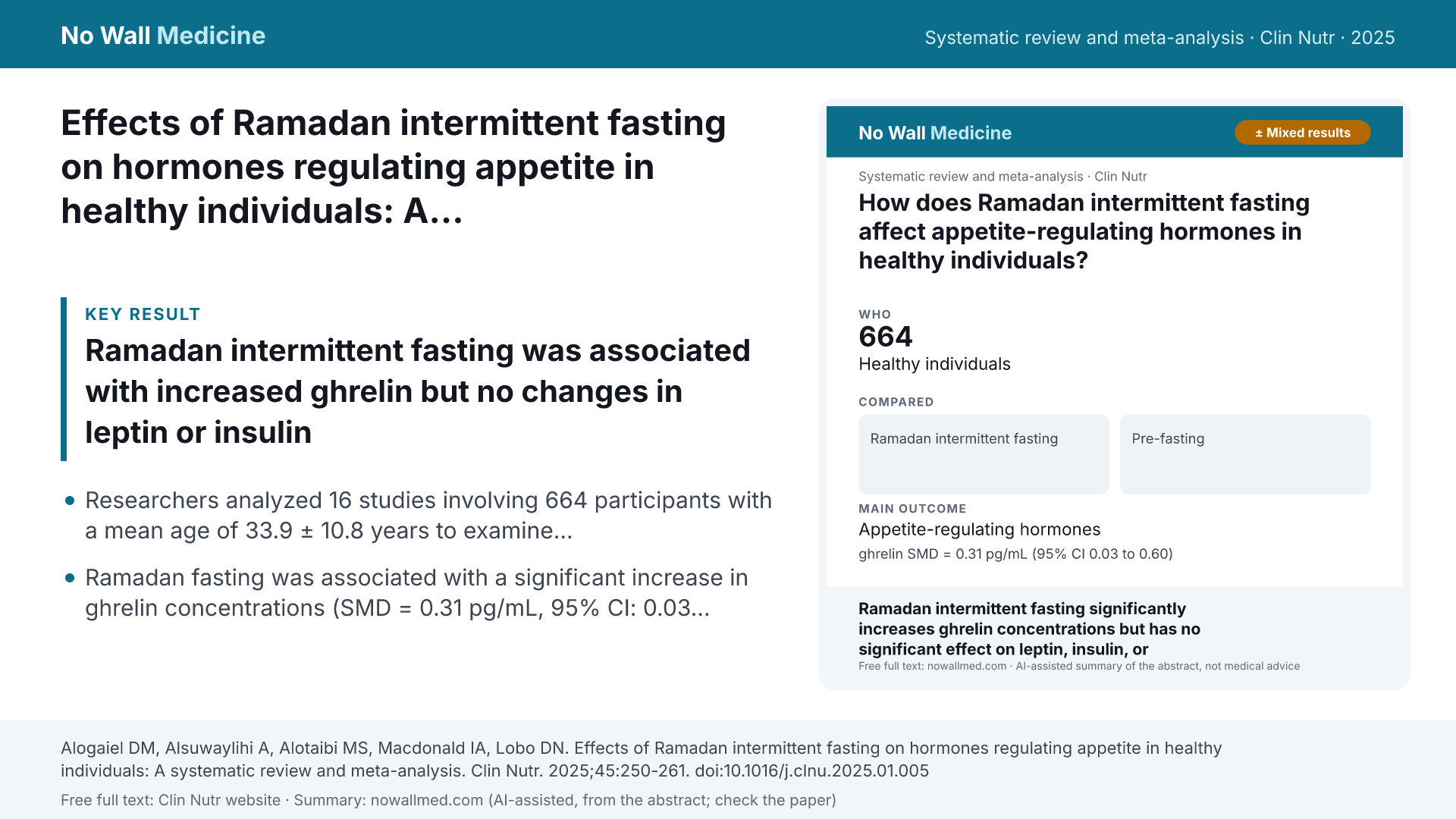
Ramadan intermittent fasting was associated with increased ghrelin but no changes in leptin or insulin
Effects of Ramadan intermittent fasting on hormones regulating appetite in healthy individuals: A systematic review and meta-analysis
Systematic review and meta-analysisMixed results
How does Ramadan intermittent fasting affect appetite-regulating hormones in healthy individuals?
Who
664
Healthy individuals
Compared
Ramadan intermittent fasting
Pre-fasting
Main outcome
Appetite-regulating hormones
Result: ghrelin SMD = 0.31 pg/mL (95% CI 0.03 to 0.60)
Bottom line: Ramadan intermittent fasting significantly increases ghrelin concentrations but has no significant effect on leptin, insulin, or gastrin.
Clin Nutr · 2025-01-06Download image
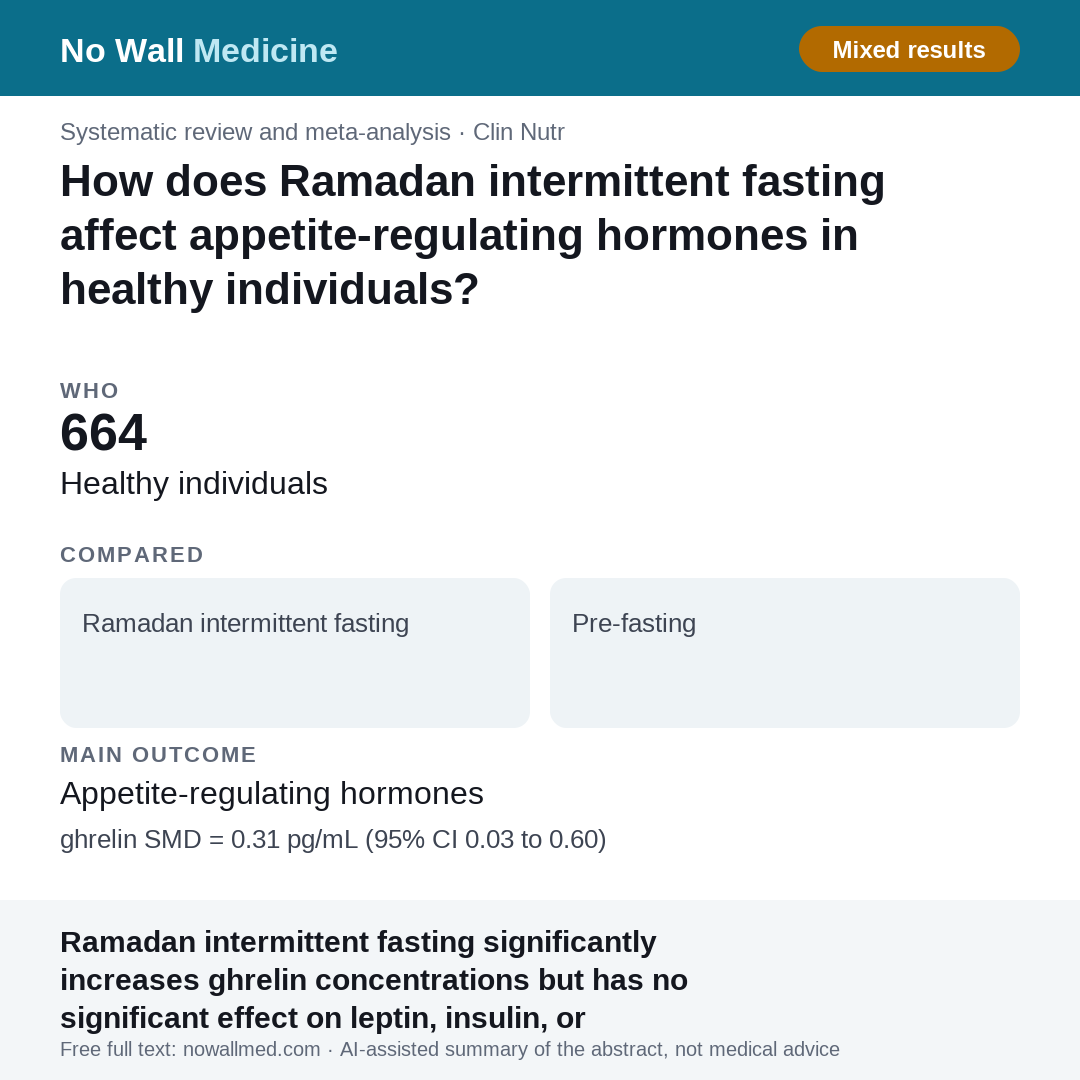
Clinical question: How does Ramadan intermittent fasting affect appetite-regulating hormones in healthy individuals?
Why it matters: It was unknown how Ramadan intermittent fasting affects specific hormones that regulate appetite, such as leptin, ghrelin, and insulin.
Key points
- Researchers analyzed 16 studies involving 664 participants with a mean age of 33.9 ± 10.8 years to examine appetite-regulating hormones.
- Ramadan fasting was associated with a significant increase in ghrelin concentrations (SMD = 0.31 pg/mL, 95% CI: 0.03 to 0.60).
- No significant effects were found for leptin (SMD = -0.11 μg/mL, 95% CI: -0.36 to 0.14), insulin (SMD = -0.24 μU/mL, 95% CI: -0.54 to 0.02), or gastrin (SMD = 0.23 pg/mL, 95% CI: -0.71 to 0.99).
Headline and key points written with AI from the paper’s abstract, with every number checked against it. Read the paper before relying on them.
Was this summary helpful?
Subject terms
Cite this article
Alogaiel DM, Alsuwaylihi A, Alotaibi MS, Macdonald IA, Lobo DN. Effects of Ramadan intermittent fasting on hormones regulating appetite in healthy individuals: A systematic review and meta-analysis. Clin Nutr. 2025. doi:10.1016/j.clnu.2025.01.005
Spotted a mistake? Suggest a correction
Top studies every Monday
The week’s key trials and guidelines in your specialties, plus any topics you follow. By email, free.
Get the weekly digest