Ramosetron tablets reduced nausea and vomiting in women after outpatient day surgery
Effects of ramosetron orally disintegrating tablets on the prophylaxis of post-discharge nausea and/or vomiting in female patients undergoing day surgery under general anesthesia: a randomized controlled trial
Multicenter randomized studyBenefit found
Does ramosetron orally disintegrating tablets prevent post-discharge nausea and vomiting in female patients?
Who
138
Female patients undergoing day surgery under general anesthesia · Three South Korean tertiary hospitals
Compared
13%Ramosetron orally disintegrating tablets
33%Control
Main outcome
Incidence of nausea during 24 h after discharge
Bottom line: Ramosetron orally disintegrating tablets reduce the incidence and severity of postoperative nausea after discharge.
Perioper Med · 2022-05-12 · Save PNG
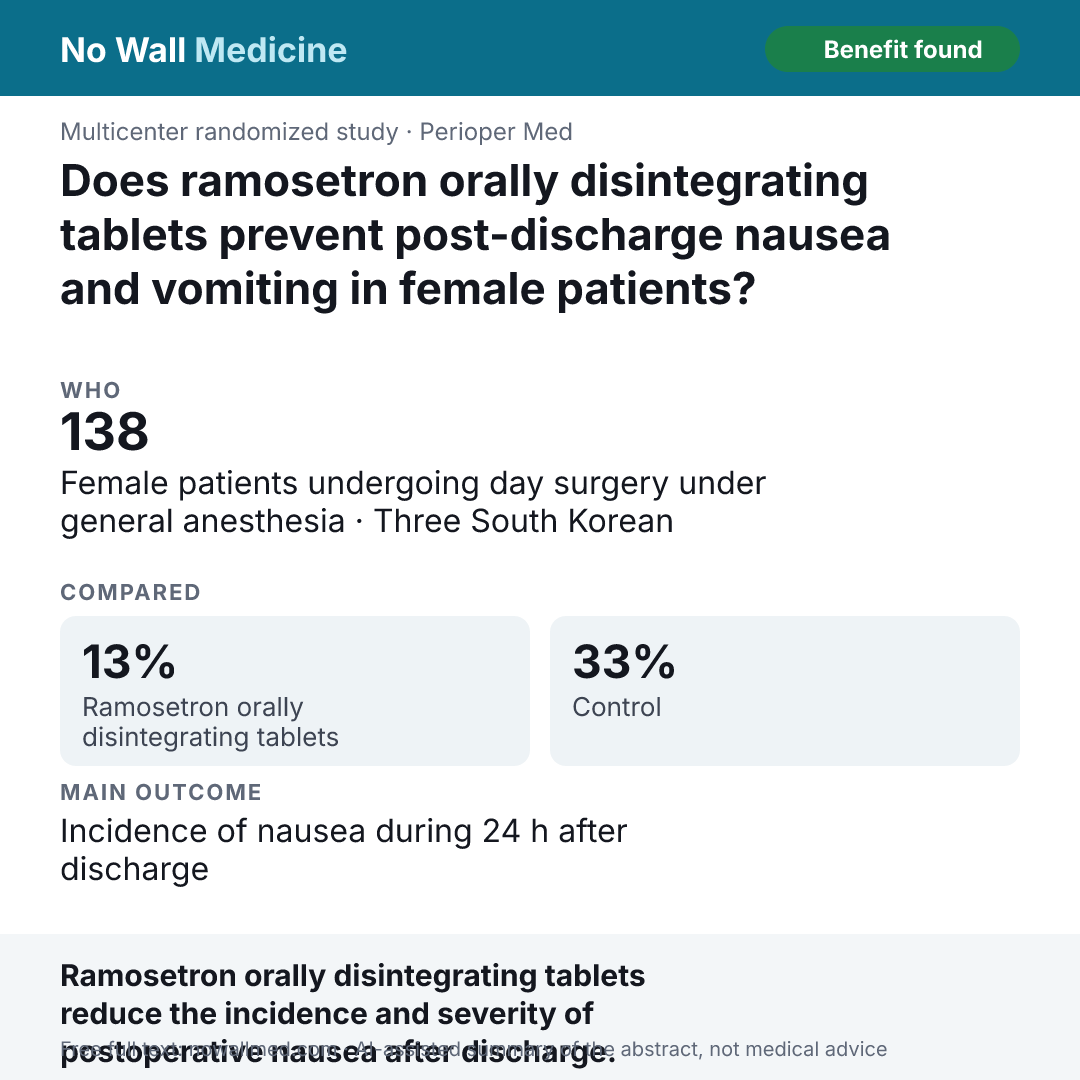
Clinical question: Does ramosetron orally disintegrating tablets prevent post-discharge nausea and vomiting in female patients?
In absolute numbers
Ramosetron orally disintegrating tablets: 13% · Control: 33% → a difference of 20 percentage points, so about 5 people would need the treatment for 1 more to benefit (number needed to treat) over the trial’s follow-up.
Worked out by us from the two group results above, not reported by the authors. Check the paper for the exact outcome and timing.
Key points
- Researchers studied 138 female patients undergoing day surgery under general anesthesia across three South Korean hospitals.
- The ramosetron group had a 13% incidence of nausea during the first 24 hours after discharge compared to 33% in the control group.
- The rate of rescue antiemetic, or medicine used to stop vomiting, was 6% in the ramosetron group and 18% in the control group.
Headline and key points written with AI from the paper’s abstract, with every number checked against it. Read the paper before relying on them.
Was this summary helpful?
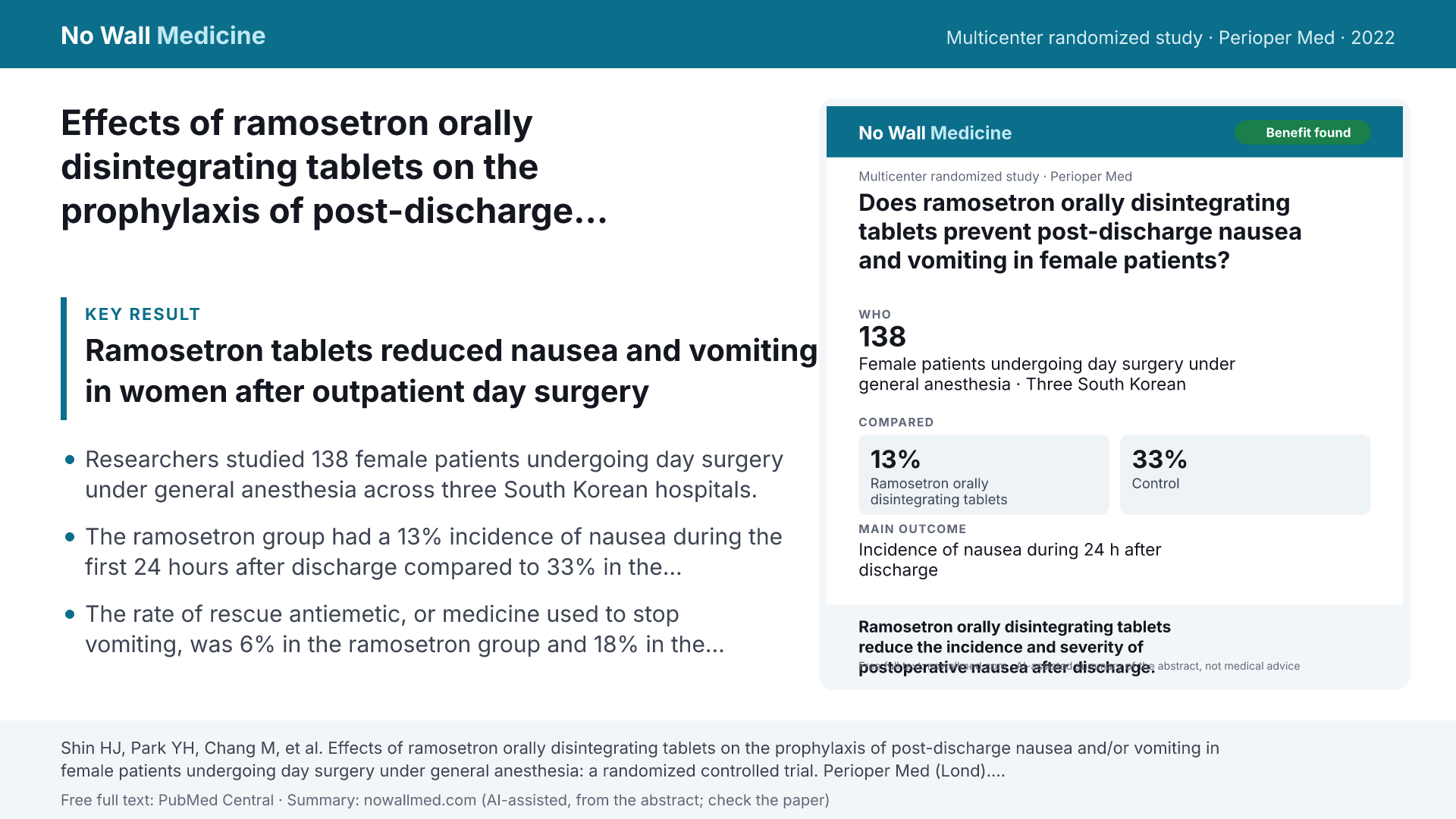
Headline, design, result, key points, caveat and citation as plain text.
Cite this article
Shin HJ, Park YH, Chang M, et al. Effects of ramosetron orally disintegrating tablets on the prophylaxis of post-discharge nausea and/or vomiting in female patients undergoing day surgery under general anesthesia: a randomized controlled trial. Perioper Med (Lond). 2022;11(1):17. doi:10.1186/s13741-022-00251-6
Spotted a mistake? Suggest a correction