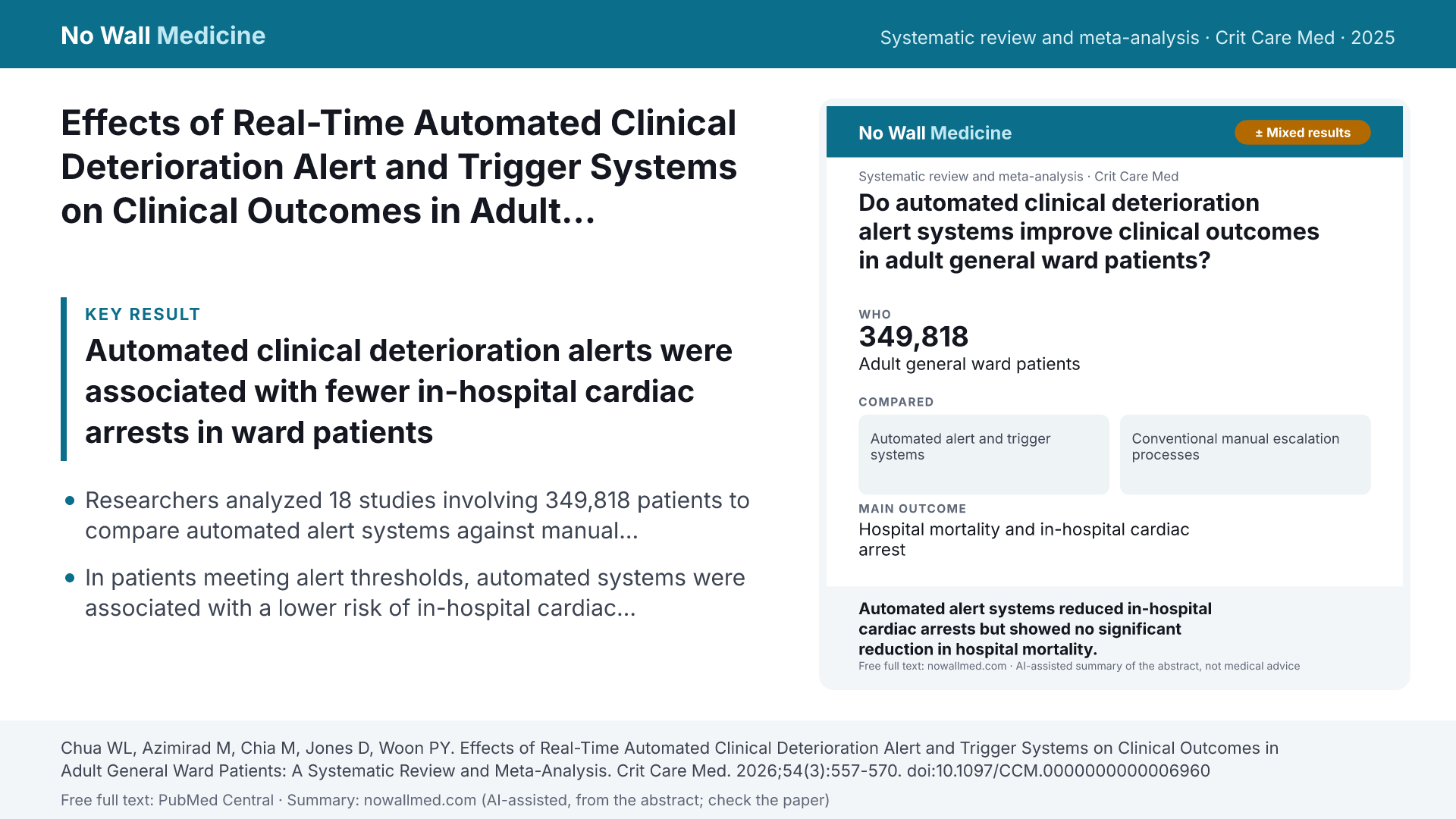
Automated clinical deterioration alerts were associated with fewer in-hospital cardiac arrests in ward patients
Effects of Real-Time Automated Clinical Deterioration Alert and Trigger Systems on Clinical Outcomes in Adult General Ward Patients: A Systematic Review and Meta-Analysis
Systematic review and meta-analysisMixed results
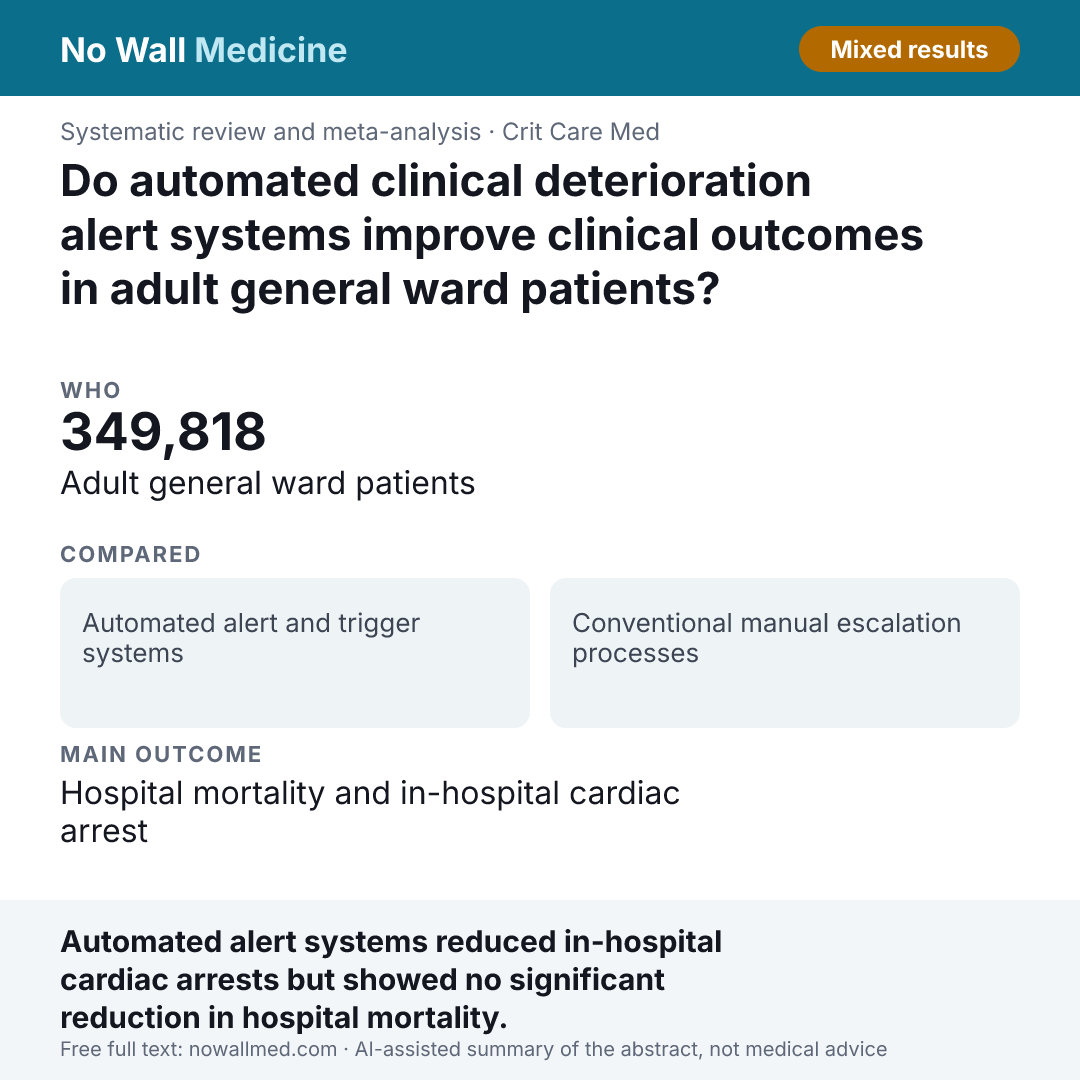
Do automated clinical deterioration alert systems improve clinical outcomes in adult general ward patients?
Who
349,818
Adult general ward patients
Compared
Automated alert and trigger systems
Conventional manual escalation processes
Main outcome
Hospital mortality and in-hospital cardiac arrest
Result: risk ratio 0.60 (95% CI, 0.43-0.85) for in-hospital cardiac arrest
Bottom line: Automated alert systems reduced in-hospital cardiac arrests but showed no significant reduction in hospital mortality.
Limitation: All studies had at least moderate risk of bias.
Crit Care Med · 2025-11-12 · Save PNG
Clinical question: Do automated clinical deterioration alert systems improve clinical outcomes in adult general ward patients?
Key points
- Researchers analyzed 18 studies involving 349,818 patients to compare automated alert systems against manual escalation processes.
- In patients meeting alert thresholds, automated systems were associated with a lower risk of in-hospital cardiac arrest (risk ratio, 0.60; 95% CI, 0.43-0.85; p = 0.004).
- The systems were not associated with a significant change in hospital mortality (risk ratio, 0.80; 95% CI, 0.62-1.05; p = 0.09).
Limitation the authors note: All included studies had at least moderate risk of bias.
Headline and key points written with AI from the paper’s abstract, with every number checked against it. Read the paper before relying on them.
Was this summary helpful?
Subject terms
Headline, design, result, key points, caveat and citation as plain text.
Cite this article
Chua WL, Azimirad M, Chia M, Jones D, Woon PY. Effects of Real-Time Automated Clinical Deterioration Alert and Trigger Systems on Clinical Outcomes in Adult General Ward Patients: A Systematic Review and Meta-Analysis. Crit Care Med. 2026;54(3):557-570. doi:10.1097/CCM.0000000000006960
Spotted a mistake? Suggest a correction