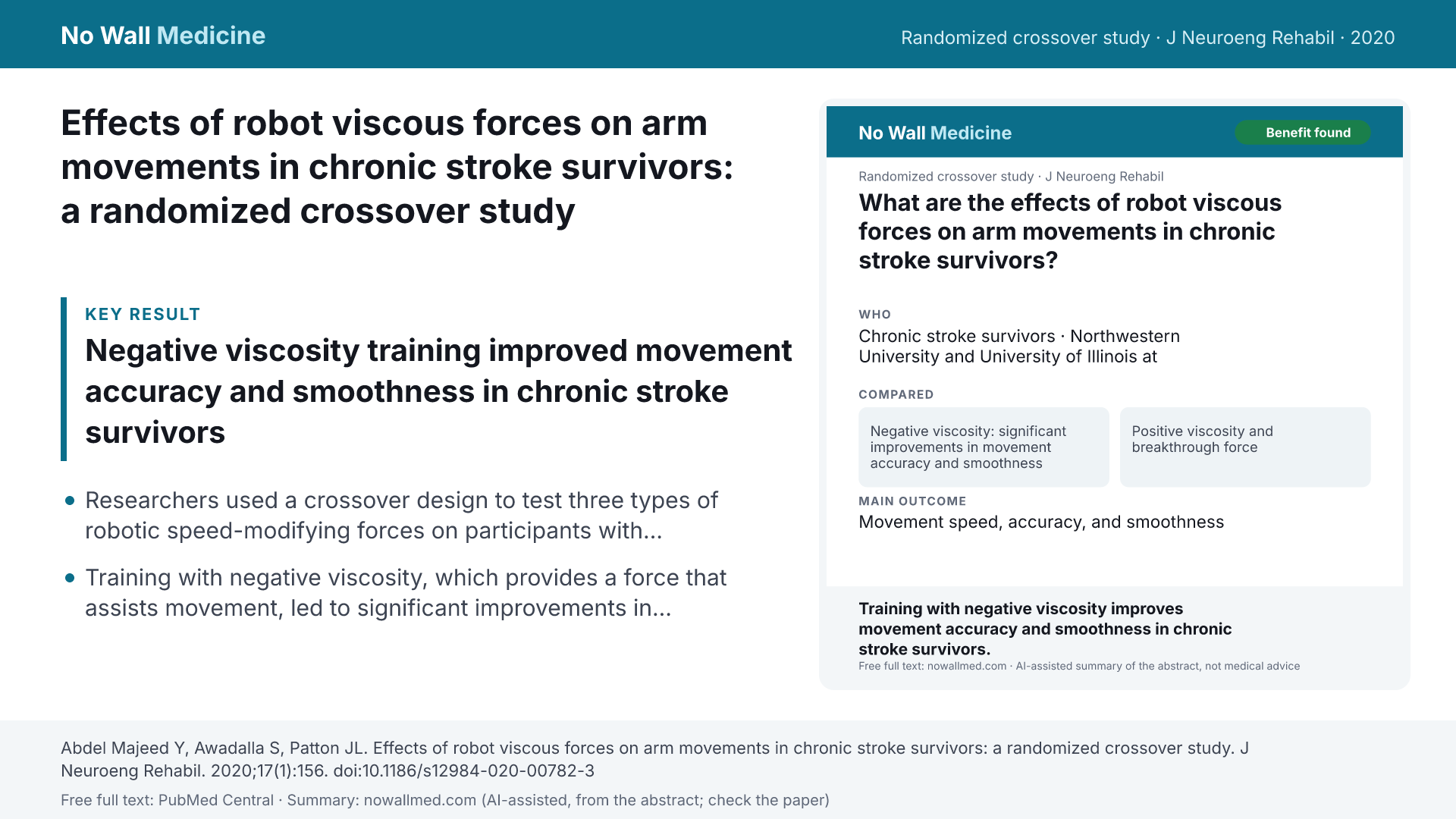
Negative viscosity training improved movement accuracy and smoothness in chronic stroke survivors
Effects of robot viscous forces on arm movements in chronic stroke survivors: a randomized crossover study
Randomized crossover studyBenefit found
What are the effects of robot viscous forces on arm movements in chronic stroke survivors?
Who
Chronic stroke survivors · Northwestern University and University of Illinois at Chicago
Compared
Negative viscosity: significant improvements in movement accuracy and smoothness
Positive viscosity and breakthrough force
Main outcome
Movement speed, accuracy, and smoothness
Bottom line: Training with negative viscosity improves movement accuracy and smoothness in chronic stroke survivors.
J Neuroeng Rehabil · 2020-11-24Download image
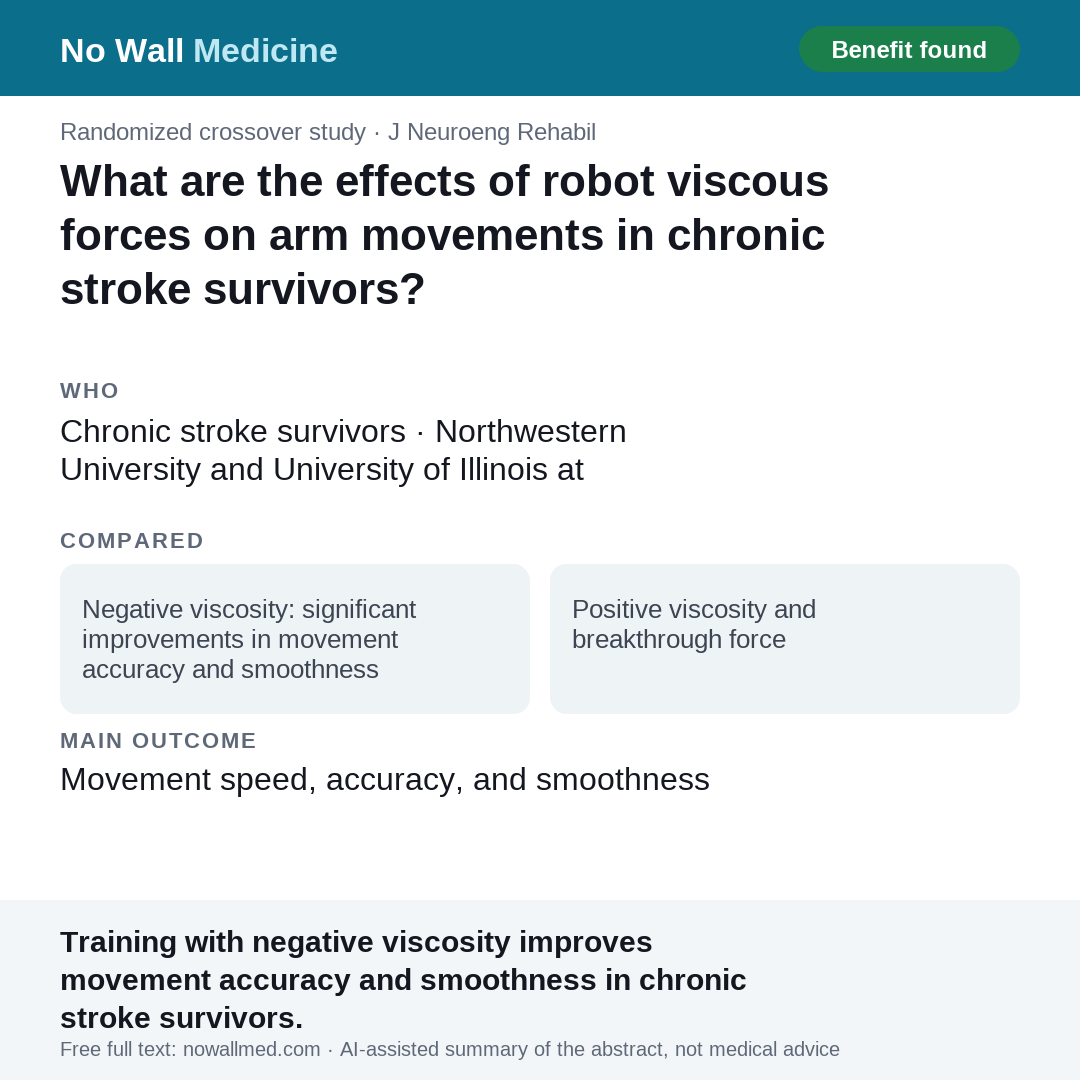
Clinical question: What are the effects of robot viscous forces on arm movements in chronic stroke survivors?
Key points
- Researchers used a crossover design to test three types of robotic speed-modifying forces on participants with chronic stroke.
- Training with negative viscosity, which provides a force that assists movement, led to significant improvements in movement accuracy and smoothness.
- No lasting after effects on movement speed were observed from any of the three robotic force treatments.
Headline and key points written with AI from the paper’s abstract, with every number checked against it. Read the paper before relying on them.
Was this summary helpful?
Subject terms
Headline, design, result, key points, caveat and citation as plain text.
Cite this article
Abdel Majeed Y, Awadalla S, Patton JL. Effects of robot viscous forces on arm movements in chronic stroke survivors: a randomized crossover study. J Neuroeng Rehabil. 2020. doi:10.1186/s12984-020-00782-3
Spotted a mistake? Suggest a correction