Smartphone meditation apps showed limited differences between self-compassion and mindfulness for Japanese workers
Effects of Self-Compassion and Mindfulness Interventions on Mental Health and Work-Related Outcomes Among Japanese Workers: Randomized Controlled Trial
Open-label, 3-arm randomized controlled trialNo clear difference
Do smartphone-based self-compassion and mindfulness interventions improve mental health and work outcomes?
Who
300
Nonclinical Japanese working adults · Japan
Compared
Self-compassion meditation
Mindfulness meditation
Waitlist control
Main outcome
Psychological distress and work performance
Bottom line: Smartphone-based meditation showed good feasibility, but between-group effects were limited and do not support strong causal claims.
Limitation: Findings are preliminary and clinical significance remains unclear in this nonclinical sample.
J Med Internet Res · 2026-03-17Download image
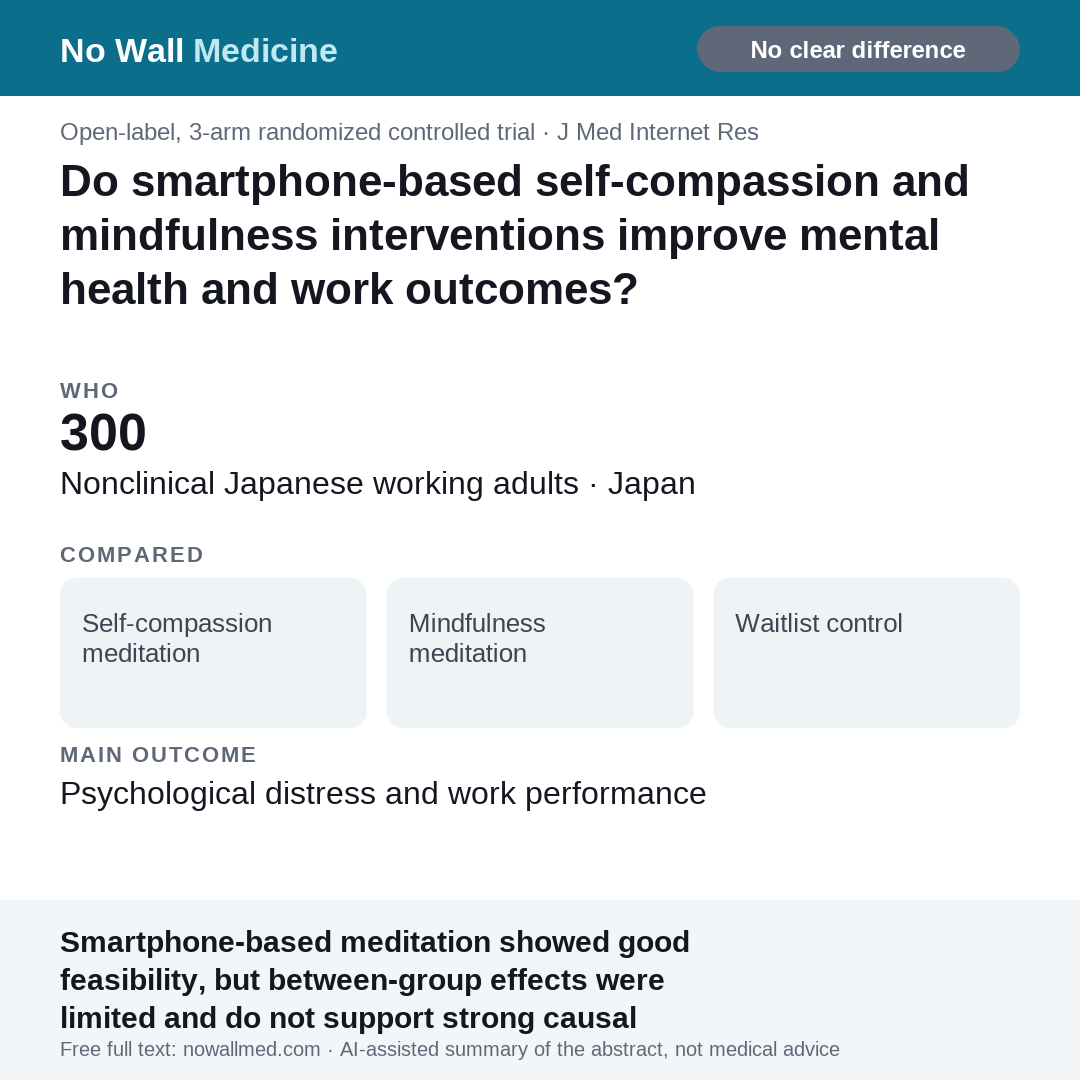
Clinical question: Do smartphone-based self-compassion and mindfulness interventions improve mental health and work outcomes?
Why it matters: Low-intensity digital interventions for improving mental health and work outcomes in occupational settings remain underexplored.
Key points
- Researchers studied 300 Japanese working adults assigned to self-compassion meditation, mindfulness meditation, or a waitlist control group.
- The smartphone app interventions showed limited between-group effects, though self-compassion meditation showed a larger improvement in work performance during sensitivity analyses.
- Participants showed high adherence to the daily guided meditation, with an average of 23.30 days for self-compassion and 22.95 days for mindfulness.
Limitation the authors note: The authors state that between-group effects were limited and the findings should be interpreted as preliminary.
Headline and key points written with AI from the paper’s abstract, with every number checked against it. Read the paper before relying on them.
Topics
Cite this article
Kurosawa T, Adachi K, Takizawa R. Effects of Self-Compassion and Mindfulness Interventions on Mental Health and Work-Related Outcomes Among Japanese Workers: Randomized Controlled Trial. J Med Internet Res. 2026. doi:10.2196/79991
Spotted a mistake? Suggest a correction