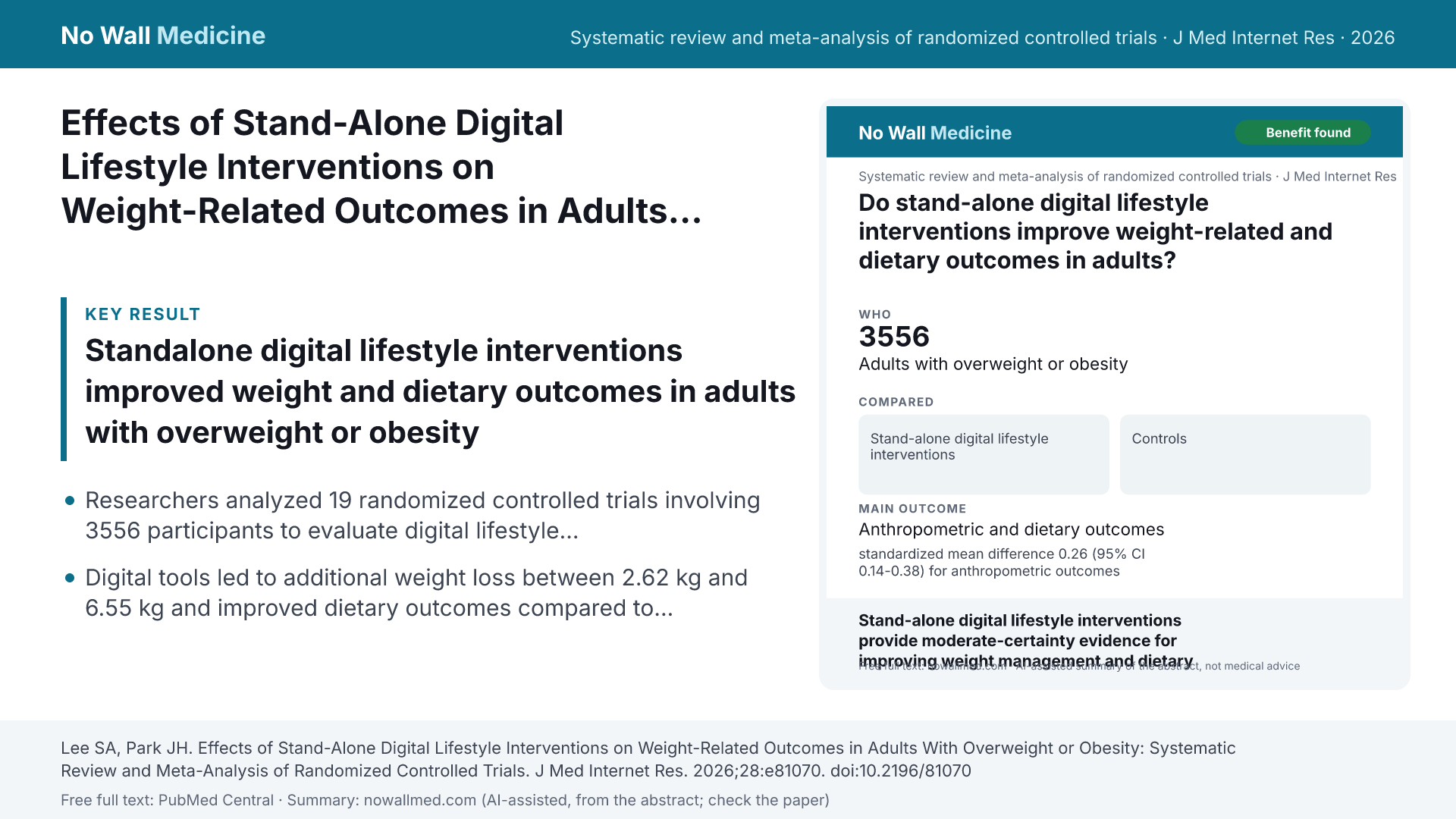
Standalone digital lifestyle interventions improved weight and dietary outcomes in adults with overweight or obesity
Effects of Stand-Alone Digital Lifestyle Interventions on Weight-Related Outcomes in Adults With Overweight or Obesity: Systematic Review and Meta-Analysis of Randomized Controlled Trials
Systematic review and meta-analysis of randomized controlled trialsBenefit found
Do stand-alone digital lifestyle interventions improve weight-related and dietary outcomes in adults?
Who
3556
Adults with overweight or obesity
Compared
Stand-alone digital lifestyle interventions
Controls
Main outcome
Anthropometric and dietary outcomes
Result: standardized mean difference 0.26 (95% CI 0.14-0.38) for anthropometric outcomes
Bottom line: Stand-alone digital lifestyle interventions provide moderate-certainty evidence for improving weight management and dietary outcomes without human intervention.
Limitation: Substantial statistical heterogeneity was observed and prediction intervals included zero.
J Med Internet Res · 2026-05-04 · Save PNG
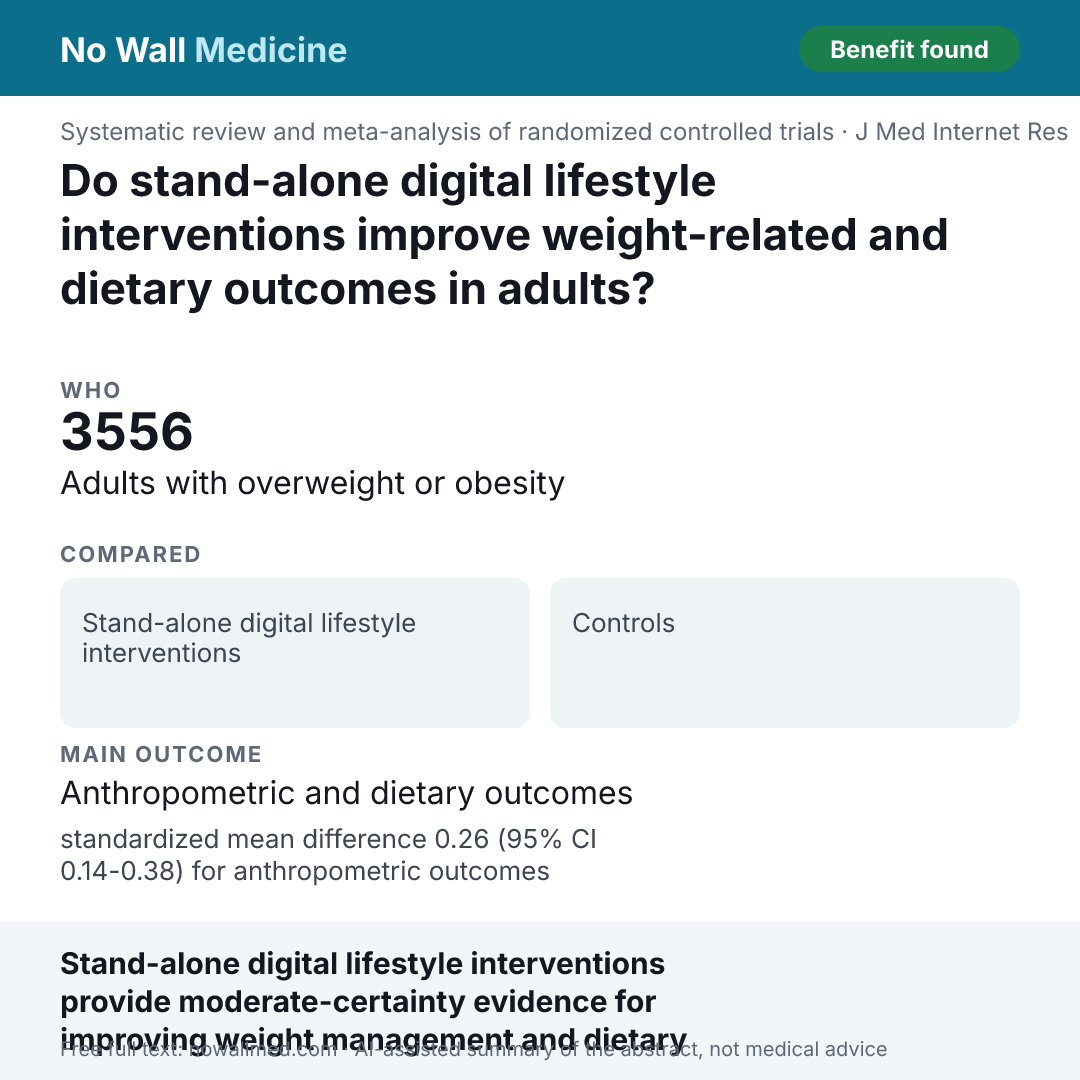
Clinical question: Do stand-alone digital lifestyle interventions improve weight-related and dietary outcomes in adults?
Why it matters: Prior research often included hybrid formats with human support, which limited understanding of how effective fully digital interventions are on their own.
Key points
- Researchers analyzed 19 randomized controlled trials involving 3556 participants to evaluate digital lifestyle interventions delivered without human support.
- Digital tools led to additional weight loss between 2.62 kg and 6.55 kg and improved dietary outcomes compared to control groups.
- The certainty of evidence for both weight and dietary improvements was rated as moderate due to statistical heterogeneity.
Limitation the authors note: The authors noted substantial statistical heterogeneity was observed in some outcomes and the prediction intervals included zero.
Headline and key points written with AI from the paper’s abstract, with every number checked against it. Read the paper before relying on them.
Was this summary helpful?
Subject terms
Headline, design, result, key points, caveat and citation as plain text.
Cite this article
Lee SA, Park JH. Effects of Stand-Alone Digital Lifestyle Interventions on Weight-Related Outcomes in Adults With Overweight or Obesity: Systematic Review and Meta-Analysis of Randomized Controlled Trials. J Med Internet Res. 2026;28:e81070. doi:10.2196/81070
Spotted a mistake? Suggest a correction