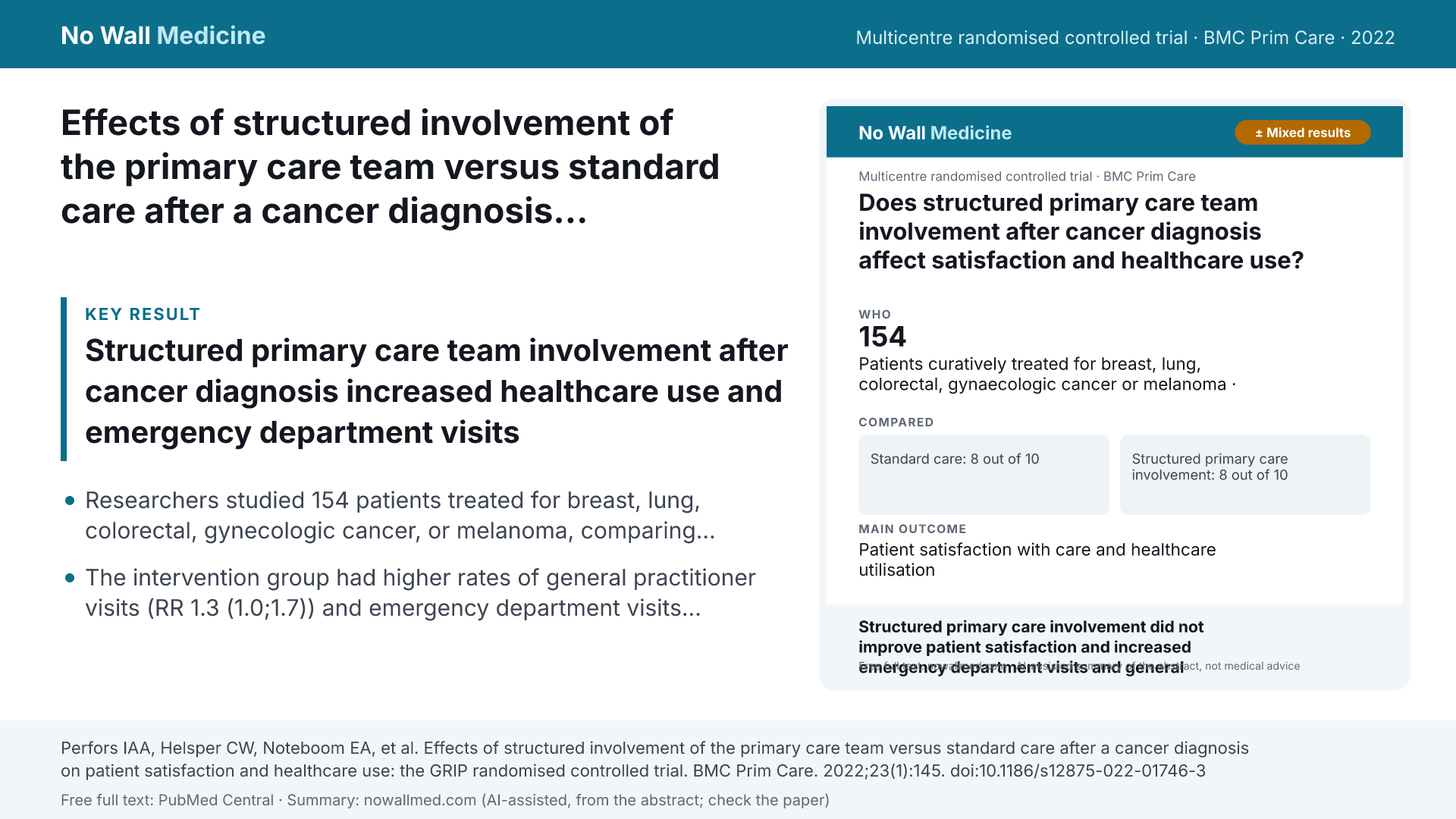
Structured primary care team involvement after cancer diagnosis increased healthcare use and emergency department visits
Effects of structured involvement of the primary care team versus standard care after a cancer diagnosis on patient satisfaction and healthcare use: the GRIP randomised controlled trial
Multicentre randomised controlled trialMixed results
Does structured primary care team involvement after cancer diagnosis affect satisfaction and healthcare use?
Who
154
Patients curatively treated for breast, lung, colorectal, gynaecologic cancer or melanoma · Multicentre
Compared
Standard care: 8 out of 10
Structured primary care involvement: 8 out of 10
Main outcome
Patient satisfaction with care and healthcare utilisation
Bottom line: Structured primary care involvement did not improve patient satisfaction and increased emergency department visits and general practitioner visits.
BMC Prim Care · 2022-06-04 · Save PNG
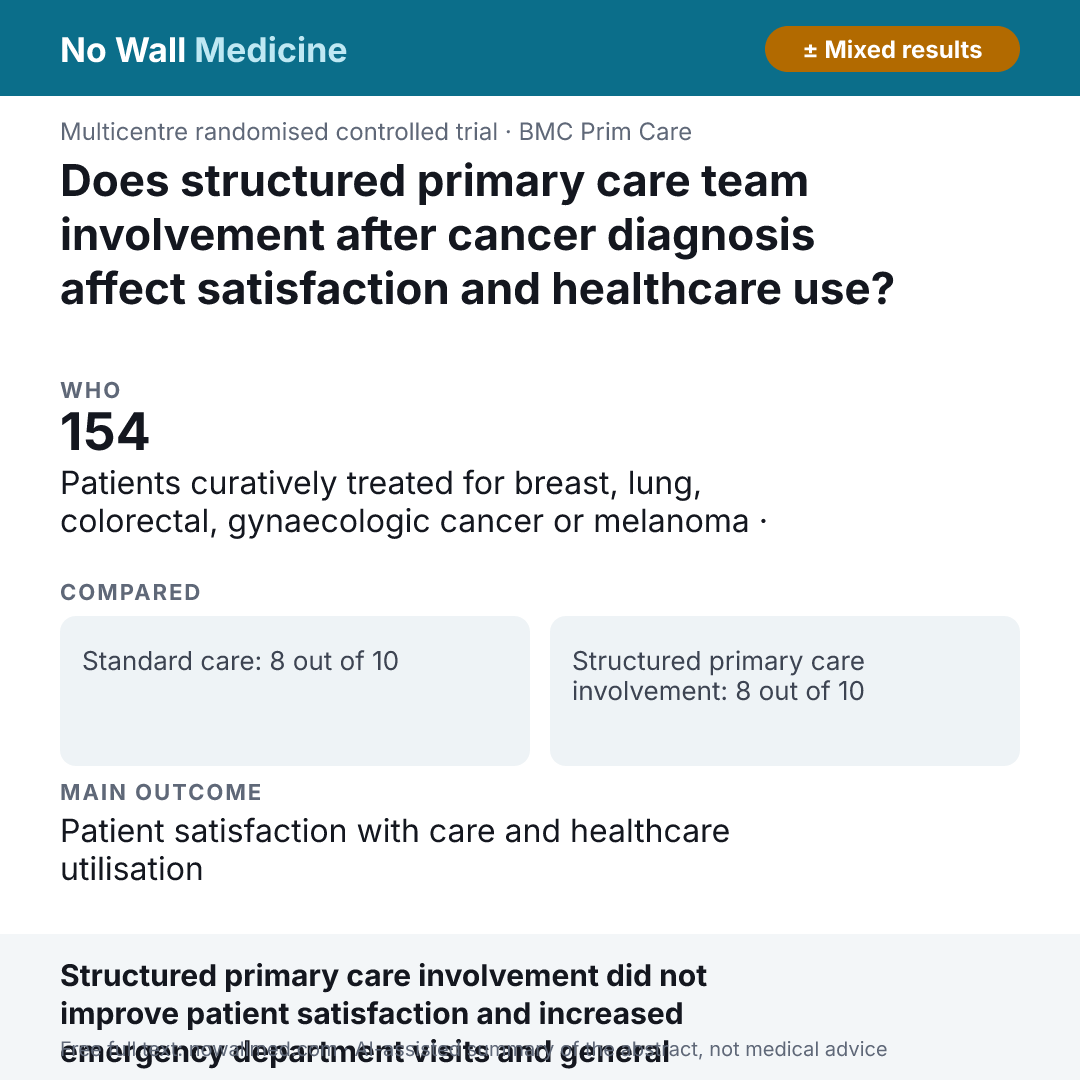
Clinical question: Does structured primary care team involvement after cancer diagnosis affect satisfaction and healthcare use?
Key points
- Researchers studied 154 patients treated for breast, lung, colorectal, gynecologic cancer, or melanoma, comparing standard care to structured follow-up by a general practitioner and oncology nurse.
- The intervention group had higher rates of general practitioner visits (RR 1.3 (1.0;1.7)) and emergency department visits (RR 1.70 (1.0;2.8)) compared to the control group.
- Patient satisfaction with care remained high at 8 out of 10 in both groups, though general practitioner satisfaction was lower in the intervention group on three subscales.
Headline and key points written with AI from the paper’s abstract, with every number checked against it. Read the paper before relying on them.
Was this summary helpful?
Subject terms
Headline, design, result, key points, caveat and citation as plain text.
Cite this article
Perfors IAA, Helsper CW, Noteboom EA, et al. Effects of structured involvement of the primary care team versus standard care after a cancer diagnosis on patient satisfaction and healthcare use: the GRIP randomised controlled trial. BMC Prim Care. 2022;23(1):145. doi:10.1186/s12875-022-01746-3
Spotted a mistake? Suggest a correction