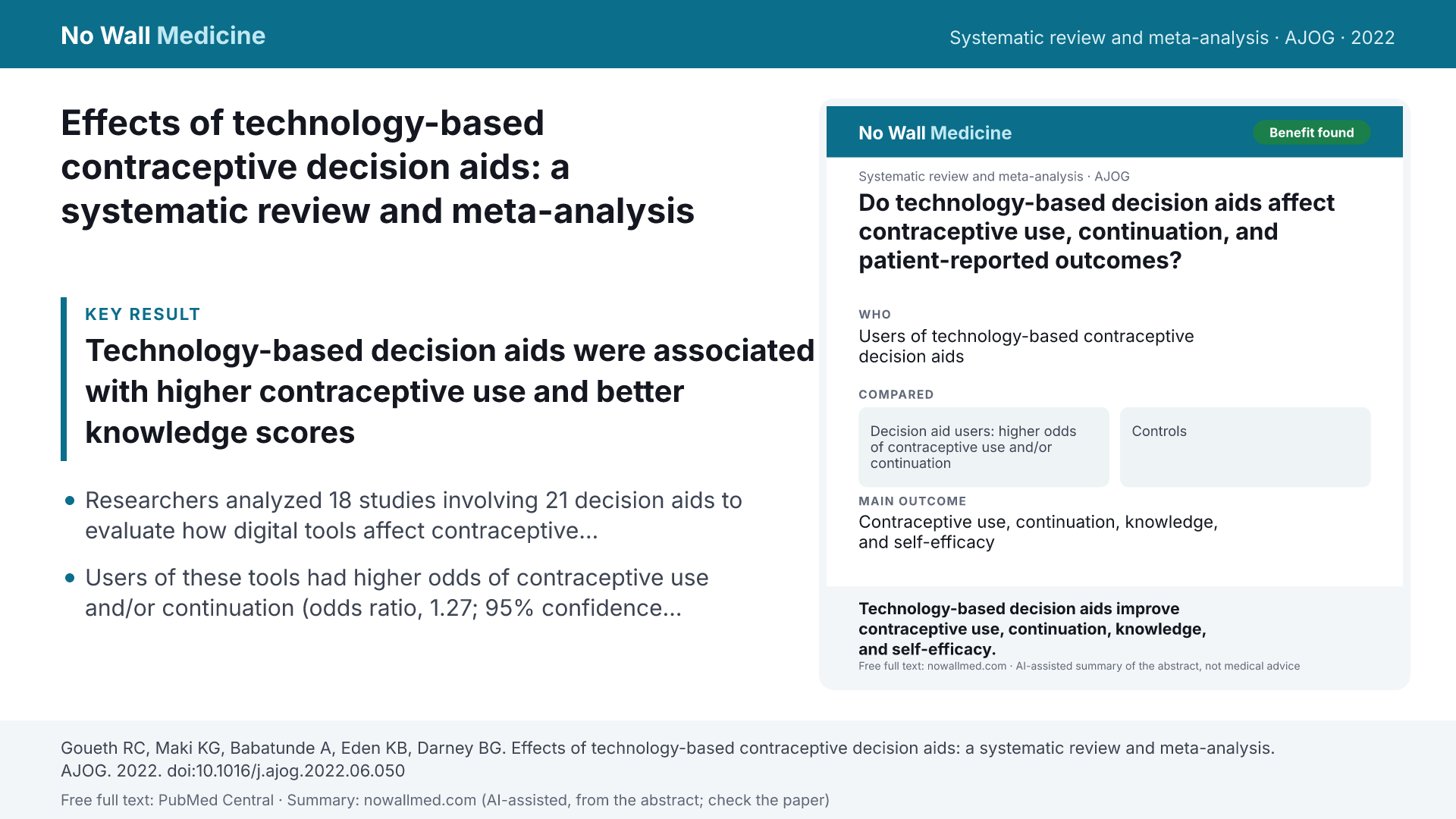
Technology-based decision aids were associated with higher contraceptive use and better knowledge scores
Effects of technology-based contraceptive decision aids: a systematic review and meta-analysis
Systematic review and meta-analysisBenefit found
Do technology-based decision aids affect contraceptive use, continuation, and patient-reported outcomes?
Who
Users of technology-based contraceptive decision aids
Compared
Decision aid users: higher odds of contraceptive use and/or continuation
Controls
Main outcome
Contraceptive use, continuation, knowledge, and self-efficacy
Result: odds ratio 1.27 (95% confidence interval, [1.05-1.55])
Bottom line: Technology-based decision aids improve contraceptive use, continuation, knowledge, and self-efficacy.
AJOG · 2022-06-30Download image
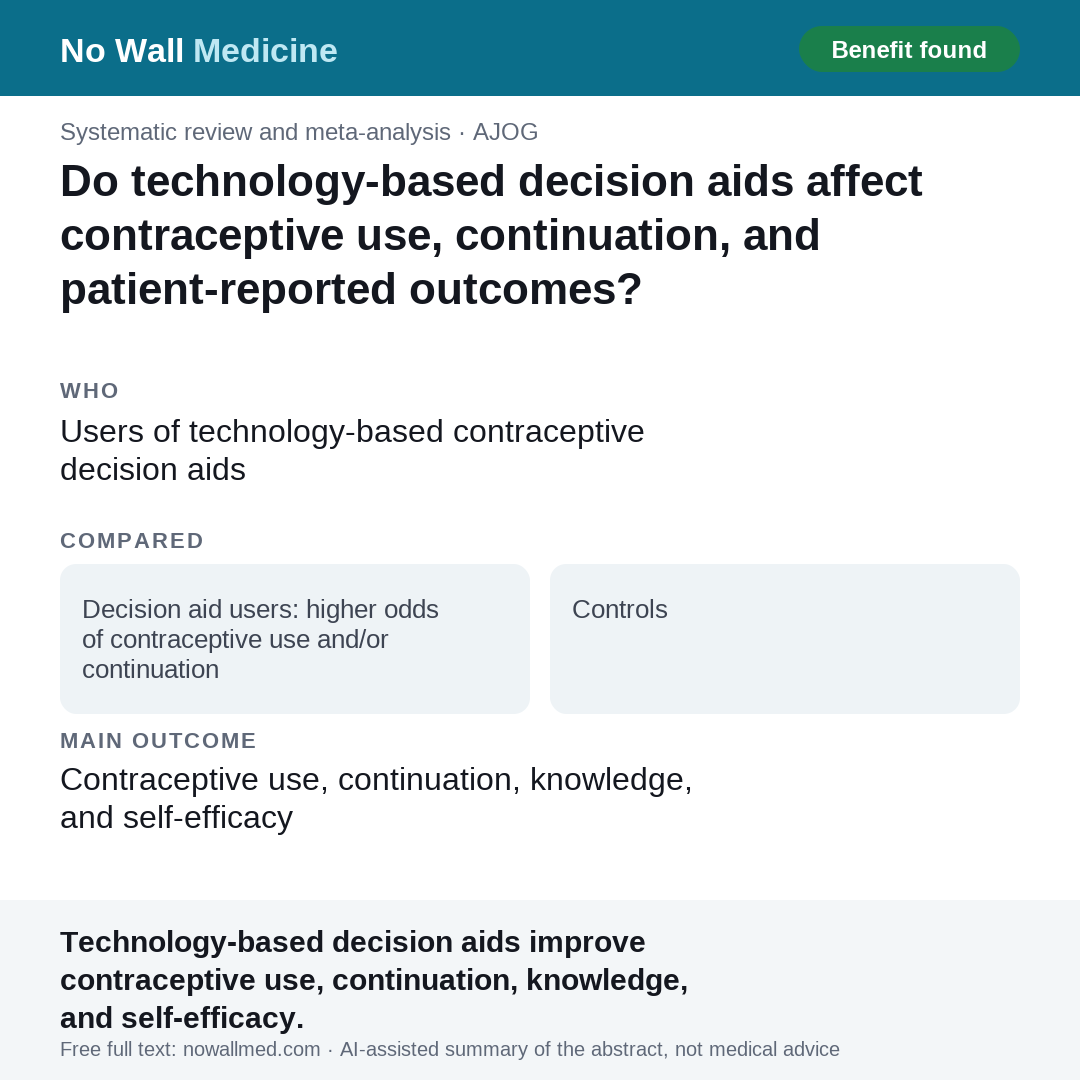
Clinical question: Do technology-based decision aids affect contraceptive use, continuation, and patient-reported outcomes?
Why it matters: It was unknown how digital tools like mobile apps or websites affect contraceptive use, continuation, and patient decision-making outcomes.
Key points
- Researchers analyzed 18 studies involving 21 decision aids to evaluate how digital tools affect contraceptive use, continuation, and patient knowledge.
- Users of these tools had higher odds of contraceptive use and/or continuation (odds ratio, 1.27; 95% confidence interval, [1.05-1.55]) compared to controls.
- Decision aid users also showed higher self-efficacy scores (mean difference, 0.09; 95% confidence interval, [0.05-0.13]) and knowledge scores (mean difference, 0.04; 95% confidence interval, [0.01-0.07]).
Headline and key points written with AI from the paper’s abstract, with every number checked against it. Read the paper before relying on them.
Was this summary helpful?
Subject terms
Cite this article
Goueth RC, Maki KG, Babatunde A, Eden KB, Darney BG. Effects of technology-based contraceptive decision aids: a systematic review and meta-analysis. AJOG. 2022. doi:10.1016/j.ajog.2022.06.050
Spotted a mistake? Suggest a correction