Effects of the short stitch technique for midline abdominal closure on incisional hernia (ESTOIH): randomized clinical trial
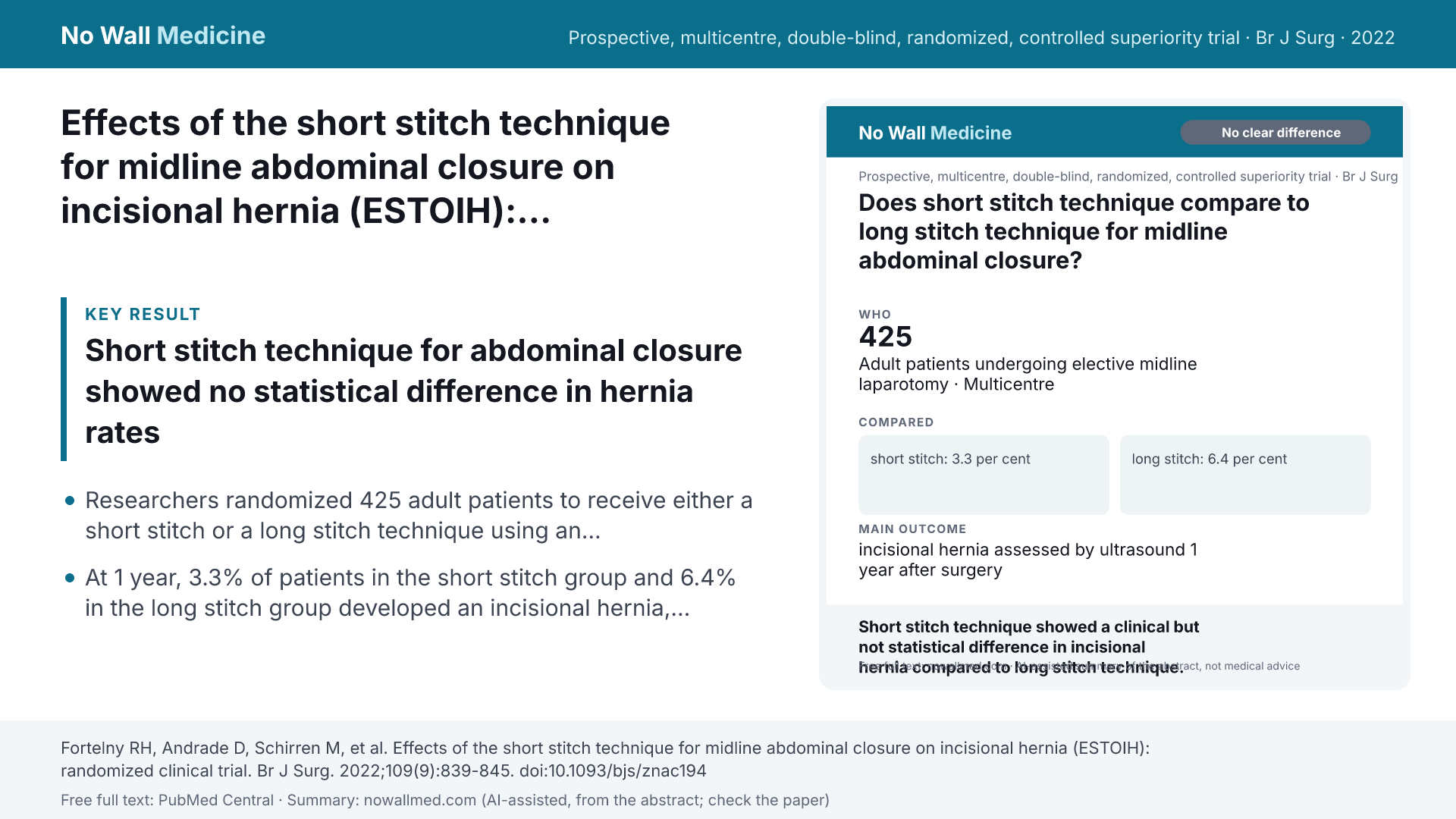
Key result: Short stitch technique for abdominal closure showed no statistical difference in hernia rates
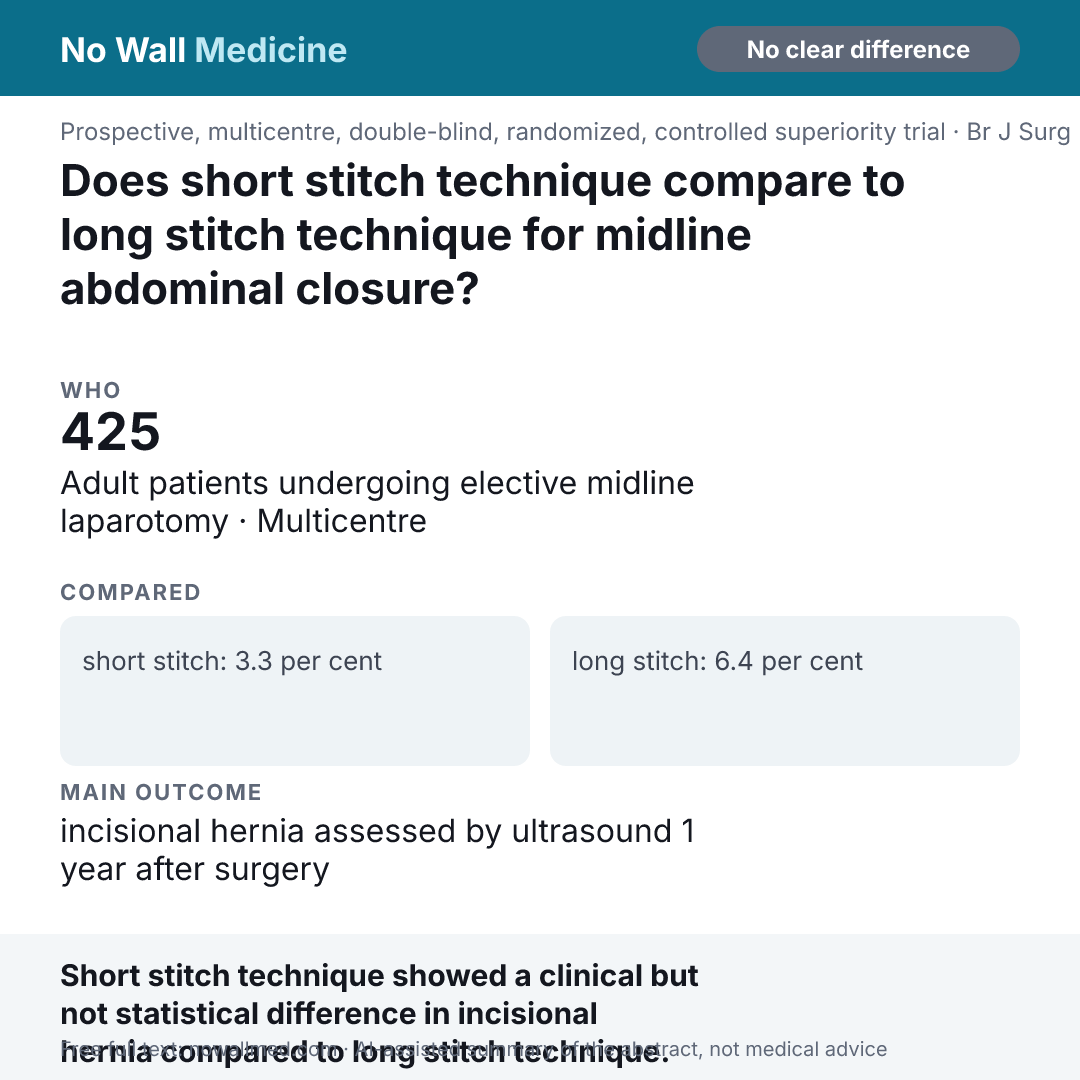
Prospective, multicentre, double-blind, randomized, controlled superiority trialNo clear difference
Does short stitch technique compare to long stitch technique for midline abdominal closure?
Who
425
Adult patients undergoing elective midline laparotomy · Multicentre
Compared
short stitch: 3.3 per cent
long stitch: 6.4 per cent
Main outcome
incisional hernia assessed by ultrasound 1 year after surgery
Result: odds ratio 1.97, 95 per cent confidence interval 0.77 to 5.05
Bottom line: Short stitch technique showed a clinical but not statistical difference in incisional hernia compared to long stitch technique.
Br J Surg · 2022-06-17 · Save PNG
Key points
- Researchers randomized 425 adult patients to receive either a short stitch or a long stitch technique using an absorbent elastic suture for midline abdominal closure.
- At 1 year, 3.3% of patients in the short stitch group and 6.4% in the long stitch group developed an incisional hernia, which was not a statistically significant difference.
- The short stitch group used more stitches (46 versus 25) and had a higher suture-to-wound length ratio (5.3 versus 4.0) than the long stitch group.
Discussion prompts
- Would these patients look like yours? Who was left out?
- Is the main outcome one that matters to patients?
- Is the difference large enough to change what you do?
Cite: Fortelny RH, Andrade D, Schirren M, et al. Effects of the short stitch technique for midline abdominal closure on incisional hernia (ESTOIH): randomized clinical trial. Br J Surg. 2022;109(9):839-845. doi:10.1093/bjs/znac194
Free full text: PubMed Central · Summary and visual abstract: nowallmed.com/a/effects-of-the-short-stitch-technique-for-midline-abdominal-closure-ajkpt4/ (AI-assisted from the abstract; check the paper before relying on it).