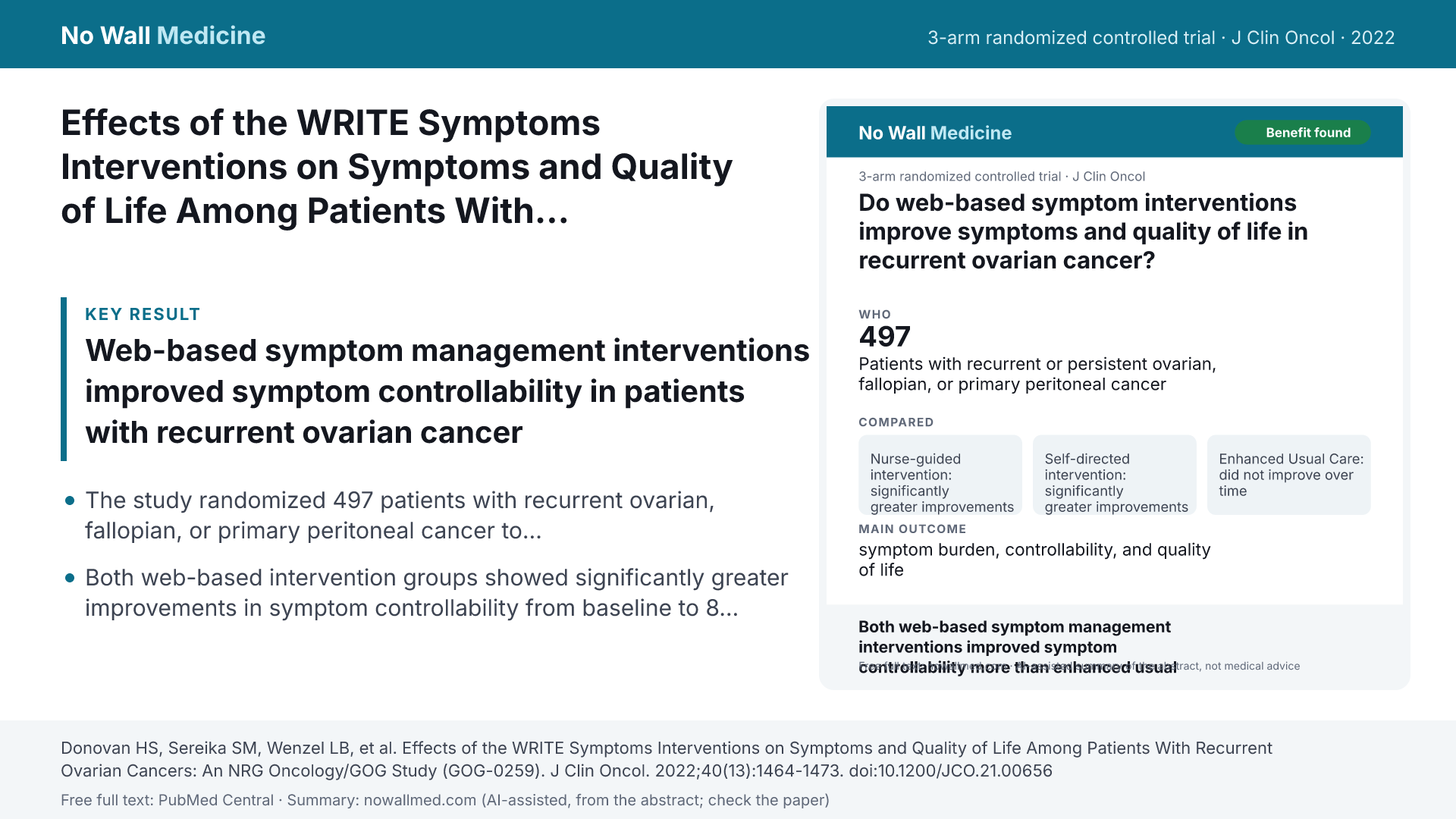
Web-based symptom management interventions improved symptom controllability in patients with recurrent ovarian cancer
Effects of the WRITE Symptoms Interventions on Symptoms and Quality of Life Among Patients With Recurrent Ovarian Cancers: An NRG Oncology/GOG Study (GOG-0259)
3-arm randomized controlled trialBenefit found
Do web-based symptom interventions improve symptoms and quality of life in recurrent ovarian cancer?
Who
497
Patients with recurrent or persistent ovarian, fallopian, or primary peritoneal cancer
Compared
Nurse-guided intervention: significantly greater improvements in symptom controllability
Self-directed intervention: significantly greater improvements in symptom controllability
Enhanced Usual Care: did not improve over time
Main outcome
symptom burden, controllability, and quality of life
Bottom line: Both web-based symptom management interventions improved symptom controllability more than enhanced usual care in patients with recurrent ovarian cancer.
J Clin Oncol · 2022-02-07Download image
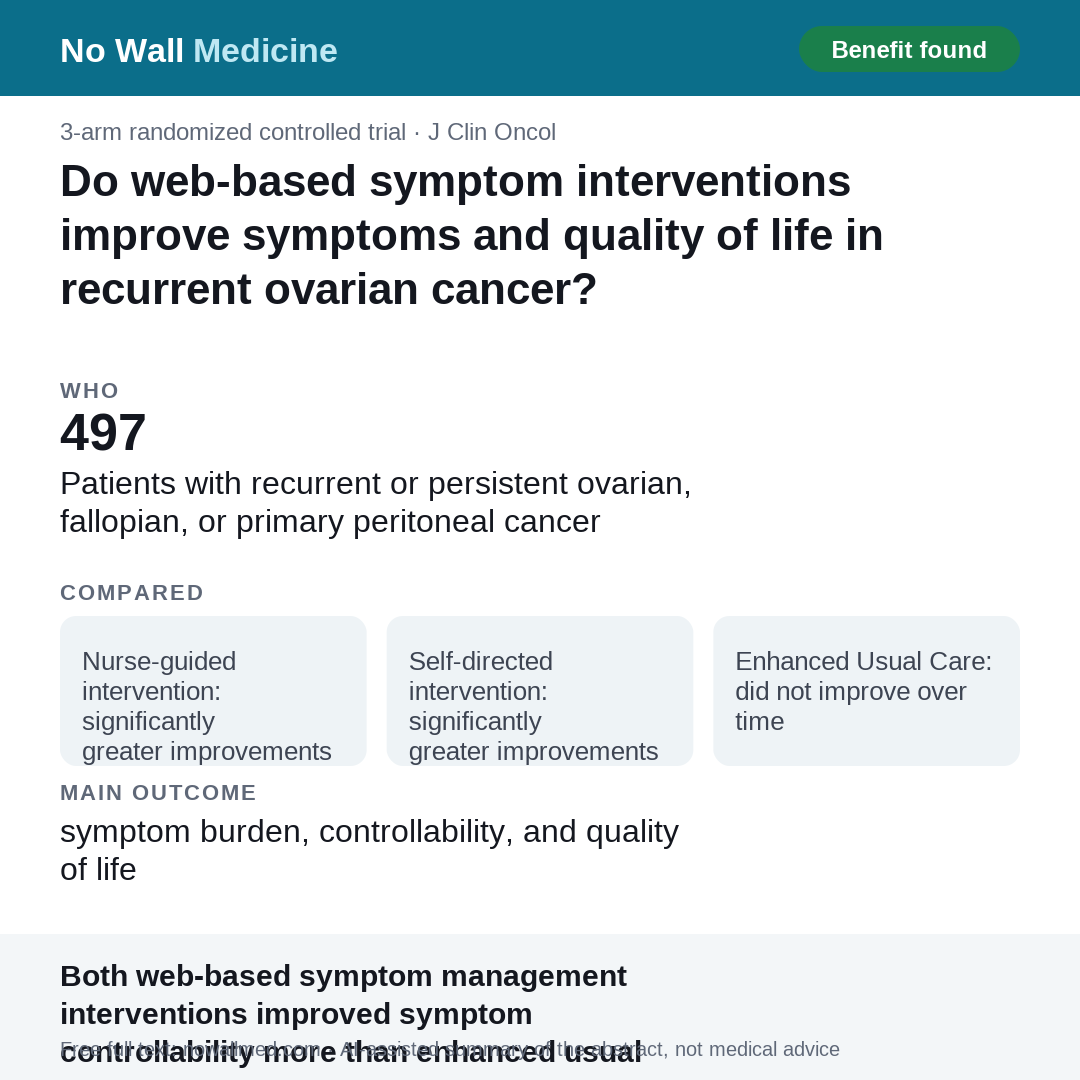
Clinical question: Do web-based symptom interventions improve symptoms and quality of life in recurrent ovarian cancer?
Why it matters: It was unknown if web-based symptom management interventions could improve symptom burden, controllability, and quality of life compared to enhanced usual care.
Key points
- The study randomized 497 patients with recurrent ovarian, fallopian, or primary peritoneal cancer to receive nurse-guided, self-directed, or enhanced usual care.
- Both web-based intervention groups showed significantly greater improvements in symptom controllability from baseline to 8 and 12 weeks compared to enhanced usual care.
- There were no significant differences in results between the nurse-guided intervention and the self-directed intervention.
Headline and key points written with AI from the paper’s abstract, with every number checked against it. Read the paper before relying on them.
Was this summary helpful?
Subject terms
Cite this article
Donovan HS, Sereika SM, Wenzel LB, et al. Effects of the WRITE Symptoms Interventions on Symptoms and Quality of Life Among Patients With Recurrent Ovarian Cancers: An NRG Oncology/GOG Study (GOG-0259). J Clin Oncol. 2022. doi:10.1200/JCO.21.00656
Spotted a mistake? Suggest a correction