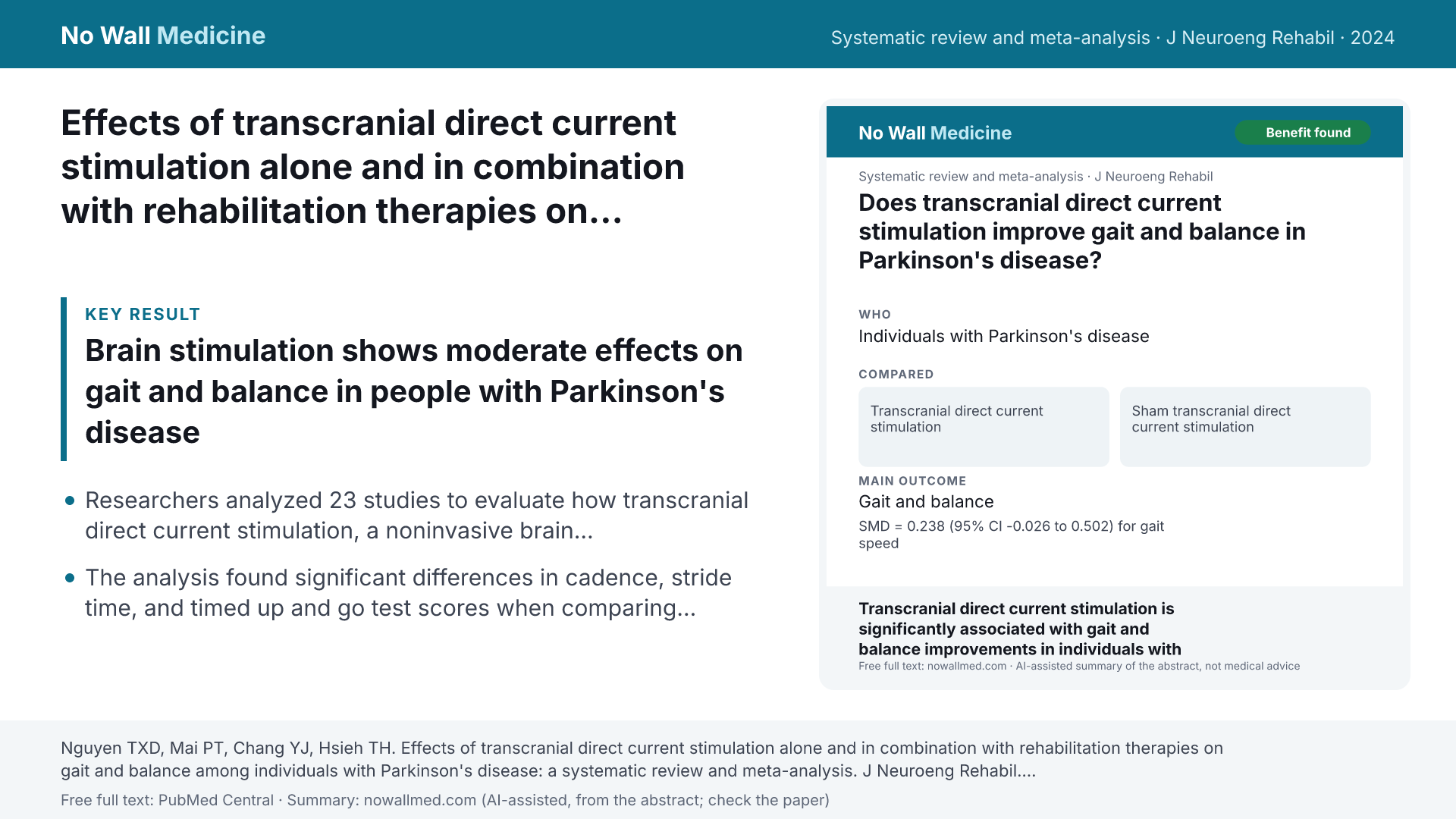
Brain stimulation shows moderate effects on gait and balance in people with Parkinson's disease
Effects of transcranial direct current stimulation alone and in combination with rehabilitation therapies on gait and balance among individuals with Parkinson's disease: a systematic review and meta-analysis
Systematic review and meta-analysisBenefit found
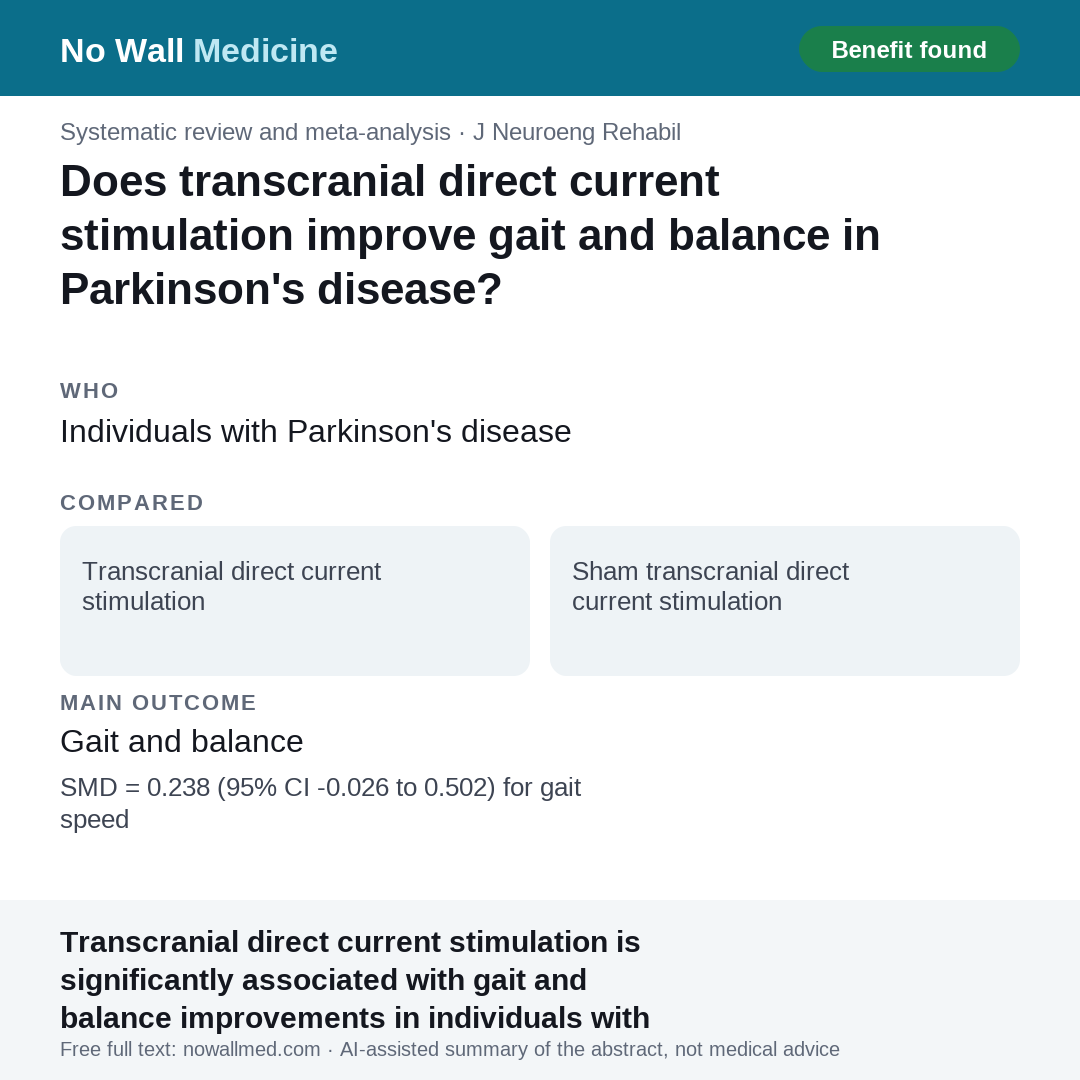
Does transcranial direct current stimulation improve gait and balance in Parkinson's disease?
Who
Individuals with Parkinson's disease
Compared
Transcranial direct current stimulation
Sham transcranial direct current stimulation
Main outcome
Gait and balance
Result: SMD = 0.238 (95% CI -0.026 to 0.502) for gait speed
Bottom line: Transcranial direct current stimulation is significantly associated with gait and balance improvements in individuals with Parkinson's disease.
J Neuroeng Rehabil · 2024-02-19Download image
Clinical question: Does transcranial direct current stimulation improve gait and balance in Parkinson's disease?
Why it matters: It was unknown if transcranial direct current stimulation alone or combined with rehabilitation therapies effectively influences gait and balance in Parkinson's disease.
Key points
- Researchers analyzed 23 studies to evaluate how transcranial direct current stimulation, a noninvasive brain stimulation, affects walking and balance in individuals with Parkinson's disease.
- The analysis found significant differences in cadence, stride time, and timed up and go test scores when comparing real versus sham brain stimulation.
- When combined with other therapies, real brain stimulation significantly differed from sham stimulation in cadence and Berg balance scale scores.
Headline and key points written with AI from the paper’s abstract, with every number checked against it. Read the paper before relying on them.
Was this summary helpful?
Subject terms
Cite this article
Nguyen TXD, Mai PT, Chang YJ, Hsieh TH. Effects of transcranial direct current stimulation alone and in combination with rehabilitation therapies on gait and balance among individuals with Parkinson's disease: a systematic review and meta-analysis. J Neuroeng Rehabil. 2024. doi:10.1186/s12984-024-01311-2
Spotted a mistake? Suggest a correction
Top studies every Monday
The week’s key trials and guidelines in your specialties, plus any topics you follow. By email, free.
Get the weekly digest