Effects of transcranial direct current stimulation on cough reflex and urge-to-cough in healthy young adults
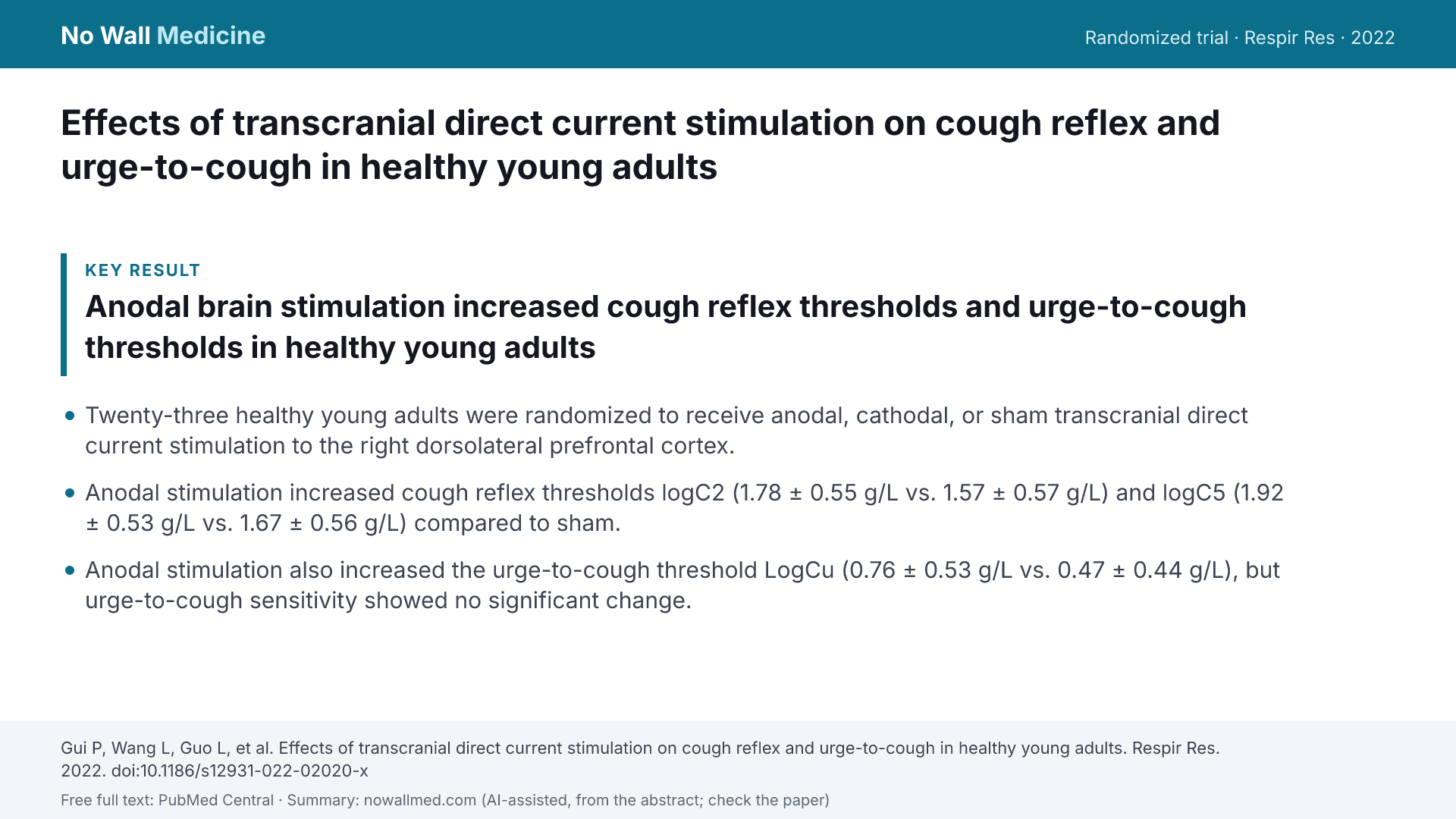
Key result: Anodal brain stimulation increased cough reflex thresholds and urge-to-cough thresholds in healthy young adults
Key points
- Twenty-three healthy young adults were randomized to receive anodal, cathodal, or sham transcranial direct current stimulation to the right dorsolateral prefrontal cortex.
- Anodal stimulation increased cough reflex thresholds logC2 (1.78 ± 0.55 g/L vs. 1.57 ± 0.57 g/L) and logC5 (1.92 ± 0.53 g/L vs. 1.67 ± 0.56 g/L) compared to sham.
- Anodal stimulation also increased the urge-to-cough threshold LogCu (0.76 ± 0.53 g/L vs. 0.47 ± 0.44 g/L), but urge-to-cough sensitivity showed no significant change.
Why it matters: Existing medical treatments for chronic cough often have poor curative effects and serious side effects, leaving the role of the right dorsolateral prefrontal cortex in cough inhibition unknown.
Discussion prompts
- Would these patients look like yours? Who was left out?
- Is the main outcome one that matters to patients?
- Is the difference large enough to change what you do?
Cite: Gui P, Wang L, Guo L, et al. Effects of transcranial direct current stimulation on cough reflex and urge-to-cough in healthy young adults. Respir Res. 2022. doi:10.1186/s12931-022-02020-x
Free full text: PubMed Central · Summary and visual abstract: nowallmed.com/a/effects-of-transcranial-direct-current-stimulation-on-cough-reflex-osc0i7/ (AI-assisted from the abstract; check the paper before relying on it).