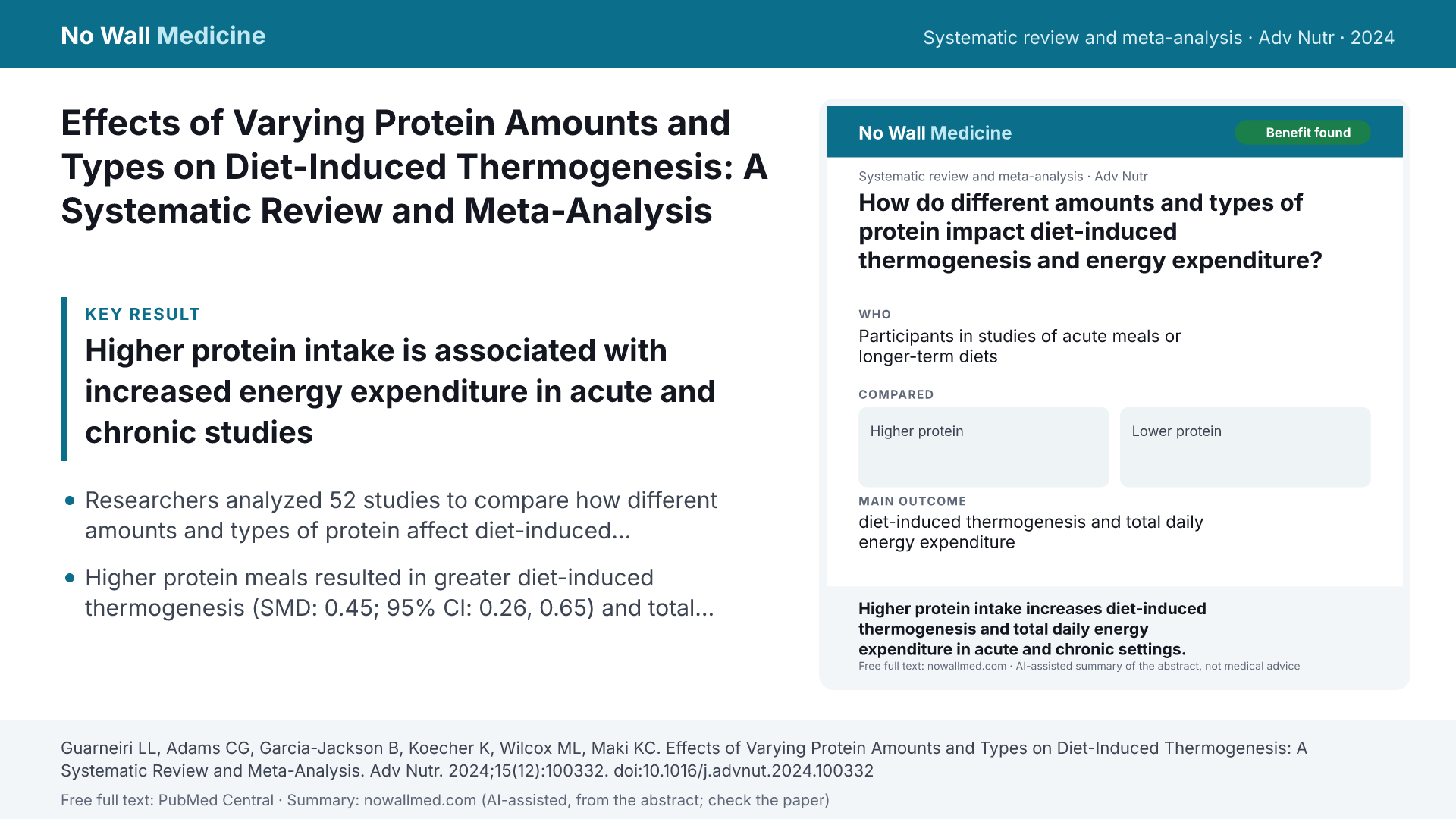
Higher protein intake is associated with increased energy expenditure in acute and chronic studies
Effects of Varying Protein Amounts and Types on Diet-Induced Thermogenesis: A Systematic Review and Meta-Analysis
Systematic review and meta-analysisBenefit found
How do different amounts and types of protein impact diet-induced thermogenesis and energy expenditure?
Who
Participants in studies of acute meals or longer-term diets
Compared
Higher protein
Lower protein
Main outcome
diet-induced thermogenesis and total daily energy expenditure
Result: SMD 0.45 (95% CI 0.26, 0.65) for acute diet-induced thermogenesis
Bottom line: Higher protein intake increases diet-induced thermogenesis and total daily energy expenditure in acute and chronic settings.
Adv Nutr · 2024-10-31 · Save PNG
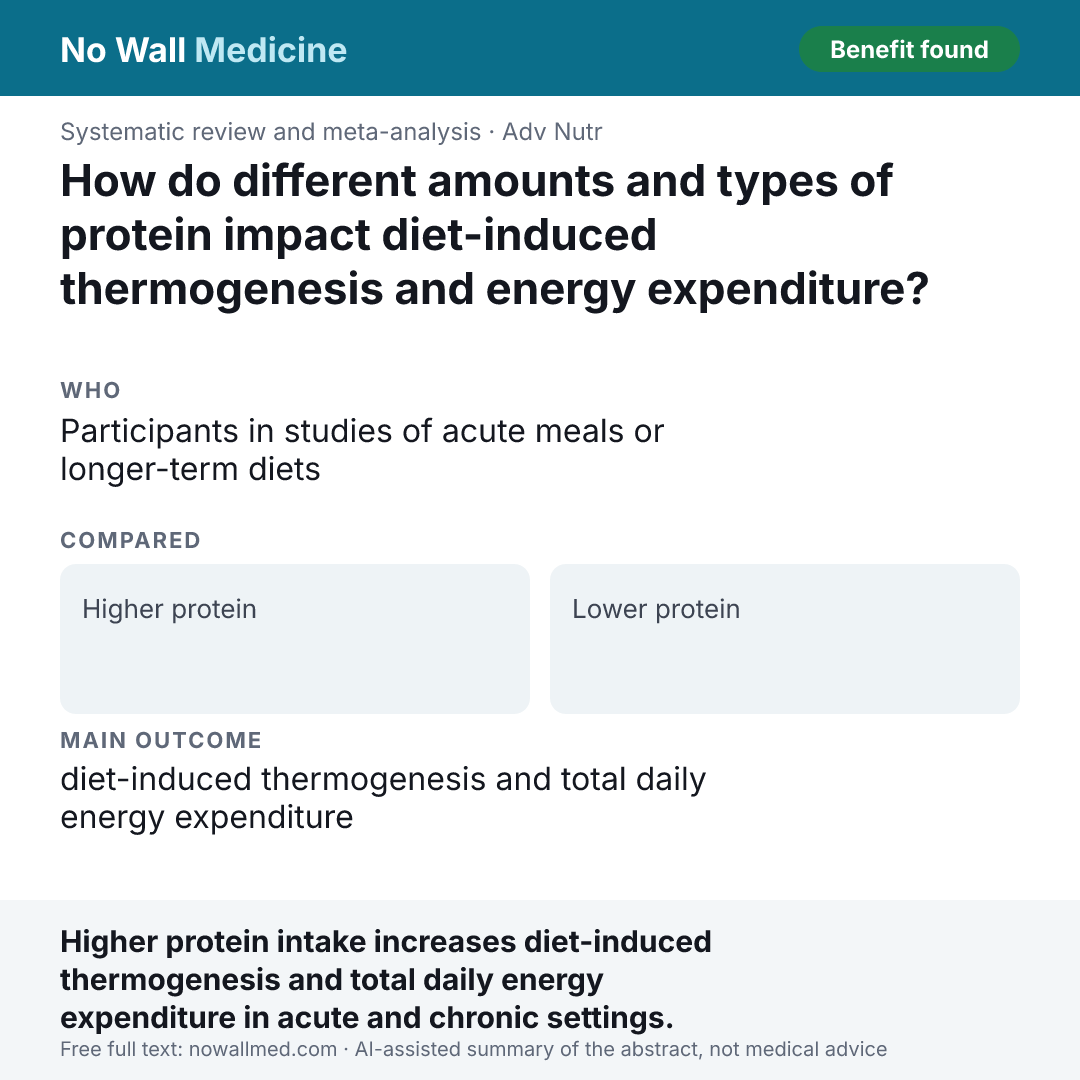
Clinical question: How do different amounts and types of protein impact diet-induced thermogenesis and energy expenditure?
Key points
- Researchers analyzed 52 studies to compare how different amounts and types of protein affect diet-induced thermogenesis, which is the energy used to digest food, and total daily energy expenditure.
- Higher protein meals resulted in greater diet-induced thermogenesis (SMD: 0.45; 95% CI: 0.26, 0.65) and total daily energy expenditure (SMD: 0.52; 95% CI: 0.30, 0.73) compared to lower protein meals.
- In chronic studies lasting 4 d to 1 y, higher protein diets were associated with greater total daily energy expenditure (SMD: 0.29; 95% CI: 0.10, 0.48) and resting energy expenditure (SMD: 0.18; 95% CI: 0.01, 0.35).
Headline and key points written with AI from the paper’s abstract, with every number checked against it. Read the paper before relying on them.
Was this summary helpful?
Subject terms
Headline, design, result, key points, caveat and citation as plain text.
Cite this article
Guarneiri LL, Adams CG, Garcia-Jackson B, Koecher K, Wilcox ML, Maki KC. Effects of Varying Protein Amounts and Types on Diet-Induced Thermogenesis: A Systematic Review and Meta-Analysis. Adv Nutr. 2024;15(12):100332. doi:10.1016/j.advnut.2024.100332
Spotted a mistake? Suggest a correction