Visual abstractsVisuals
Meta-analysisJournal of Medical Internet Research · Jul 23, 2026

Virtual reality physical exercise may improve executive function and motor performance in youth with autism

Effects of Virtual Reality-Based Physical Exercise Interventions on Behavioral, Executive Function, and Motor Outcomes in Children and Adolescents With Autism Spectrum Disorder: Systematic Review and Meta-Analysis

Jia Y, Qi K, Cai K, Mao Y, Guo H, Wang Q, et al
Digital Health & AIPediatric
Systematic review and meta-analysisMixed results
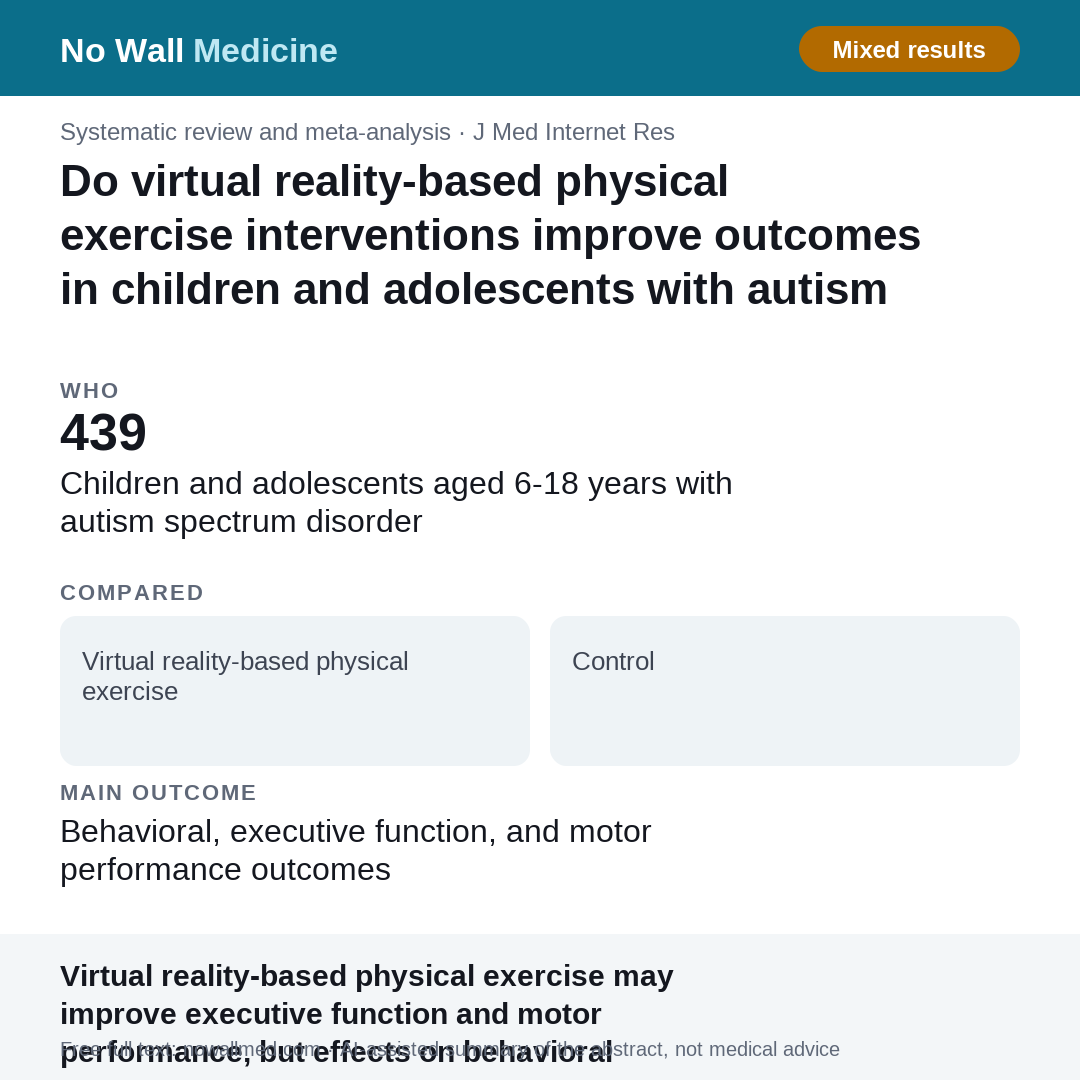
Do virtual reality-based physical exercise interventions improve outcomes in children and adolescents with autism spectrum disorder?
Who
439
Children and adolescents aged 6-18 years with autism spectrum disorder
Compared
Virtual reality-based physical exercise
Control
Main outcome
Behavioral, executive function, and motor performance outcomes
Result: executive function SMD 0.75 (95% CI 0.32-1.18); motor performance SMD 1.08 (95% CI 0.08-2.08)
Bottom line: Virtual reality-based physical exercise may improve executive function and motor performance, but effects on behavioral outcomes remain inconsistent.
Limitation: Substantial heterogeneity in study designs, assessment instruments, and wide prediction intervals suggest uncertainty.
J Med Internet Res · 2026-07-23Download image

Clinical question: Do virtual reality-based physical exercise interventions improve outcomes in children and adolescents with autism spectrum disorder?

Why it matters: Evidence regarding the multidimensional effects of virtual reality-based physical exercise on behavior, executive function, and motor performance in children with autism remains limited.

Key points

Limitation the authors note: The authors note substantial heterogeneity in study designs and assessment instruments, as well as a need for larger sample sizes and long-term follow-up.

Headline and key points written with AI from the paper’s abstract, with every number checked against it. Read the paper before relying on them.

Read the full paper free at PubMed Central ↗

Topics

Humans; Child; Adolescent; Autism Spectrum Disorder; Executive Function; Virtual Reality; Exercise Therapy; Exercise

DOI: 10.2196/98579 · PubMed: 42490572

Spotted a mistake? Suggest a correction

More in Digital Health & AI

ResearchLancet Digit Health · Nov 23, 2026 · Digital Health & AI

ClinicalAge biomarker associated with mortality and disease risk in UK datasets

ClinicalAge, a framework for modelling ageing trajectories from longitudinal electronic health records in the UK: a model development and validation study

ResearchLancet Digit Health · Nov 23, 2026 · Digital Health & AI

Facial photographs used to estimate age and predict survival in cancer patients

Foundation artificial intelligence models for health recognition by use of face photographs (FAHR-Face): a model development and validation study

ResearchLancet Digit Health · Nov 23, 2026 · Digital Health & AI

New model predicts severe fetal compromise risk at birth with 33.4% sensitivity

A prognostic model for use at labour onset to estimate the risk of severe fetal compromise at birth: a retrospective, model development and validation study

ResearchNPJ Digit Med · Nov 21, 2026 · Digital Health & AI

ECG foundation models performed well on general data but less so on athletes' data

ECG foundation models for cardiovascular screening in a cohort of young competitive athletes

ResearchJ Med Internet Res · Nov 20, 2026 · Digital Health & AI

Six large language models showed similar question-answering accuracy on medical exam questions

Medical Reasoning in Large Language Models: Development and Evaluation of the MedEvalArena Benchmark