Web-based mindfulness interventions were associated with lower anxiety, depression, and stress in frontline health care workers
Effects of Web-Based Mindfulness-Based Interventions on Anxiety, Depression, and Stress Among Frontline Health Care Workers During the COVID-19 Pandemic: Systematic Review and Meta-Analysis
Systematic review and meta-analysis of 10 randomized controlled studiesBenefit found
Do web-based mindfulness-based interventions reduce anxiety, depression, and stress among frontline health care workers?
Who
1311
Frontline health care workers during the COVID-19 pandemic
Compared
Web-based mindfulness-based intervention
General psychological intervention or no intervention
Main outcome
Anxiety, depression, and stress symptoms
Result: anxiety SMD=-0.63 (95% CI -0.96 to -0.31), depression SMD=-0.52 (95% CI -0.77 to -0.26), stress SMD=-0.20 (95% CI -0.35 to -0.05)
Bottom line: Web-based mindfulness-based interventions may effectively reduce anxiety, depression, and stress among frontline health care workers.
Limitation: The effect is relatively mild and results had wide confidence intervals and high heterogeneity.
J Med Internet Res · 2023-08-29Download image
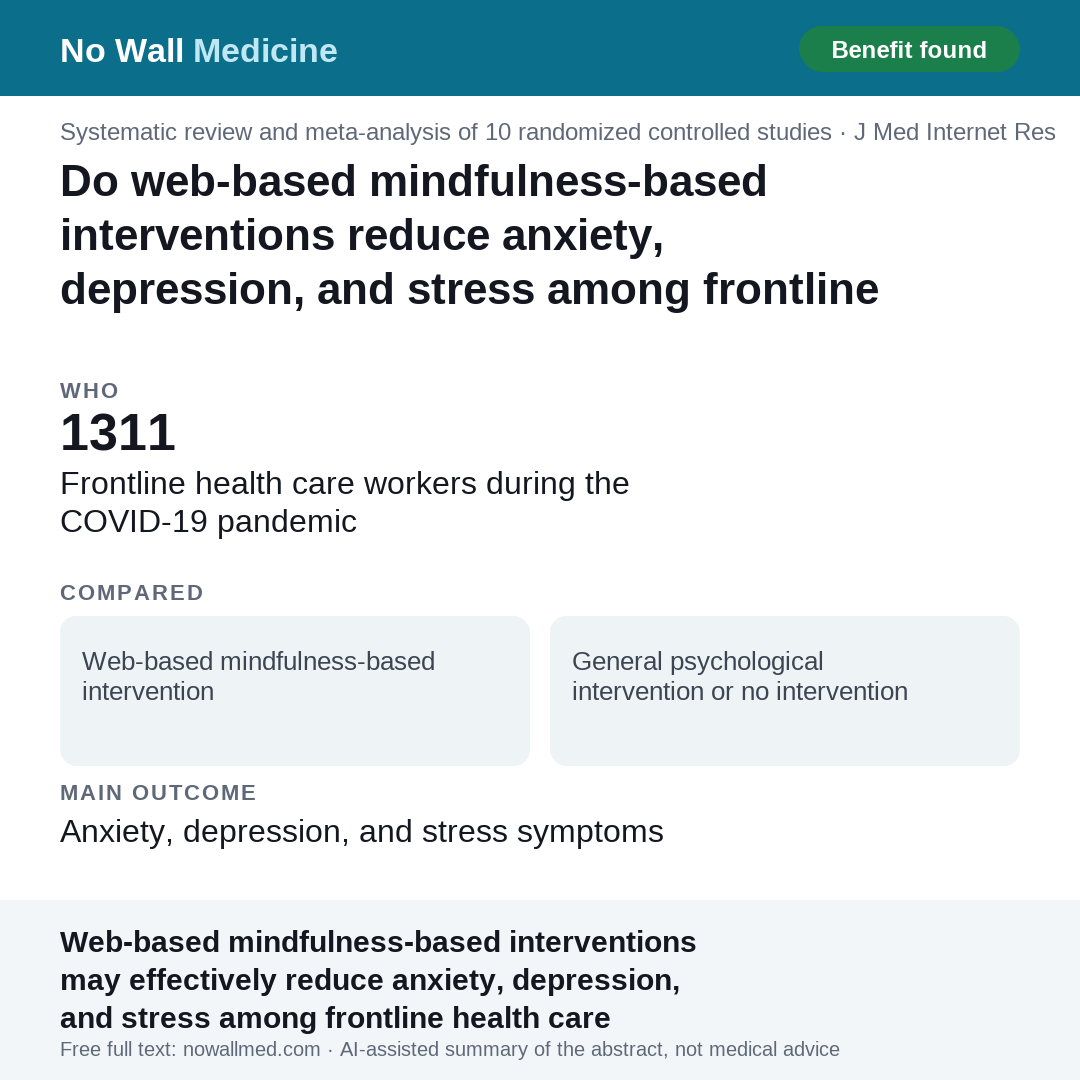
Clinical question: Do web-based mindfulness-based interventions reduce anxiety, depression, and stress among frontline health care workers?
Why it matters: It was unknown if web-based mindfulness-based interventions had a positive impact on anxiety, depression, and stress among health care workers during the COVID-19 pandemic.
Key points
- Researchers analyzed 10 randomized controlled studies involving 1311 frontline health care workers during the COVID-19 pandemic.
- Web-based mindfulness-based interventions were associated with reduced anxiety (SMD=-0.63, 95% CI -0.96 to -0.31), depression (SMD=-0.52, 95% CI -0.77 to -0.26), and stress (SMD=-0.20, 95% CI -0.35 to -0.05).
- The findings showed high heterogeneity and wide confidence intervals for these mental health outcomes.
Limitation the authors note: The results showed high heterogeneity and wide confidence intervals.
Headline and key points written with AI from the paper’s abstract, with every number checked against it. Read the paper before relying on them.
Topics
Cite this article
Yang JM, Ye H, Long Y, Zhu Q, Huang H, Zhong YB. Effects of Web-Based Mindfulness-Based Interventions on Anxiety, Depression, and Stress Among Frontline Health Care Workers During the COVID-19 Pandemic: Systematic Review and Meta-Analysis. J Med Internet Res. 2023. doi:10.2196/44000
Spotted a mistake? Suggest a correction
Top studies every Monday
The week’s key trials and guidelines in your specialties, plus any topics you follow. By email, free.
Get the weekly digest