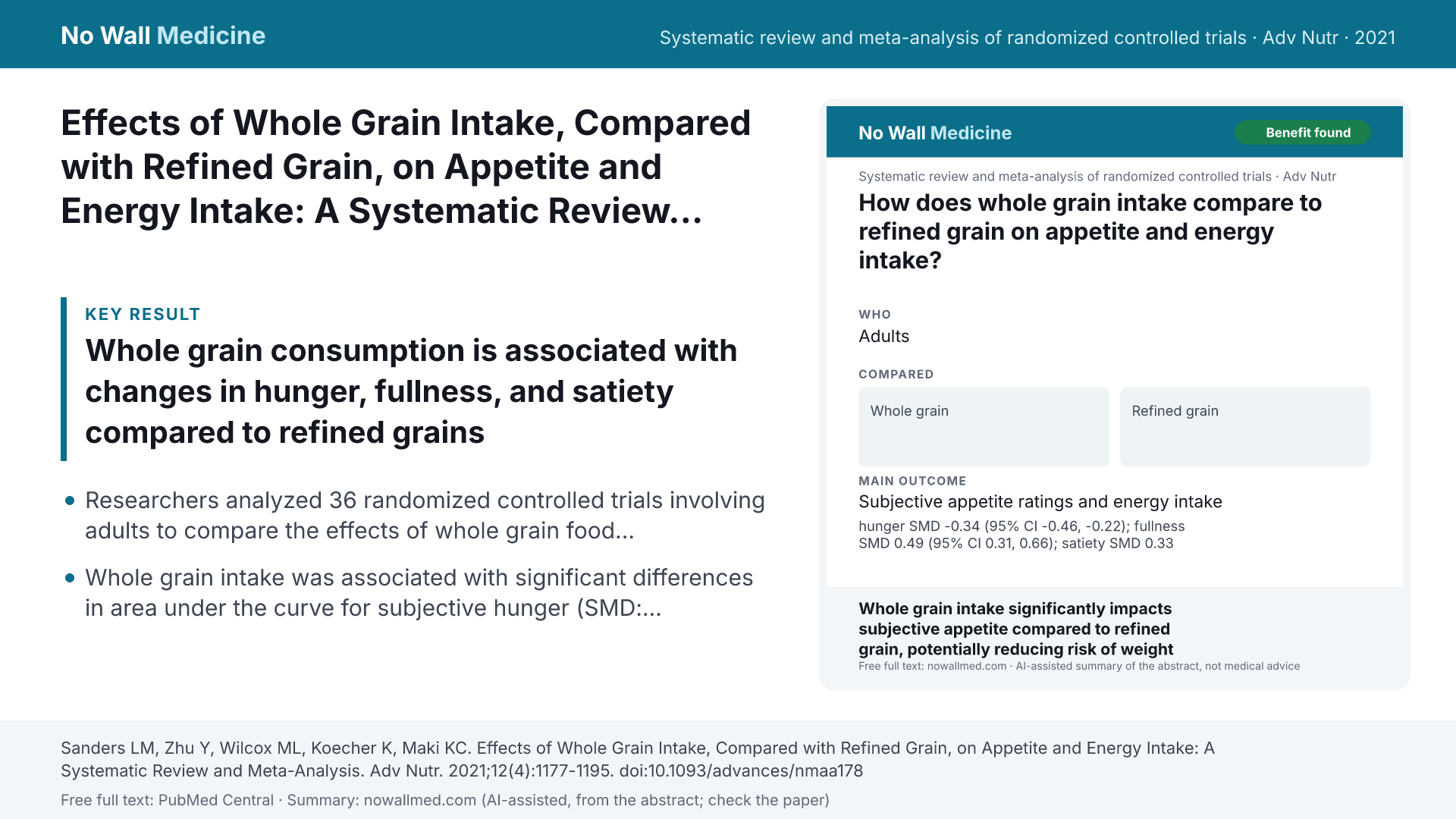
Whole grain consumption is associated with changes in hunger, fullness, and satiety compared to refined grains
Effects of Whole Grain Intake, Compared with Refined Grain, on Appetite and Energy Intake: A Systematic Review and Meta-Analysis
Systematic review and meta-analysis of randomized controlled trialsBenefit found
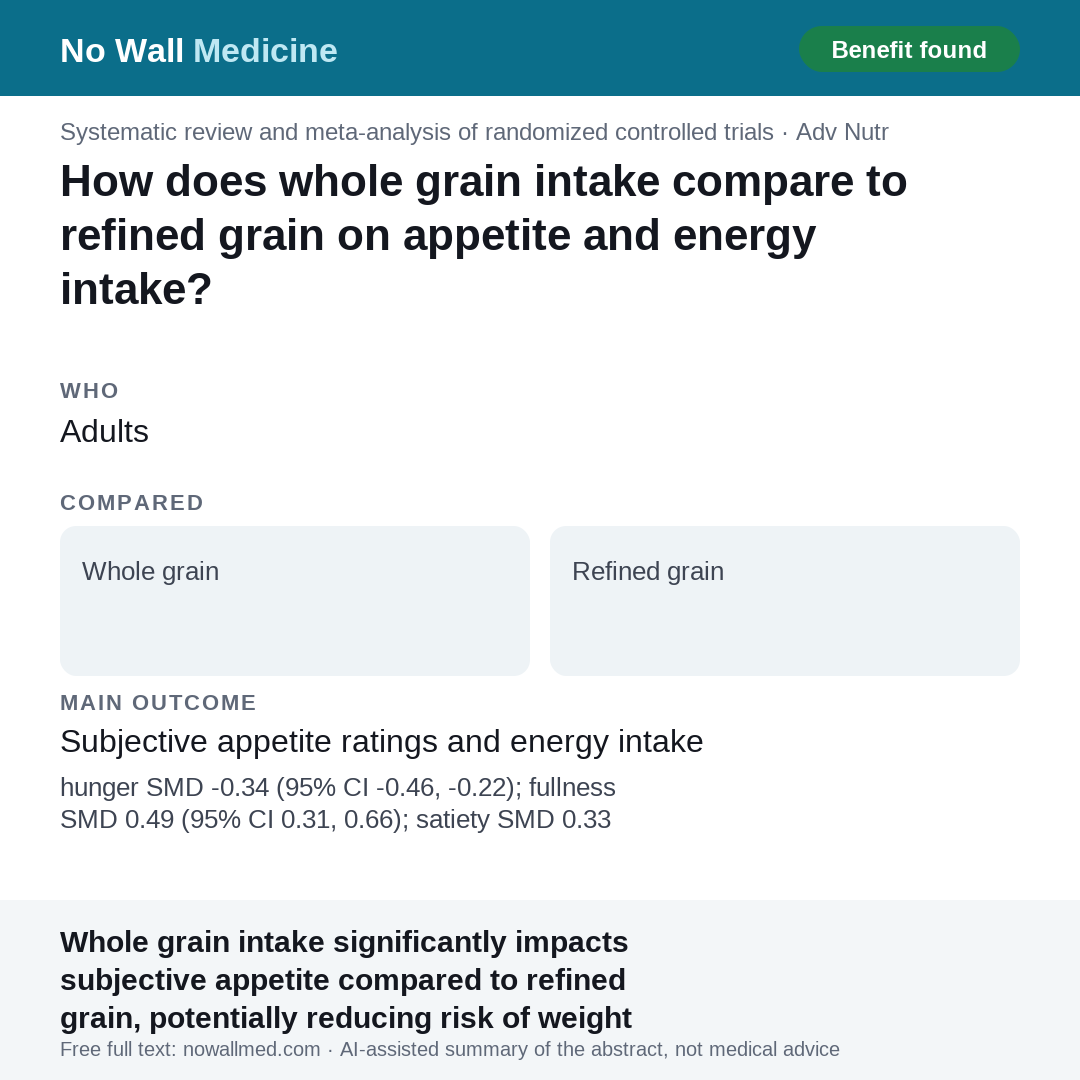
How does whole grain intake compare to refined grain on appetite and energy intake?
Who
Adults
Compared
Whole grain
Refined grain
Main outcome
Subjective appetite ratings and energy intake
Result: hunger SMD -0.34 (95% CI -0.46, -0.22); fullness SMD 0.49 (95% CI 0.31, 0.66); satiety SMD 0.33 (95% CI 0.18, 0.47); desire to eat SMD -0.33 (95% CI -0.46, -0.20)
Bottom line: Whole grain intake significantly impacts subjective appetite compared to refined grain, potentially reducing risk of weight gain.
Adv Nutr · 2021-02-03Download image
Clinical question: How does whole grain intake compare to refined grain on appetite and energy intake?
Why it matters: It is unknown how whole grain food consumption specifically impacts appetite and energy intake compared to refined grains.
Key points
- Researchers analyzed 36 randomized controlled trials involving adults to compare the effects of whole grain food consumption against refined grain controls on appetite and energy intake.
- Whole grain intake was associated with significant differences in area under the curve for subjective hunger (SMD: -0.34), fullness (SMD: 0.49), satiety (SMD: 0.33), and desire to eat (SMD: -0.33).
- There were small, nonsignificant reductions in energy intake (P = 0.07) and prospective consumption ratings (P = 0.08) with whole grain intake compared to refined grains.
Headline and key points written with AI from the paper’s abstract, with every number checked against it. Read the paper before relying on them.
Was this summary helpful?
Subject terms
Cite this article
Sanders LM, Zhu Y, Wilcox ML, Koecher K, Maki KC. Effects of Whole Grain Intake, Compared with Refined Grain, on Appetite and Energy Intake: A Systematic Review and Meta-Analysis. Adv Nutr. 2021. doi:10.1093/advances/nmaa178
Spotted a mistake? Suggest a correction