Digital self-management intervention showed no significant difference in depression, anxiety, and stress for anorexia nervosa patients
Efficacy and cost-effectiveness of a digital guided self-management intervention to support transition from intensive care to community care in anorexia nervosa (TRIANGLE): pragmatic multicentre randomised controlled trial and economic evaluation
Pragmatic multicentre randomised controlled trialNo clear difference
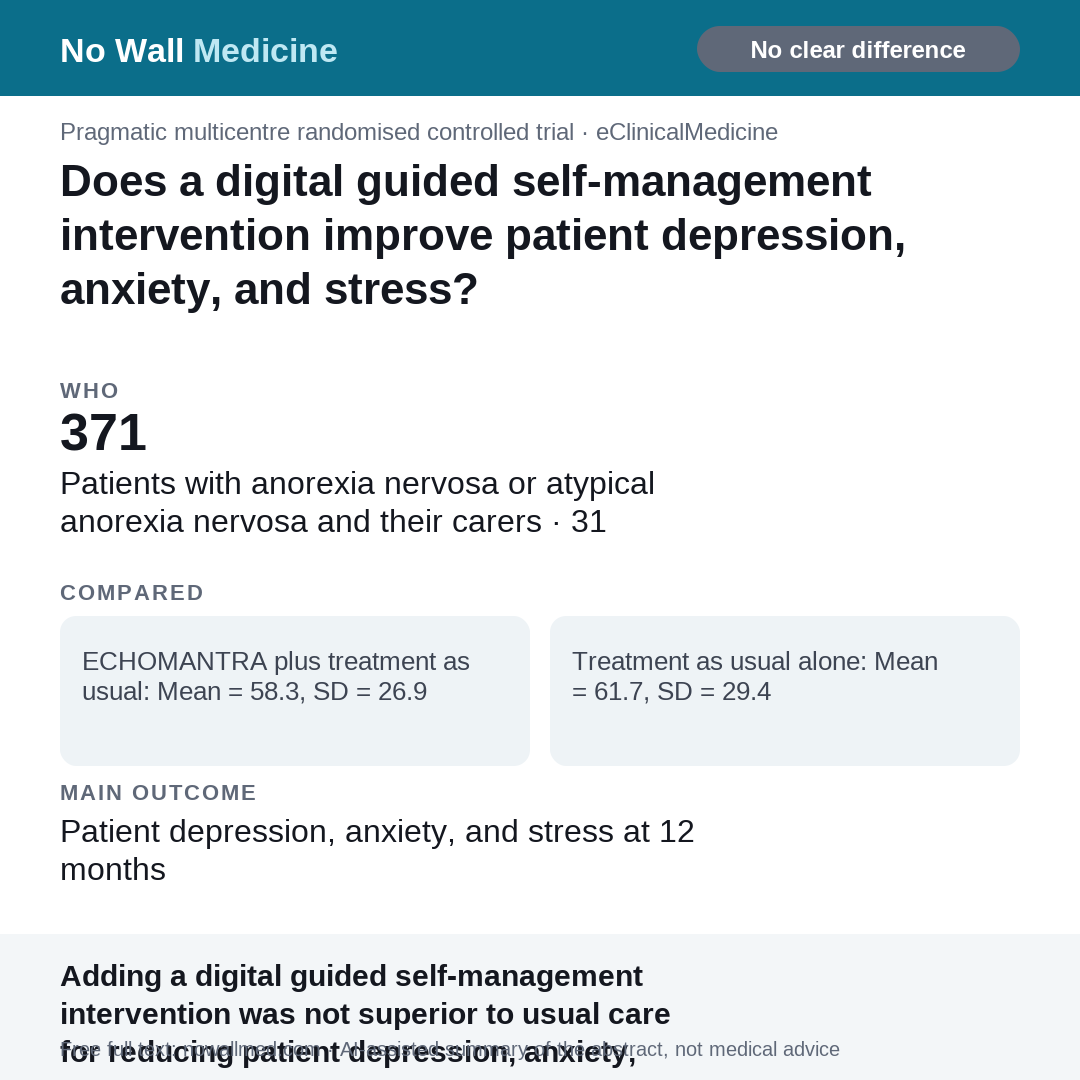
Does a digital guided self-management intervention improve patient depression, anxiety, and stress?
Who
371
Patients with anorexia nervosa or atypical anorexia nervosa and their carers · 31 inpatient or day-patient services in the UK
Compared
ECHOMANTRA plus treatment as usual: Mean = 58.3, SD = 26.9
Treatment as usual alone: Mean = 61.7, SD = 29.4
Main outcome
Patient depression, anxiety, and stress at 12 months
Result: estimated mean difference 0.48 points; 95% CI -5.36 to 6.33
Bottom line: Adding a digital guided self-management intervention was not superior to usual care for reducing patient depression, anxiety, and stress.
Limitation: Limited engagement with intervention materials and changes in usual care practices.
Funded by: National Institute for Health Research
eClinicalMedicine · 2024-05-27Download image
Clinical question: Does a digital guided self-management intervention improve patient depression, anxiety, and stress?
Why it matters: It is uncertain how to best support patients with anorexia nervosa when they transition from intensive inpatient or day care to community care.
Key points
- Researchers studied 371 patient-carer pairs receiving either standard care or standard care plus a digital self-management program called ECHOMANTRA.
- At 12 months, there were no significant differences in patient depression, anxiety, and stress between the ECHOMANTRA group (Mean = 58.3) and the standard care group (Mean = 61.7).
- Differences in secondary outcomes were small and non-significant, with standardized effect size estimates ≤0.25.
Limitation the authors note: The authors suggest results may be explained by limited engagement with the intervention materials and changes in usual care practices since the trial began.
Headline and key points written with AI from the paper’s abstract, with every number checked against it. Read the paper before relying on them.
Was this summary helpful?
Cite this article
Cardi V, Rowlands K, Ambwani S, Lord J, Clark-Bryan D, McDaid D. Efficacy and cost-effectiveness of a digital guided self-management intervention to support transition from intensive care to community care in anorexia nervosa (TRIANGLE): pragmatic multicentre randomised controlled trial and economic evaluation. eClinicalMedicine. 2024. doi:10.1016/j.eclinm.2024.102645
Spotted a mistake? Suggest a correction
Top studies every Monday
The week’s key trials and guidelines in your specialties, plus any topics you follow. By email, free.
Get the weekly digest