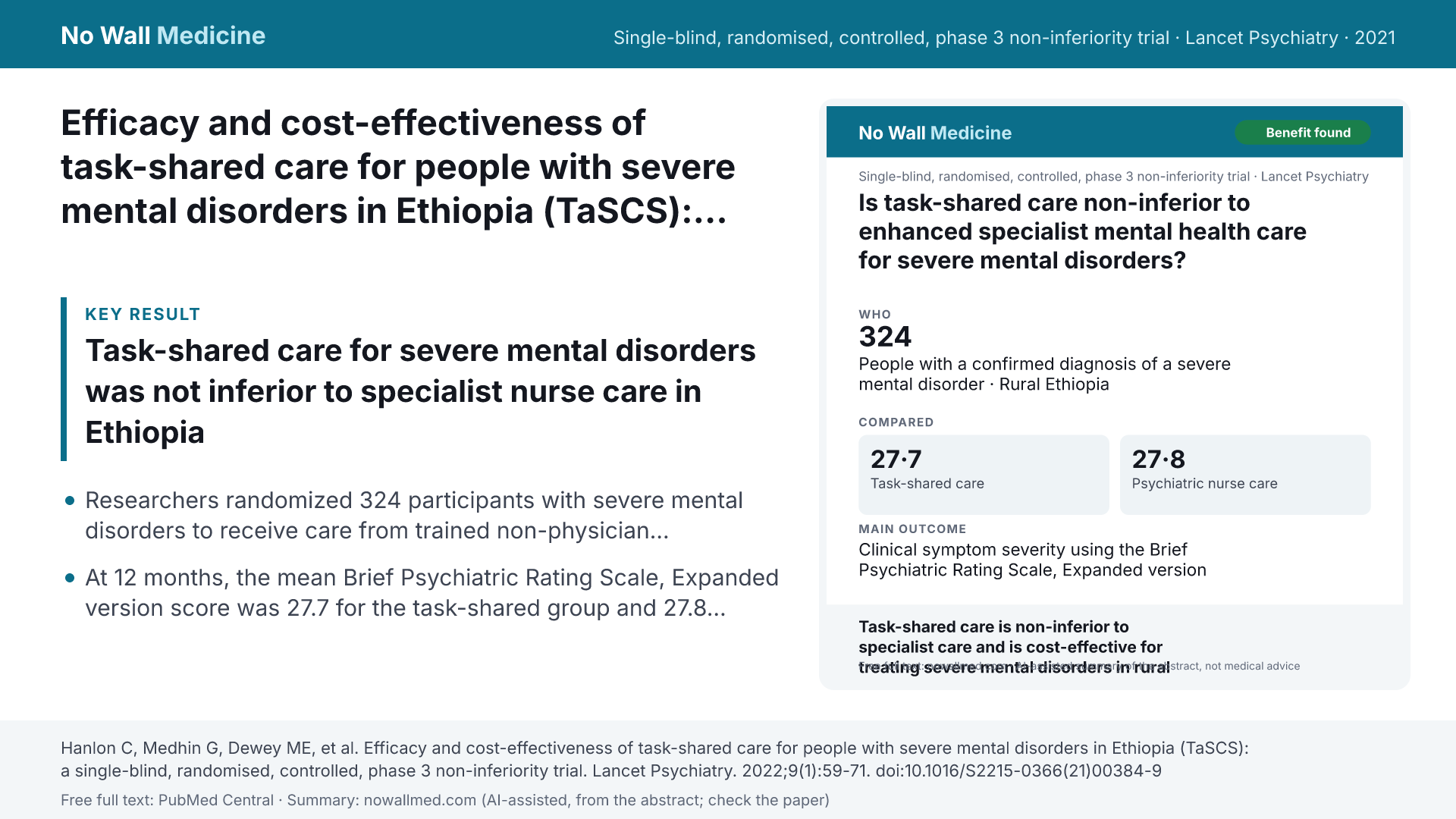
Efficacy and cost-effectiveness of task-shared care for people with severe mental disorders in Ethiopia (TaSCS): a single-blind, randomised, controlled, phase 3 non-inferiority trial
Key result: Task-shared care for severe mental disorders was not inferior to specialist nurse care in Ethiopia
Key points
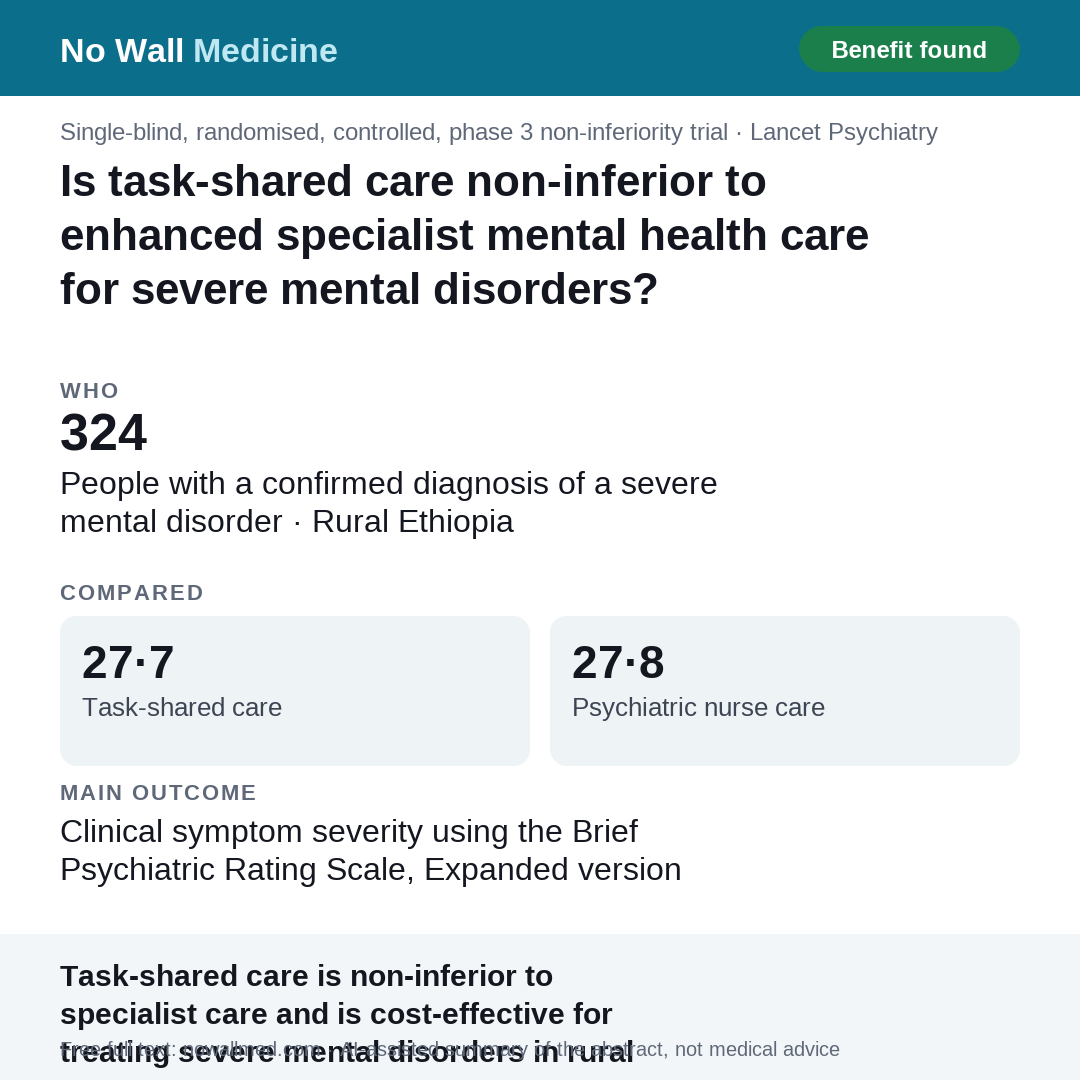
- Researchers randomized 324 participants with severe mental disorders to receive care from trained non-physician primary health care workers or outpatient psychiatric nurse care.
- At 12 months, the mean Brief Psychiatric Rating Scale, Expanded version score was 27.7 for the task-shared group and 27.8 for the nurse care group.
- The task-shared care model showed an incremental cost-effectiveness ratio of -US$299.82 per unit increase in symptom scores from a health care sector perspective.
Why it matters: It was unknown if using supervised non-specialists to deliver mental health care is as effective and cost-efficient as specialist models in low-income or middle-income countries.
Discussion prompts
- Would these patients look like yours? Who was left out?
- Is the main outcome one that matters to patients?
- Is the difference large enough to change what you do?
Cite: Hanlon C, Medhin G, Dewey ME, et al. Efficacy and cost-effectiveness of task-shared care for people with severe mental disorders in Ethiopia (TaSCS): a single-blind, randomised, controlled, phase 3 non-inferiority trial. Lancet Psychiatry. 2021. doi:10.1016/S2215-0366(21)00384-9
Free full text: PubMed Central · Summary and visual abstract: nowallmed.com/a/efficacy-and-cost-effectiveness-of-task-shared-care-for-people-with-iq5m4d/ (AI-assisted from the abstract; check the paper before relying on it).