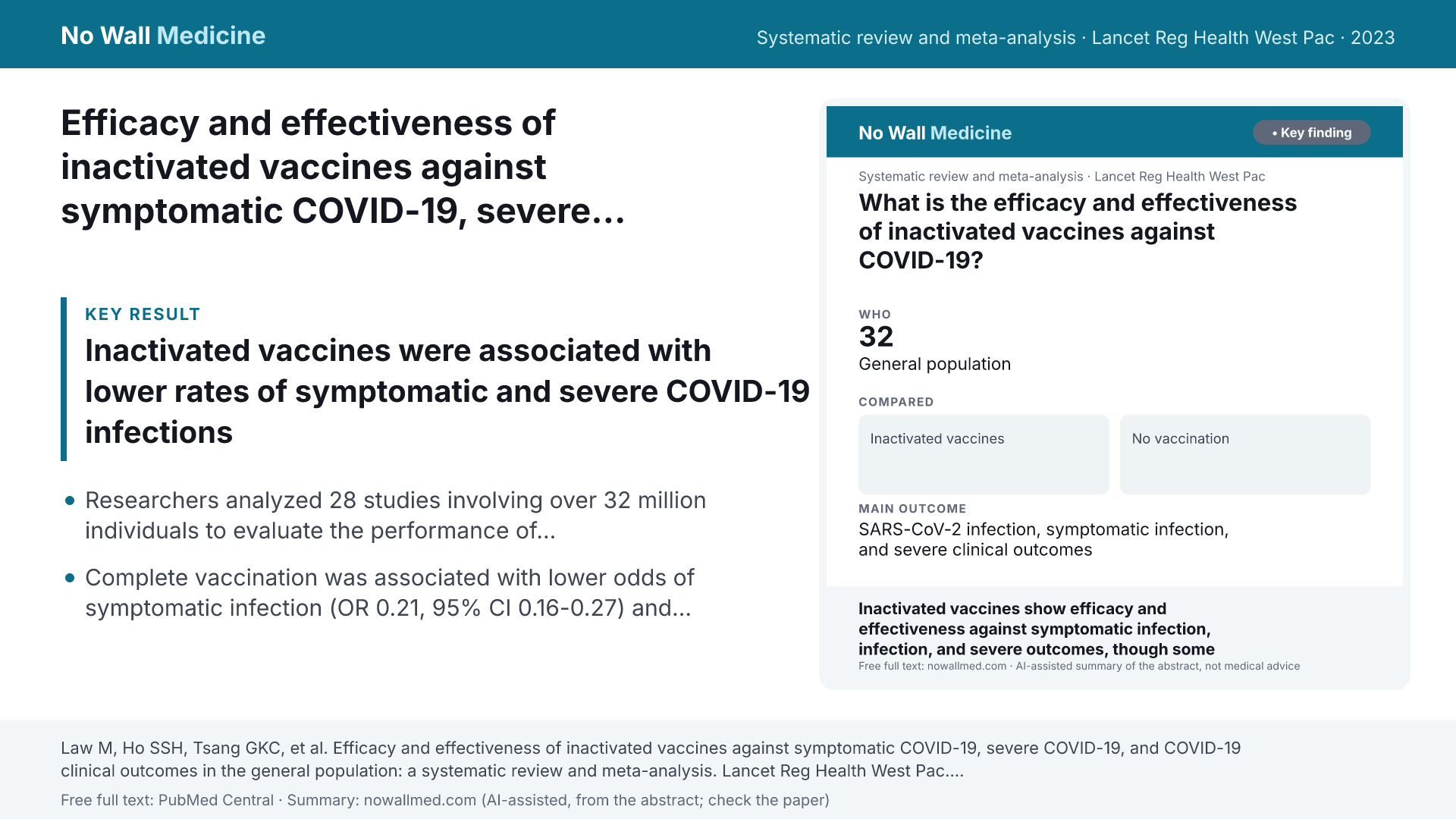
Inactivated vaccines were associated with lower rates of symptomatic and severe COVID-19 infections
Efficacy and effectiveness of inactivated vaccines against symptomatic COVID-19, severe COVID-19, and COVID-19 clinical outcomes in the general population: a systematic review and meta-analysis
Systematic review and meta-analysisKey finding
What is the efficacy and effectiveness of inactivated vaccines against COVID-19?
Who
32
General population
Compared
Inactivated vaccines
No vaccination
Main outcome
SARS-CoV-2 infection, symptomatic infection, and severe clinical outcomes
Result: symptomatic infection OR 0.21 (95% CI 0.16-0.27)
Bottom line: Inactivated vaccines show efficacy and effectiveness against symptomatic infection, infection, and severe outcomes, though some estimates were inconsistent.
Limitation: Inconsistent reporting, high heterogeneity of observational studies, and small number of specific study designs.
Funded by: Health and Medical Research Fund on COVID-19
Lancet Reg Health West Pac · 2023-05-20 · Save PNG
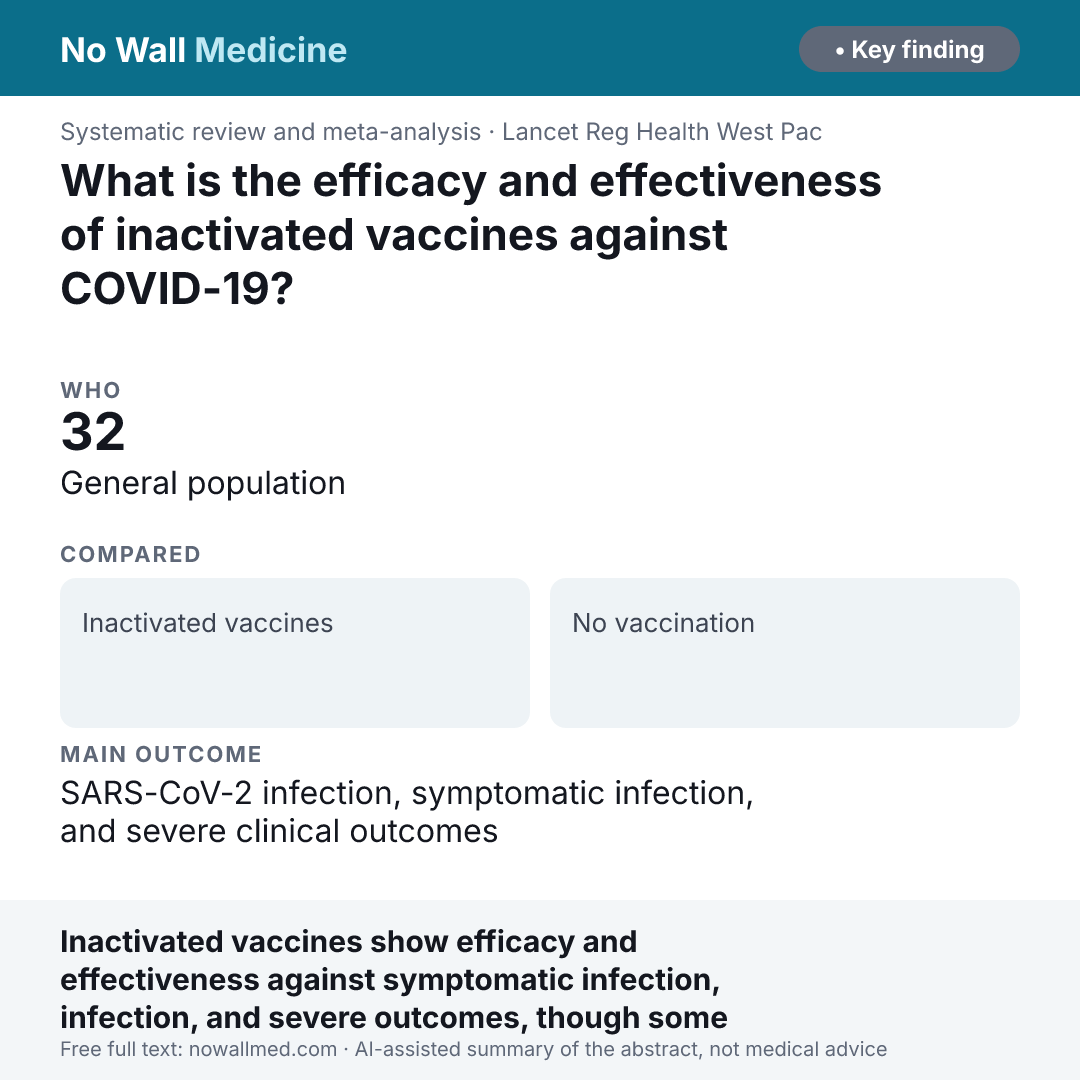
Clinical question: What is the efficacy and effectiveness of inactivated vaccines against COVID-19?
Why it matters: The efficacy and effectiveness of WHO-approved inactivated vaccines against various SARS-CoV-2 outcomes across different regions had not been systematically evaluated.
Key points
- Researchers analyzed 28 studies involving over 32 million individuals to evaluate the performance of WHO-approved inactivated vaccines.
- Complete vaccination was associated with lower odds of symptomatic infection (OR 0.21, 95% CI 0.16-0.27) and infection (OR 0.53, 95% CI 0.49-0.57) for early variants.
- Effectiveness against intensive care unit admission (OR 0.21, 95% CI 0.04-1.08) and death (OR 0.08, 95% CI 0.00-2.02) did not show statistically significant differences.
Limitation the authors note: Inconsistent reporting of key study parameters, high heterogeneity of observational studies, and a small number of studies for most outcomes undermined the reliability of the findings.
Headline and key points written with AI from the paper’s abstract, with every number checked against it. Read the paper before relying on them.
Was this summary helpful?
Abstract
Background
Inactivated, whole-virion vaccines have been used extensively in the SARS-CoV-2 pandemic. Its efficacy and effectiveness across regions have not been systematically evaluated. Efficacy refers to how well a vaccine performs in a controlled environment. Effectiveness refers to how well it performs in real world settings. Methods
This systematic review and meta-analysis reviewed published, peer-reviewed evidence on all WHO-approved inactivated vaccines and evaluated their efficacy and effectiveness against SARS-CoV-2 infection, symptomatic infection, severe clinical outcomes, and severe COVID-19. We searched Pubmed (including MEDLINE), EMBASE (via OVID), Web of Science Core Collection, Web of Science Chinese Science Citation Database, and Clinicaltrials.gov. Findings
The final pool included 28 studies representing over 32 million individuals reporting efficacy or effectiveness estimates of complete vaccination using any approved inactivated vaccine between January 1, 2019 and June 27, 2022. Evidence was found for efficacy and effectiveness against symptomatic infection (OR 0.21, 95% CI 0.16-0.27, I2 = 28% and OR 0.32, 95% CI 0.16-0.64, I2 = 98%, respectively) and infection (OR 0.53, 95% CI 0.49-0.57, I2 = 90% and OR 0.31, 95% CI 0.24-0.41, I2 = 0%, respectively) for early SARS-CoV-2 variants of concern (VoCs) (Alpha, Delta), and for waning of vaccine effectiveness with more recent VoCs (Gamma, Omicron). Effectiveness remained robust against COVID-related ICU admission (OR 0.21, 95% CI 0.04-1.08, I2 = 99%) and death (OR 0.08, 95% CI 0.00-2.02, I2 = 96%), although effectiveness estimates against hospitalization (OR 0.44, 95% CI 0.37-0.53, I2 = 0%) were inconsistent. Interpretation
This study showed evidence of efficacy and effectiveness of inactivated vaccines for all outcomes, although inconsistent reporting of key study parameters, high heterogeneity of observational studies, and the small number of studies of particular designs for most outcomes undermined the reliability of the findings. Findings highlight the need for additional research to address these limitations so that more definitive conclusions can be drawn to inform SARS-CoV-2 vaccine development and vaccination policies. Funding
Health and Medical Research Fund on COVID-19, Health Bureau of the Government of the Hong Kong SAR.
Abstract reproduced under the article’s CC BY-NC-ND licence.
Headline, design, result, key points, caveat and citation as plain text.
Cite this article
Law M, Ho SSH, Tsang GKC, et al. Efficacy and effectiveness of inactivated vaccines against symptomatic COVID-19, severe COVID-19, and COVID-19 clinical outcomes in the general population: a systematic review and meta-analysis. Lancet Reg Health West Pac. 2023;37:100788. doi:10.1016/j.lanwpc.2023.100788
Spotted a mistake? Suggest a correction