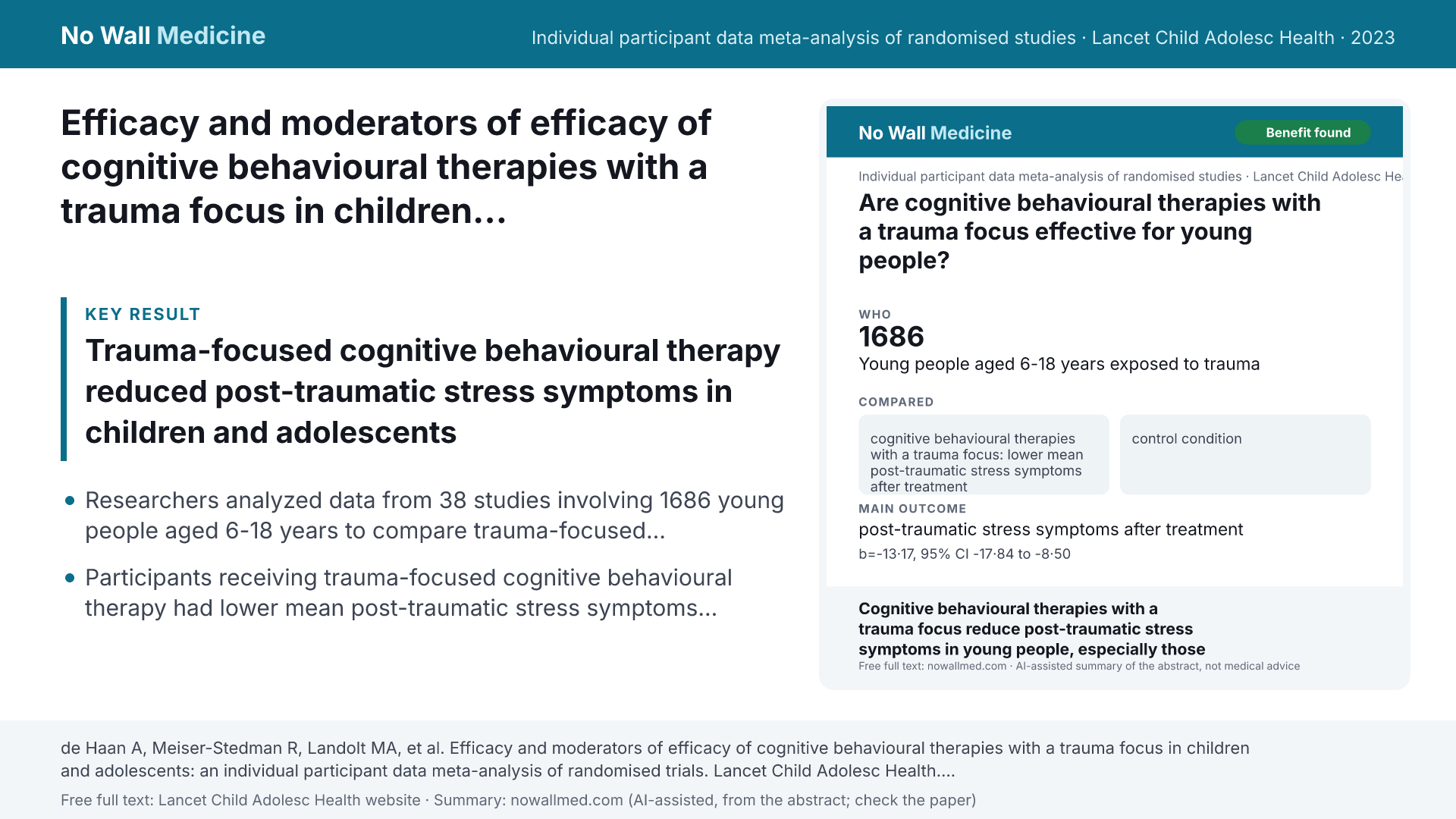
Trauma-focused cognitive behavioural therapy reduced post-traumatic stress symptoms in children and adolescents
Efficacy and moderators of efficacy of cognitive behavioural therapies with a trauma focus in children and adolescents: an individual participant data meta-analysis of randomised trials
Individual participant data meta-analysis of randomised studiesBenefit found
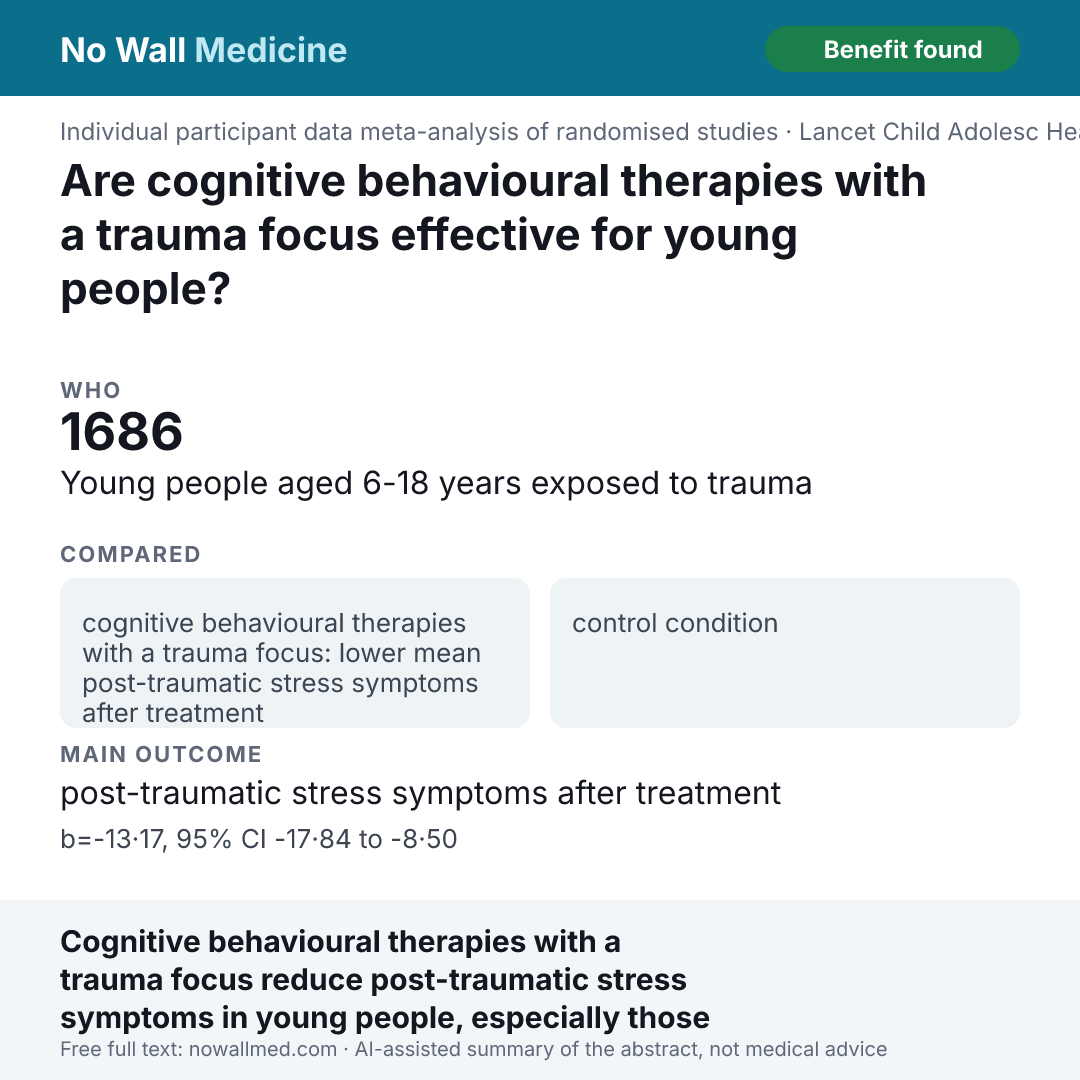
Are cognitive behavioural therapies with a trauma focus effective for young people?
Who
1686
Young people aged 6-18 years exposed to trauma
Compared
cognitive behavioural therapies with a trauma focus: lower mean post-traumatic stress symptoms after treatment
control condition
Main outcome
post-traumatic stress symptoms after treatment
Result: b=-13·17, 95% CI -17·84 to -8·50
Bottom line: Cognitive behavioural therapies with a trauma focus reduce post-traumatic stress symptoms in young people, especially those with higher initial distress.
Limitation: Twenty studies were identified as having some concerns regarding risk of bias.
Lancet Child Adolesc Health · 2023-11-18 · Funded by Swiss National Science Foundation · PROSPERO CRD42019151954
Why it matters: Existing clinical trials of trauma-focused cognitive behavioural therapies are underpowered to examine which individual or treatment variables might influence how well the therapy works.
Headline and visual abstract written with AI from the paper’s abstract, with every number checked against it. Read the paper before relying on them.
Was this summary helpful?
Abstract
Background
Existing clinical trials of cognitive behavioural therapies with a trauma focus (CBTs-TF) are underpowered to examine key variables that might moderate treatment effects. We aimed to determine the efficacy of CBTs-TF for young people, relative to passive and active control conditions, and elucidate putative individual-level and treatment-level moderators. Methods
This was an individual participant data meta-analysis of published and unpublished randomised studies in young people aged 6-18 years exposed to trauma. We included studies identified by the latest UK National Institute of Health and Care Excellence guidelines (completed on Jan 29, 2018) and updated their search. The search strategy included database searches restricted to publications between Jan 1, 2018, and Nov 12, 2019; grey literature search of trial registries ClinicalTrials.gov and ISRCTN; preprint archives PsyArXiv and bioRxiv; and use of social media and emails to key authors to identify any unpublished datasets. The primary outcome was post-traumatic stress symptoms after treatment (<1 month after the final session). Predominantly, one-stage random-effects models were fitted. This study is registered with PROSPERO, CRD42019151954. Findings
We identified 38 studies; 25 studies provided individual participant data, comprising 1686 young people (mean age 13·65 years [SD 3·01]), with 802 receiving CBTs-TF and 884 a control condition. The risk-of-bias assessment indicated five studies as low risk and 20 studies with some concerns. Participants who received CBTs-TF had lower mean post-traumatic stress symptoms after treatment than those who received the control conditions, after adjusting for post-traumatic stress symptoms before treatment (b=-13·17, 95% CI -17·84 to -8·50, p<0·001, τ2=103·72). Moderation analysis indicated that this effect of CBTs-TF on post-traumatic stress symptoms post-treatment increased by 0·15 units (b=-0·15, 95% CI -0·29 to -0·01, p=0·041, τ2=0·03) for each unit increase in pre-treatment post-traumatic stress symptoms. Interpretation
This is the first individual participant data meta-analysis of young people exposed to trauma. Our findings support CBTs-TF as the first-line treatment, irrespective of age, gender, trauma characteristics, or carer involvement in treatment, with particular benefits for those with higher initial distress. Funding
Swiss National Science Foundation.
Abstract reproduced under the article’s CC BY licence.
Subject terms
Cite this article
de Haan A, Meiser-Stedman R, Landolt MA, et al. Efficacy and moderators of efficacy of cognitive behavioural therapies with a trauma focus in children and adolescents: an individual participant data meta-analysis of randomised trials. Lancet Child Adolesc Health. 2024;8(1):28-39. doi:10.1016/S2352-4642(23)00253-5
Spotted a mistake? Suggest a correction