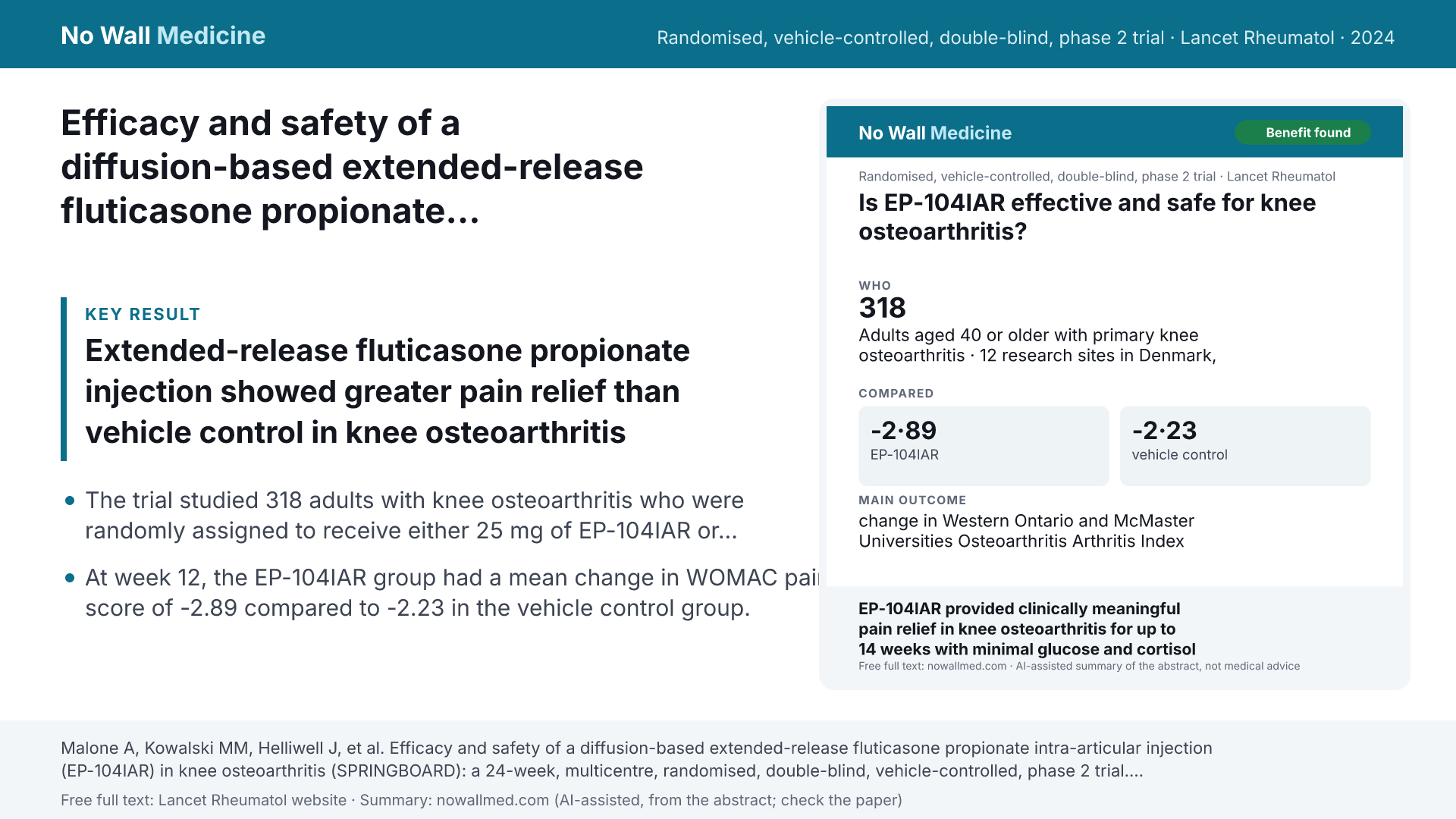
Extended-release fluticasone propionate injection showed greater pain relief than vehicle control in knee osteoarthritis
Efficacy and safety of a diffusion-based extended-release fluticasone propionate intra-articular injection (EP-104IAR) in knee osteoarthritis (SPRINGBOARD): a 24-week, multicentre, randomised, double-blind, vehicle-controlled, phase 2 trial
Randomised, vehicle-controlled, double-blind, phase 2 trialBenefit found
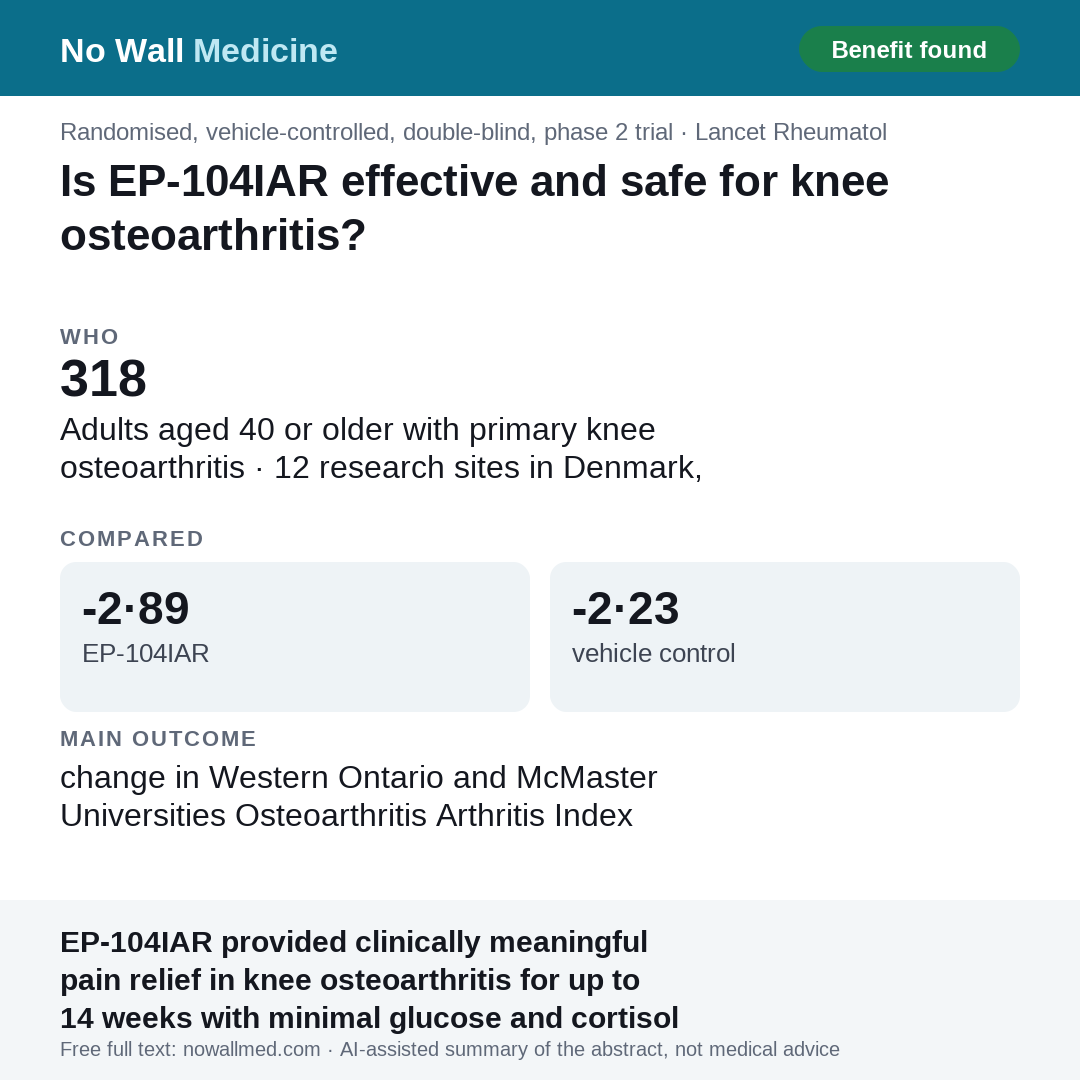
Is EP-104IAR effective and safe for knee osteoarthritis?
Who
318
Adults aged 40 or older with primary knee osteoarthritis · 12 research sites in Denmark, Poland, and Czech Republic
Compared
-2·89EP-104IAR (95% CI -3·22 to -2·56)
-2·23vehicle control (-2·56 to -1·89)
Main outcome
change in Western Ontario and McMaster Universities Osteoarthritis Arthritis Index pain score
Result: -0·66 (-1·11 to -0·21; p=0·0044)
Bottom line: EP-104IAR provided clinically meaningful pain relief in knee osteoarthritis for up to 14 weeks with minimal glucose and cortisol effects.
Funded by: Eupraxia Pharmaceuticals
Lancet Rheumatol · 2024-10-11Download image
Clinical question: Is EP-104IAR effective and safe for knee osteoarthritis?
Why it matters: The short duration of action of current corticosteroid treatments limits their utility for managing knee osteoarthritis pain.
Key points
- The trial studied 318 adults with knee osteoarthritis who were randomly assigned to receive either 25 mg of EP-104IAR or a vehicle control injection.
- At week 12, the EP-104IAR group had a mean change in WOMAC pain score of -2.89 compared to -2.23 in the vehicle control group.
- One or more adverse events occurred in 65% of the EP-104IAR group and 57% of the vehicle control group, but no treatment-related serious adverse events occurred.
Headline and key points written with AI from the paper’s abstract, with every number checked against it. Read the paper before relying on them.
Was this summary helpful?
Abstract
Background
Corticosteroids are among the few effective treatments for knee osteoarthritis, but short duration of action limits their utility. EP-104IAR, a long-acting formulation of fluticasone propionate for intra-articular injection, optimises the action of fluticasone propionate through novel diffusion-based extended-release technology. The SPRINGBOARD trial assessed the efficacy, safety, and pharmacokinetics of EP-104IAR in people with knee osteoarthritis. Methods
SPRINGBOARD was a randomised, vehicle-controlled, double-blind, phase 2 trial done at 12 research sites in Denmark, Poland, and Czech Republic. We recruited adults aged 40 years or older with primary knee osteoarthritis (Kellgren-Lawrence grade 2-3) who reported Western Ontario and McMaster Universities Osteoarthritis Arthritis Index (WOMAC) pain scores of at least 4 and no more than 9 out of 10. Participants were randomly assigned (1:1) to receive one intra-articular dose of 25 mg EP-104IAR or vehicle control. Randomisation was done via interactive web-based access to a central predefined computer-generated list with block size of six (allocated by clinical site). Participants and assessors were masked to treatment allocation. Participants were followed up for 24 weeks. The primary outcome was the difference between groups in change in WOMAC pain score from baseline to week 12, analysed in all participants who were randomly assigned and received treatment. Safety, including laboratory analyses, and pharmacokinetics from quantification of fluticasone propionate in peripheral blood were assessed in all participants who received a dose of randomly assigned treatment. A person with lived experience of knee osteoarthritis was involved in study interpretation and writing of the report. This trial is registered with ClinicalTrials.gov, NCT04120402, and the EU Clinical Trials Register, EudraCT 2021-000859-39, and is complete. Findings
Between Sept 10, 2021, and Nov 16, 2022, 1294 people were screened for eligibility, and 319 were randomly assigned to EP-104IAR (n=164) or vehicle control (n=155). One participant in the EP-104IAR group was excluded from all analyses because treatment was not administered due to an adverse event. 318 participants (135 [42%] male and 183 [58%] female, 315 [99%] White) received randomly assigned treatment and were included in the primary analysis and safety analysis (EP-104IAR, n=163; vehicle control, n=155). At week 12, least squares mean change in WOMAC pain score from baseline was -2·89 (95% CI -3·22 to -2·56) in the EP-104IAR group and -2·23 (-2·56 to -1·89) in the vehicle control group, with a between-group difference of -0·66 (-1·11 to -0·21; p=0·0044); a significant between-group difference persisted to week 14. 106 (65%) of 163 participants in the EP-104IAR group had one or more treatment-emergent adverse event compared with 89 (57%) of 155 participants in the vehicle control group. Effects on serum glucose and cortisol concentrations were minimal and transient. There were no treatment-emergent deaths or treatment-related serious adverse events. Plasma concentrations of fluticasone propionate showed a blunted initial peak with terminal half-life of approximately 18-20 weeks. Interpretation
These phase 2 results suggest that EP-104IAR has the potential to offer clinically meaningful pain relief in knee osteoarthritis for an extended period of up to 14 weeks, longer than published data for currently marketed corticosteroids. There were minimal effects on glucose and cortisol, and stable fluticasone propionate concentrations in plasma. The safety and efficacy of EP-104IAR will be further evaluated in phase 3 trials, including the possibility of bilateral and repeat dosing with EP-104IAR. Funding
Eupraxia Pharmaceuticals. Translation
For the Danish translation of the abstract see Supplementary Materials section.
Abstract reproduced under the article’s CC BY NC licence.
Subject terms
Cite this article
Malone A, Kowalski MM, Helliwell J, Lynggaard Boll S, Rovsing H, Moriat K. Efficacy and safety of a diffusion-based extended-release fluticasone propionate intra-articular injection (EP-104IAR) in knee osteoarthritis (SPRINGBOARD): a 24-week, multicentre, randomised, double-blind, vehicle-controlled, phase 2 trial. Lancet Rheumatol. 2024. doi:10.1016/S2665-9913(24)00223-6
Spotted a mistake? Suggest a correction