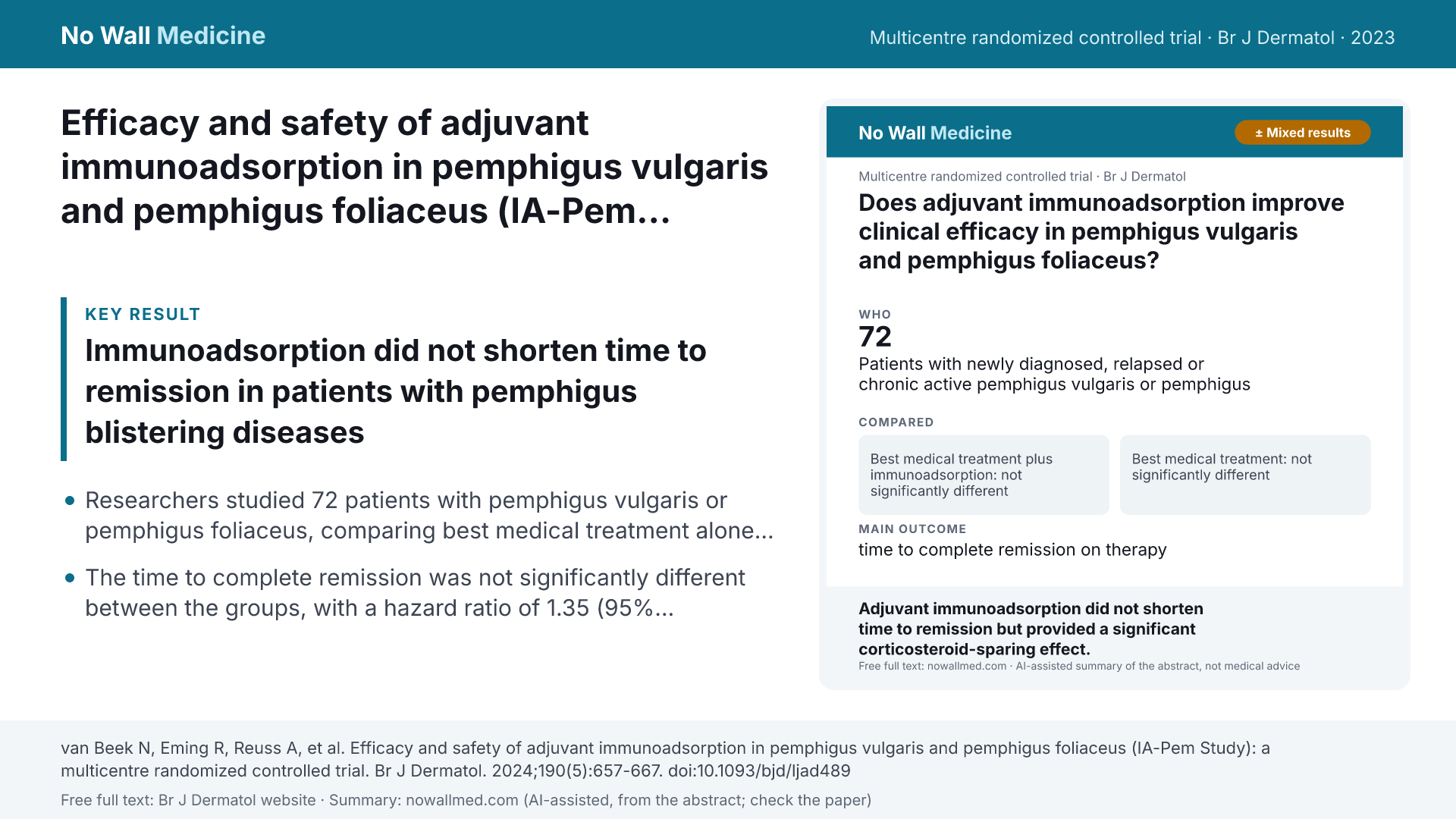
Immunoadsorption did not shorten time to remission in patients with pemphigus blistering diseases
Efficacy and safety of adjuvant immunoadsorption in pemphigus vulgaris and pemphigus foliaceus (IA-Pem Study): a multicentre randomized controlled trial
Multicentre randomized controlled trialMixed results
Does adjuvant immunoadsorption improve clinical efficacy in pemphigus vulgaris and pemphigus foliaceus?
Who
72
Patients with newly diagnosed, relapsed or chronic active pemphigus vulgaris or pemphigus foliaceus · 26 centres from Germany and Austria
Compared
Best medical treatment plus immunoadsorption: not significantly different
Best medical treatment: not significantly different
Main outcome
time to complete remission on therapy
Result: hazard ratio 1.35 (95% confidence interval 0.68-2.69)
Bottom line: Adjuvant immunoadsorption did not shorten time to remission but provided a significant corticosteroid-sparing effect.
Br J Dermatol · 2023-12-22Download image
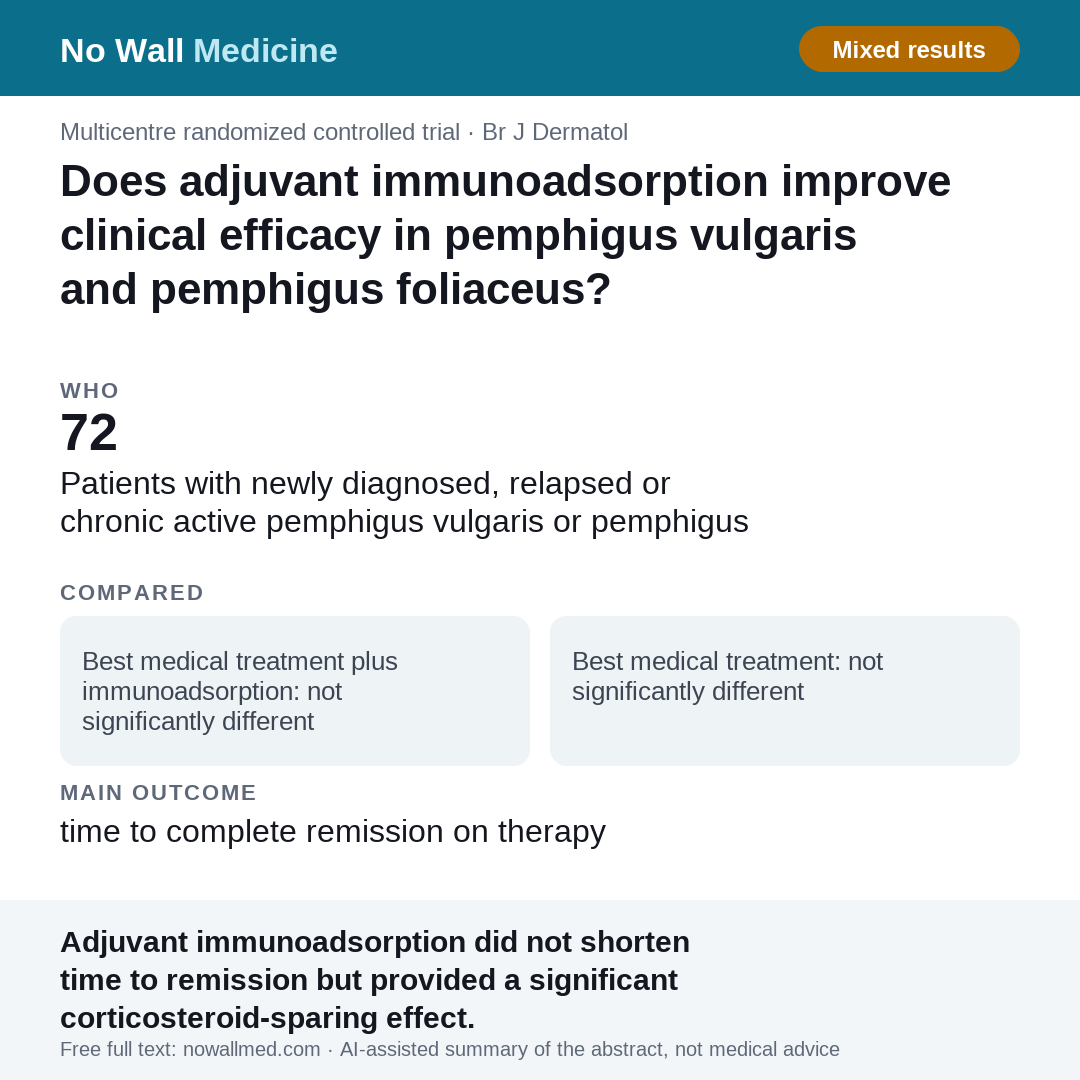
Clinical question: Does adjuvant immunoadsorption improve clinical efficacy in pemphigus vulgaris and pemphigus foliaceus?
Why it matters: It is unknown if adding immunoadsorption to standard medical treatment improves the time to clinical remission for patients with pemphigus vulgaris or pemphigus foliaceus.
Key points
- Researchers studied 72 patients with pemphigus vulgaris or pemphigus foliaceus, comparing best medical treatment alone to best medical treatment plus immunoadsorption.
- The time to complete remission was not significantly different between the groups, with a hazard ratio of 1.35 (95% CI 0.68-2.69; P = 0.39).
- The cumulative dose of prednisolone was significantly lower in the group receiving immunoadsorption compared to the group receiving medical treatment alone (difference -1214, 95% CI -2225 to -70; P = 0.03).
Headline and key points written with AI from the paper’s abstract, with every number checked against it. Read the paper before relying on them.
Was this summary helpful?
Subject terms
Cite this article
van Beek N, Eming R, Reuss A, et al. Efficacy and safety of adjuvant immunoadsorption in pemphigus vulgaris and pemphigus foliaceus (IA-Pem Study): a multicentre randomized controlled trial. Br J Dermatol. 2023. doi:10.1093/bjd/ljad489
Spotted a mistake? Suggest a correction