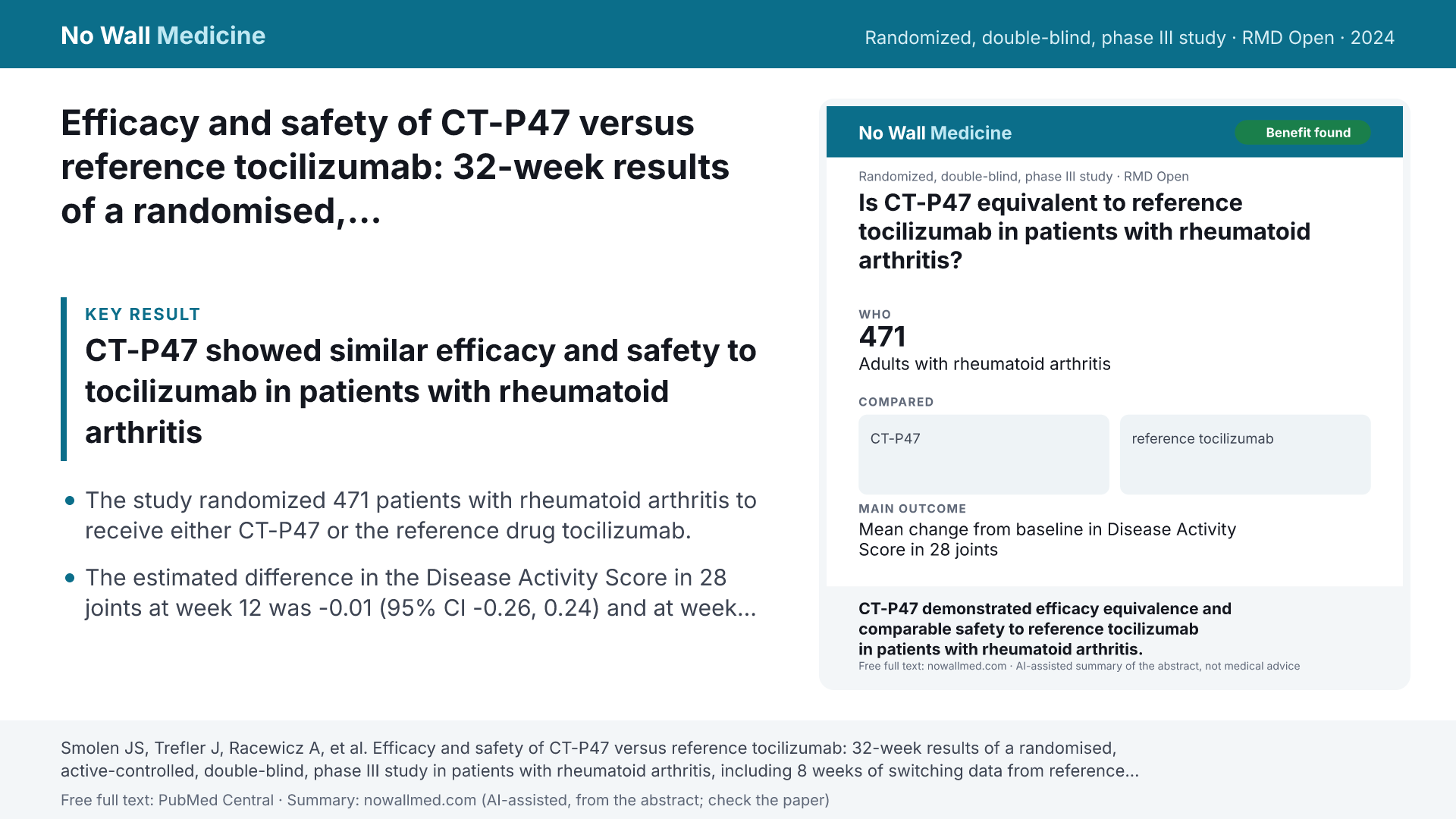
CT-P47 showed similar efficacy and safety to tocilizumab in patients with rheumatoid arthritis
Efficacy and safety of CT-P47 versus reference tocilizumab: 32-week results of a randomised, active-controlled, double-blind, phase III study in patients with rheumatoid arthritis, including 8 weeks of switching data from reference tocilizumab to CT-P47
Randomized, double-blind, phase III studyBenefit found
Is CT-P47 equivalent to reference tocilizumab in patients with rheumatoid arthritis?
Who
471
Adults with rheumatoid arthritis
Compared
CT-P47
reference tocilizumab
Main outcome
Mean change from baseline in Disease Activity Score in 28 joints
Result: -0.01 (95% CI -0.26, 0.24) at week 12
Bottom line: CT-P47 demonstrated efficacy equivalence and comparable safety to reference tocilizumab in patients with rheumatoid arthritis.
RMD Open · 2024-10-18 · Save PNG
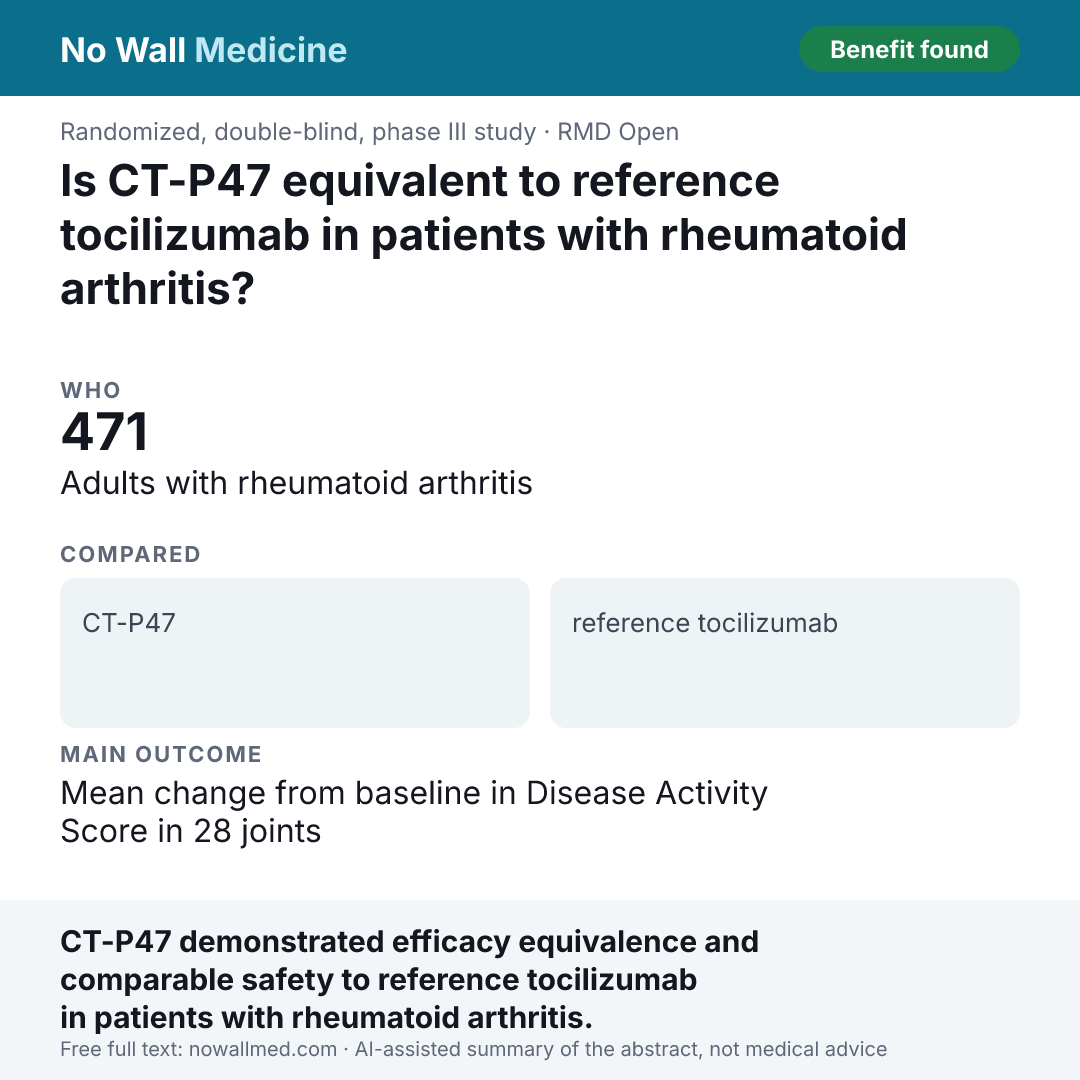
Clinical question: Is CT-P47 equivalent to reference tocilizumab in patients with rheumatoid arthritis?
Why it matters: It was necessary to demonstrate the efficacy equivalence of the biosimilar CT-P47 compared to the approved reference tocilizumab in adults with rheumatoid arthritis.
Key points
- The study randomized 471 patients with rheumatoid arthritis to receive either CT-P47 or the reference drug tocilizumab.
- The estimated difference in the Disease Activity Score in 28 joints at week 12 was -0.01 (95% CI -0.26, 0.24) and at week 24 was -0.10 (90% CI -0.30, 0.10).
- Secondary efficacy, pharmacokinetics, and overall safety were comparable between the two groups up to week 32.
Headline and key points written with AI from the paper’s abstract, with every number checked against it. Read the paper before relying on them.
Was this summary helpful?
Abstract
Objectives
To demonstrate efficacy equivalence of CT-P47 and EU-approved reference tocilizumab (r-TCZ) in patients with rheumatoid arthritis (RA). Methods
This double-blind, phase III study randomised (1:1) patients to receive CT-P47 or r-TCZ (8 mg/kg) every 4 weeks until week 20 during treatment period (TP) 1. Prior to week 24 dosing, patients receiving r-TCZ were randomised (1:1) to continue r-TCZ or switch to CT-P47; patients receiving CT-P47 continued CT-P47 (TP2, 8 mg/kg every 4 weeks until week 48). The dual primary endpoints (for different regulatory requirements) were mean changes from baseline in Disease Activity Score in 28 joints (DAS28; erythrocyte sedimentation rate (ESR)) at week 12 and week 24. Efficacy equivalence was determined if CIs for the treatment difference were within predefined equivalence margins: (95% CI -0.6, 0.6 (analysis of covariance (ANCOVA)) at week 12 or 90% CI -0.6, 0.5 (ANCOVA with multiple imputation) at week 24). Additional efficacy, pharmacokinetic (PK) and safety endpoints, including immunogenicity, were investigated. Findings up to week 32 are presented. Results
In TP1, 471 patients were randomised (234 CT-P47; 237 r-TCZ). The 95% and 90% CIs for the estimated treatment differences were contained within the predefined equivalence margins; the estimated difference in DAS28-ESR at week 12 was -0.01 (95% CI -0.26, 0.24) and at week 24 was -0.10 (90% CI -0.30, 0.10). Secondary efficacy endpoints, PKs and overall safety were comparable between groups up to week 32. Conclusions
Efficacy equivalence, alongside comparable PK, safety and immunogenicity profiles, was determined between CT-P47 and r-TCZ in adults with RA, including after switching from r-TCZ to CT-P47.
Abstract reproduced under the article’s CC BY NC licence.
Subject terms
Headline, design, result, key points, caveat and citation as plain text.
Cite this article
Smolen JS, Trefler J, Racewicz A, et al. Efficacy and safety of CT-P47 versus reference tocilizumab: 32-week results of a randomised, active-controlled, double-blind, phase III study in patients with rheumatoid arthritis, including 8 weeks of switching data from reference tocilizumab to CT-P47. RMD Open. 2024;10(4). doi:10.1136/rmdopen-2024-004514
Spotted a mistake? Suggest a correction