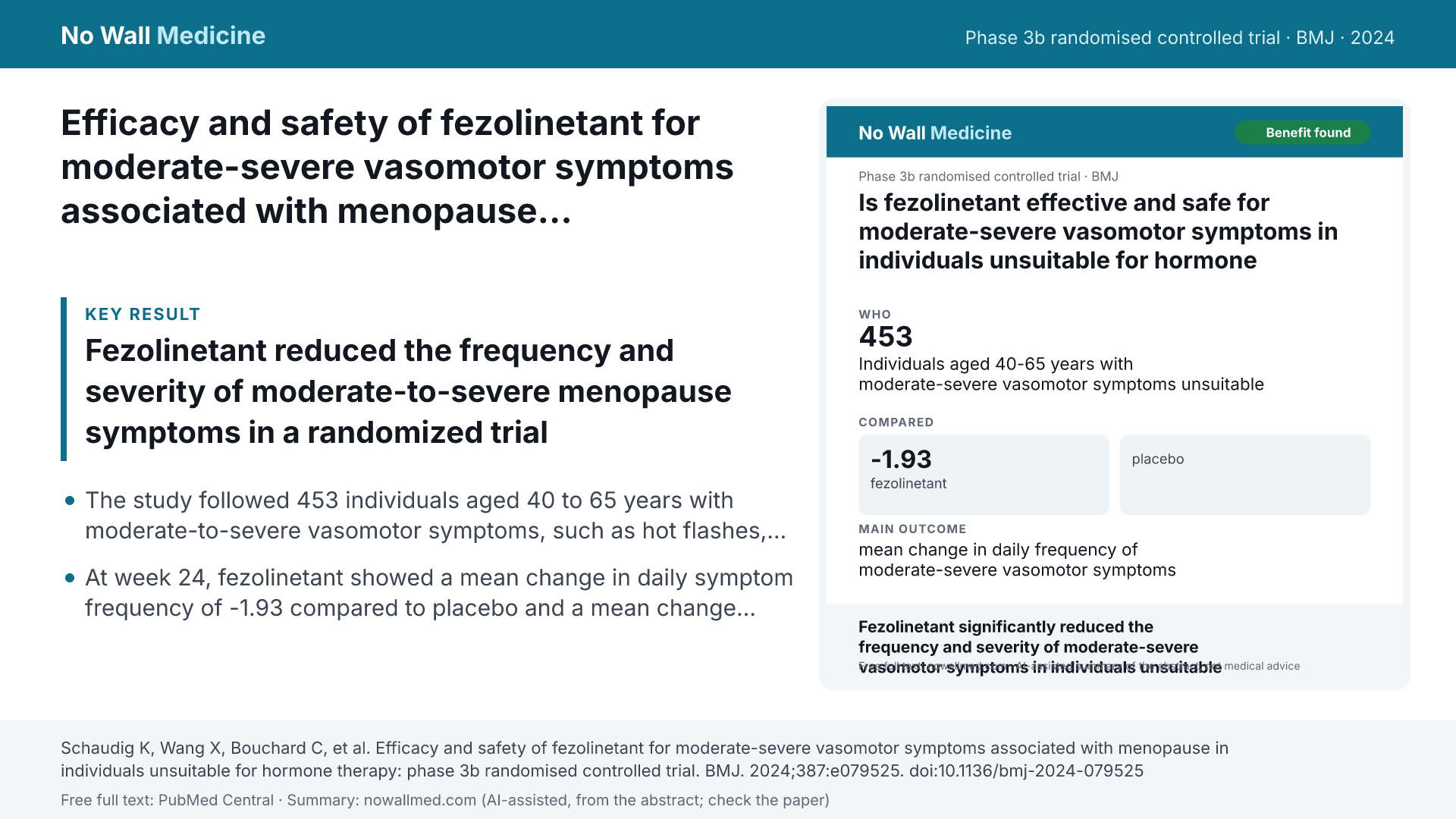
Fezolinetant reduced the frequency and severity of moderate-to-severe menopause symptoms in a randomized trial
Efficacy and safety of fezolinetant for moderate-severe vasomotor symptoms associated with menopause in individuals unsuitable for hormone therapy: phase 3b randomised controlled trial
Phase 3b randomised controlled trialBenefit found
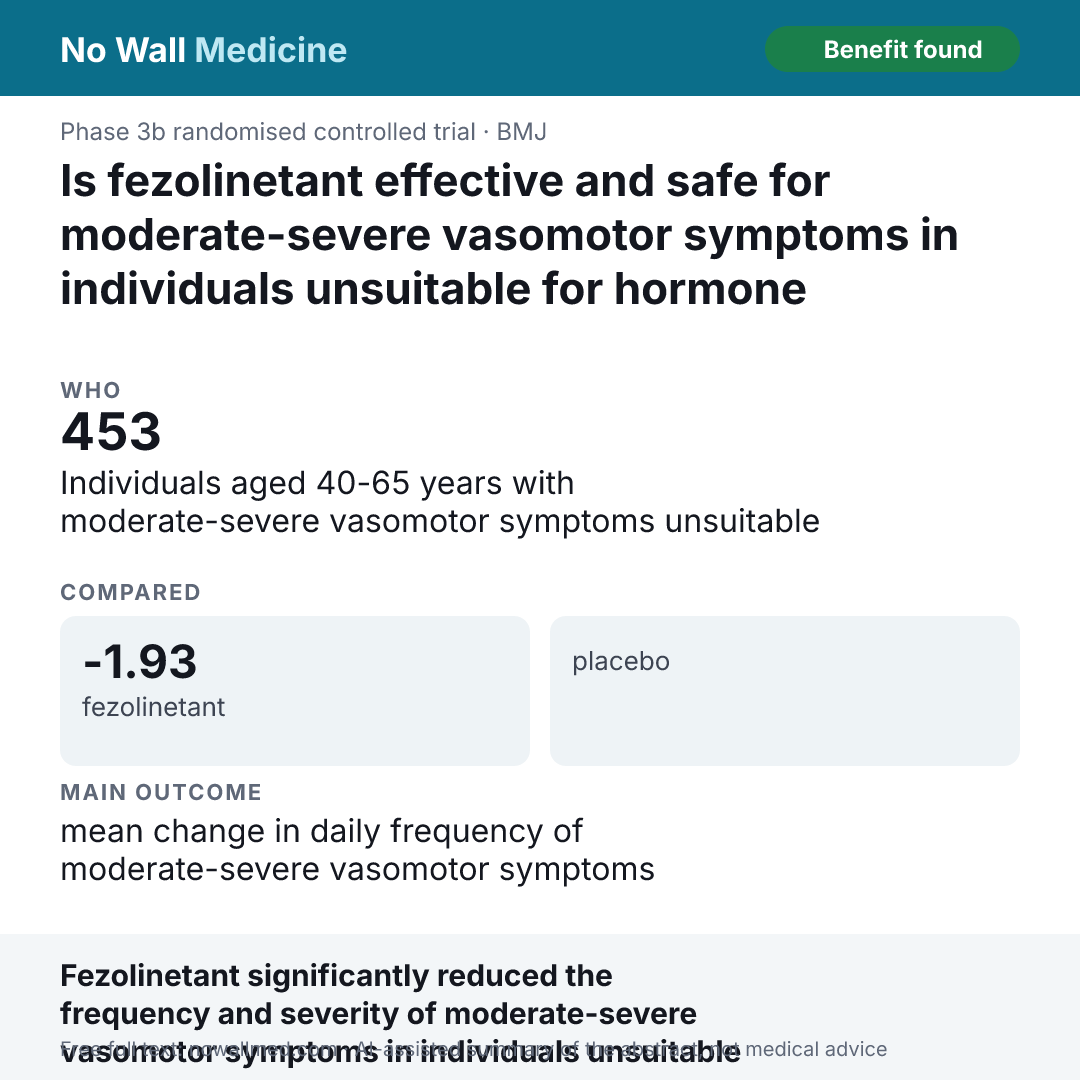
Is fezolinetant effective and safe for moderate-severe vasomotor symptoms in individuals unsuitable for hormone therapy?
Who
453
Individuals aged 40-65 years with moderate-severe vasomotor symptoms unsuitable for hormone therapy · 16 countries
Compared
-1.93fezolinetant
placebo
Main outcome
mean change in daily frequency of moderate-severe vasomotor symptoms
Result: least squares mean difference -1.93, 95% confidence interval -2.64 to -1.22
Bottom line: Fezolinetant significantly reduced the frequency and severity of moderate-severe vasomotor symptoms in individuals unsuitable for hormone therapy.
BMJ · 2024-11-18 · NCT05033886
Why it matters: Individuals who cannot use or choose not to use hormone therapy lack established non-hormonal treatment options for moderate-to-severe vasomotor symptoms.
Headline and visual abstract written with AI from the paper’s abstract, with every number checked against it. Read the paper before relying on them.
Was this summary helpful?
Abstract
Objectives
To assess the efficacy and safety of the non-hormonal, neurokinin 3 receptor antagonist, fezolinetant, to treat moderate-severe vasomotor symptoms associated with menopause in individuals unsuitable for hormone therapy. Design
Phase 3b randomised controlled trial. Setting
16 countries. Participants
453 individuals aged 40-65 years with moderate-severe vasomotor symptoms associated with menopause who were considered unsuitable candidates for hormone therapy (contraindicated, caution (based on medical history), stoppers (previous discontinuation of hormone therapy), or averse (informed choice not to use hormone therapy)) were randomised to receive fezolinetant (n=227) or placebo (n=226). Intervention
Fezolinetant 45 mg or placebo once daily for 24 weeks. Main outcome measures
The primary endpoint was mean change in daily frequency of moderate-severe vasomotor symptoms from baseline to week 24. Secondary endpoints were mean change in symptom severity, sleep disturbance using the Patient-Reported Outcome Measurement Information System Sleep Disturbance Short Form (PROMIS SD-SF) 8b total score, and safety. Results
370 (81.7%) participants completed the study (fezolinetant=195, placebo group=175). The safety and full analysis sets comprised 452 participants who received at least one dose of study drug. Mean age was 54.5 (standard deviation 4.7) years and most of the participants (435 (96.7%) were white and categorised as either hormone therapy averse (168 (37.2%)) or caution (165 (36.5%)). At week 24, fezolinetant significantly reduced the frequency (least squares mean difference -1.93, 95% confidence interval (CI) -2.64 to -1.22; P<0.001) and severity of vasomotor symptoms (-0.39, -0.57 to -0.21; P<0.001). At week 24, the fezolinetant group had a greater reduction in sleep disturbance (PROMIS SD-SF 8b total score) compared with placebo (-2.5, -3.9 to -1.1; P<0.001). Improvements over placebo were observed as early as week 1. Both groups showed similar incidences of treatment emergent adverse events (TEAEs, 147 (65.0%) in the fezolinetant group, 138 (61.1%) in the placebo group) and serious TEAEs (10 (4.4%) and 8 (3.5%), respectively). The most common TEAEs in the fezolinetant group were covid-19 (30 (13.3%)), headache (20 (8.8%)), and fatigue (13 (5.8%)). Conclusions
Fezolinetant was efficacious and well tolerated over a six month period for treating moderate-severe vasomotor symptoms in individuals considered unsuitable for hormone therapy. These results highlight the utility of fezolinetant as an effective treatment option for those who have contraindications to or choose not to use hormone therapy. Trial registration
ClinicalTrials.gov NCT05033886; EudraCT 2021-001685-38.
Abstract reproduced under the article’s CC BY NC licence.
Subject terms
Cite this article
Schaudig K, Wang X, Bouchard C, et al. Efficacy and safety of fezolinetant for moderate-severe vasomotor symptoms associated with menopause in individuals unsuitable for hormone therapy: phase 3b randomised controlled trial. BMJ. 2024;387:e079525. doi:10.1136/bmj-2024-079525
Spotted a mistake? Suggest a correction