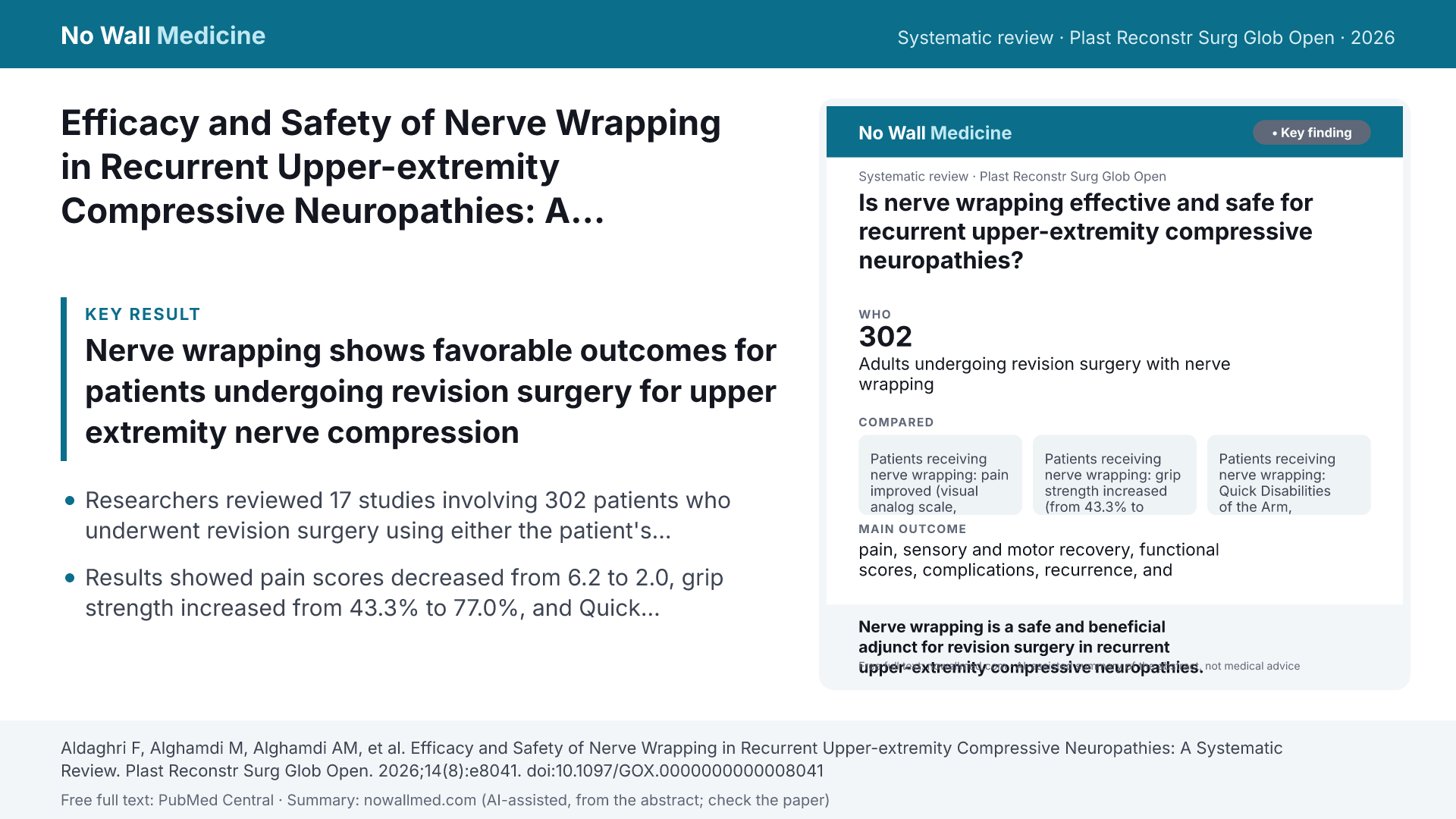
Nerve wrapping shows favorable outcomes for patients undergoing revision surgery for upper extremity nerve compression
Efficacy and Safety of Nerve Wrapping in Recurrent Upper-extremity Compressive Neuropathies: A Systematic Review
Systematic reviewKey finding
Is nerve wrapping effective and safe for recurrent upper-extremity compressive neuropathies?
Who
302
Adults undergoing revision surgery with nerve wrapping
Compared
Patients receiving nerve wrapping: pain improved (visual analog scale, 6.2-2.0)
Patients receiving nerve wrapping: grip strength increased (from 43.3% to 77.0%)
Patients receiving nerve wrapping: Quick Disabilities of the Arm, Shoulder, and Hand scores decreased (from 59.9 to 28.0)
Main outcome
pain, sensory and motor recovery, functional scores, complications, recurrence, and satisfaction
Bottom line: Nerve wrapping is a safe and beneficial adjunct for revision surgery in recurrent upper-extremity compressive neuropathies.
Plast Reconstr Surg Glob Open · 2026-08-26 · Save PNG
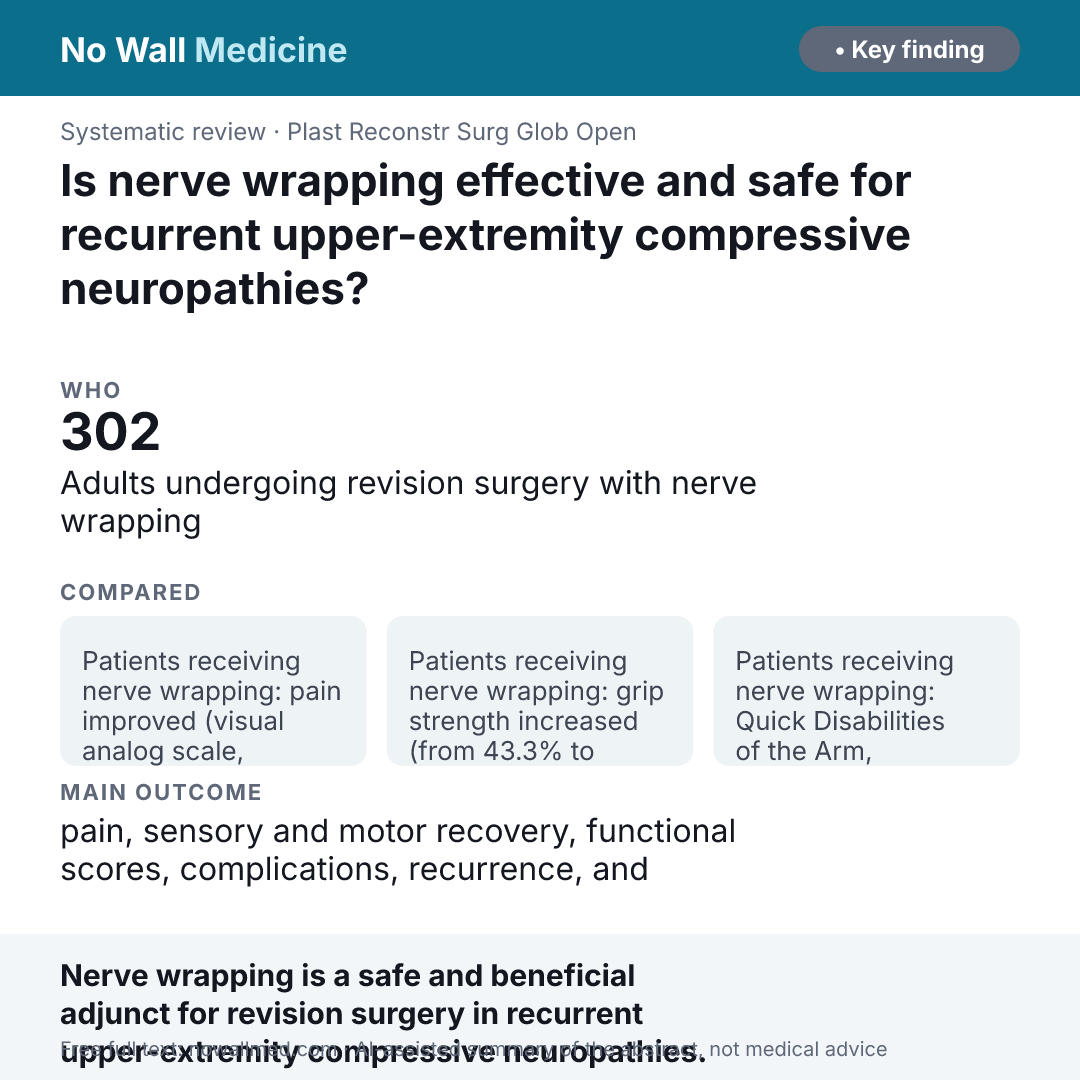
Clinical question: Is nerve wrapping effective and safe for recurrent upper-extremity compressive neuropathies?
Key points
- Researchers reviewed 17 studies involving 302 patients who underwent revision surgery using either the patient's own tissue or external materials to wrap nerves.
- Results showed pain scores decreased from 6.2 to 2.0, grip strength increased from 43.3% to 77.0%, and Quick Disabilities of the Arm, Shoulder, and Hand scores fell from 59.9 to 28.0.
- The procedure was associated with 98.2% patient satisfaction, a 4.6% complication rate, and 0.7% reoperation rate during a mean follow-up of 26.6 months.
Headline and key points written with AI from the paper’s abstract, with every number checked against it. Read the paper before relying on them.
Was this summary helpful?
Abstract
Background
Recurrent upper-extremity compressive neuropathies can lead to persistent sensory and motor dysfunction. Nerve wrapping is used to reduce perineural fibrosis and improve nerve gliding after revision decompression. This systematic review evaluates outcomes of revision neurolysis using autologous (eg, vein, fat, synovium) and nonautologous (eg, amniotic membrane, extracellular matrix, collagen) nerve wraps. Methods
Following PRISMA (preferred reporting items for systematic reviews and meta-analyses) 2020 guidelines (PROSPERO: CRD420251088116), PubMed, Ovid MEDLINE, Web of Science, and Google Scholar were searched through August 2025. Eligible studies included adults undergoing revision surgery with nerve wrapping. Reported outcomes included pain, sensory and motor recovery, functional scores, complications, recurrence, and patient satisfaction. Results
Seventeen studies (16 case series, 1 cohort) involving 302 patients were included. Pain improved (visual analog scale, 6.2-2.0), grip strength increased (from 43.3% to 77.0%), and QuickDASH (Quick Disabilities of the Arm, Shoulder, and Hand) scores decreased (from 59.9 to 28.0). Sensory recovery and nerve conduction findings were consistently favorable. Overall satisfaction was high (98.2%), with low complication rates (4.6%), minimal reoperations (0.7%), and no reported recurrences during a mean 26.6-month follow-up. Both autologous and nonautologous materials demonstrated safety and efficacy, with choice varying by surgical context and availability. Conclusions
The available data suggest that neurolysis with nerve wrapping may be a safe and beneficial adjunct in revision surgery for recurrent upper-extremity compressive neuropathies. Prospective multicenter studies are needed to compare wrapping materials and assess long-term durability.
Abstract reproduced under the article’s CC BY-NC-ND licence.
Headline, design, result, key points, caveat and citation as plain text.
Cite this article
Aldaghri F, Alghamdi M, Alghamdi AM, et al. Efficacy and Safety of Nerve Wrapping in Recurrent Upper-extremity Compressive Neuropathies: A Systematic Review. Plast Reconstr Surg Glob Open. 2026;14(8):e8041. doi:10.1097/GOX.0000000000008041
Spotted a mistake? Suggest a correction