Efficacy and safety of pharmacotherapy for refractory or unexplained chronic cough: a systematic review and network meta-analysis
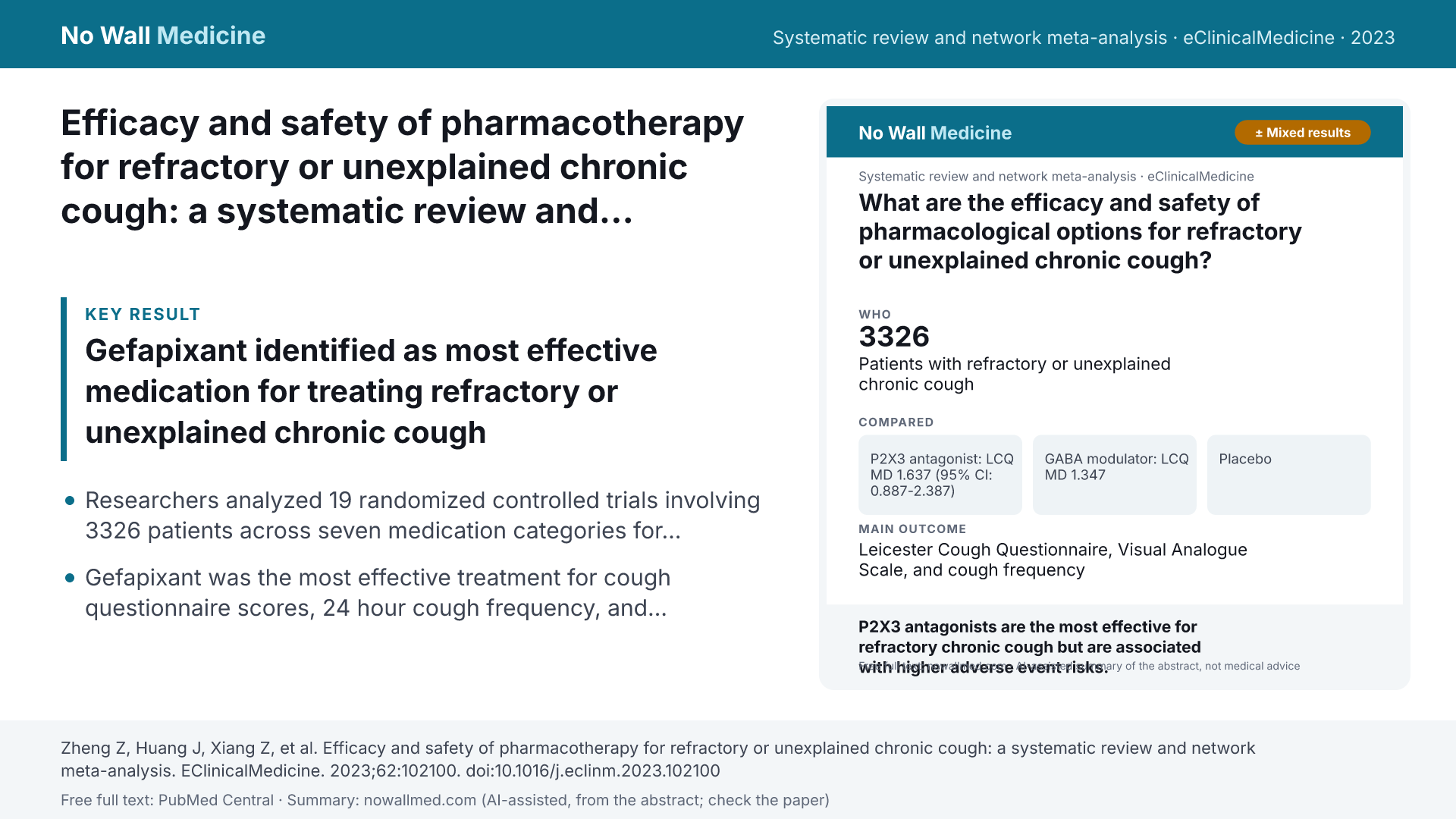
Key result: Gefapixant identified as most effective medication for treating refractory or unexplained chronic cough
Systematic review and network meta-analysisMixed results
What are the efficacy and safety of pharmacological options for refractory or unexplained chronic cough?
Who
3326
Patients with refractory or unexplained chronic cough
Compared
P2X3 antagonist: LCQ MD 1.637 (95% CI: 0.887-2.387)
GABA modulator: LCQ MD 1.347
Placebo
Main outcome
Leicester Cough Questionnaire, Visual Analogue Scale, and cough frequency
Result: P2X3 antagonist adverse events RR 1.129 (95% CI 1.012-1.259)
Bottom line: P2X3 antagonists are the most effective for refractory chronic cough but are associated with higher adverse event risks.
Limitation: Further research is needed to determine the potential beneficiary population for optimizing management.
eClinicalMedicine · 2023-07-20 · Funded by National Natural Science Foundation of China and others
Key points
- Researchers analyzed 19 randomized controlled trials involving 3326 patients across seven medication categories for refractory chronic cough.
- Gefapixant was the most effective treatment for cough questionnaire scores, 24 hour cough frequency, and cough severity.
- P2X3 antagonists were associated with a higher risk of adverse events, particularly taste-related issues with a relative risk of 6.216.
Why it matters: The optimal pharmacological treatment for refractory chronic cough remains controversial and difficult to manage clinically.
Discussion prompts
- Would these patients look like yours? Who was left out?
- Is the main outcome one that matters to patients?
- Is the difference large enough to change what you do?
Cite: Zheng Z, Huang J, Xiang Z, et al. Efficacy and safety of pharmacotherapy for refractory or unexplained chronic cough: a systematic review and network meta-analysis. EClinicalMedicine. 2023;62:102100. doi:10.1016/j.eclinm.2023.102100
Free full text: PubMed Central · Summary and visual abstract: nowallmed.com/a/efficacy-and-safety-of-pharmacotherapy-for-refractory-or-unexplained-1hs65ro/ (AI-assisted from the abstract; check the paper before relying on it).