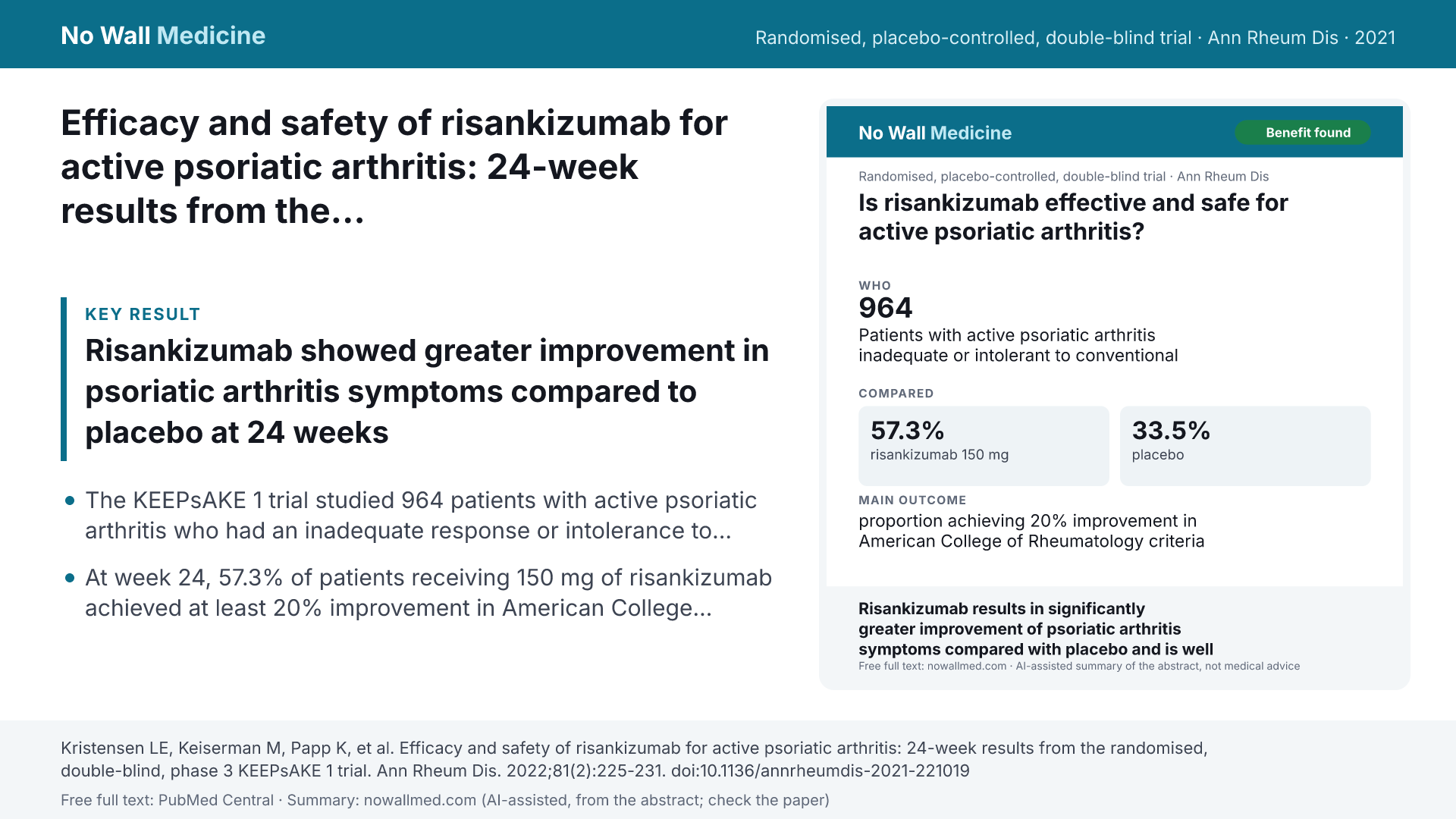
Risankizumab showed greater improvement in psoriatic arthritis symptoms compared to placebo at 24 weeks
Efficacy and safety of risankizumab for active psoriatic arthritis: 24-week results from the randomised, double-blind, phase 3 KEEPsAKE 1 trial
Randomised, placebo-controlled, double-blind trialBenefit found
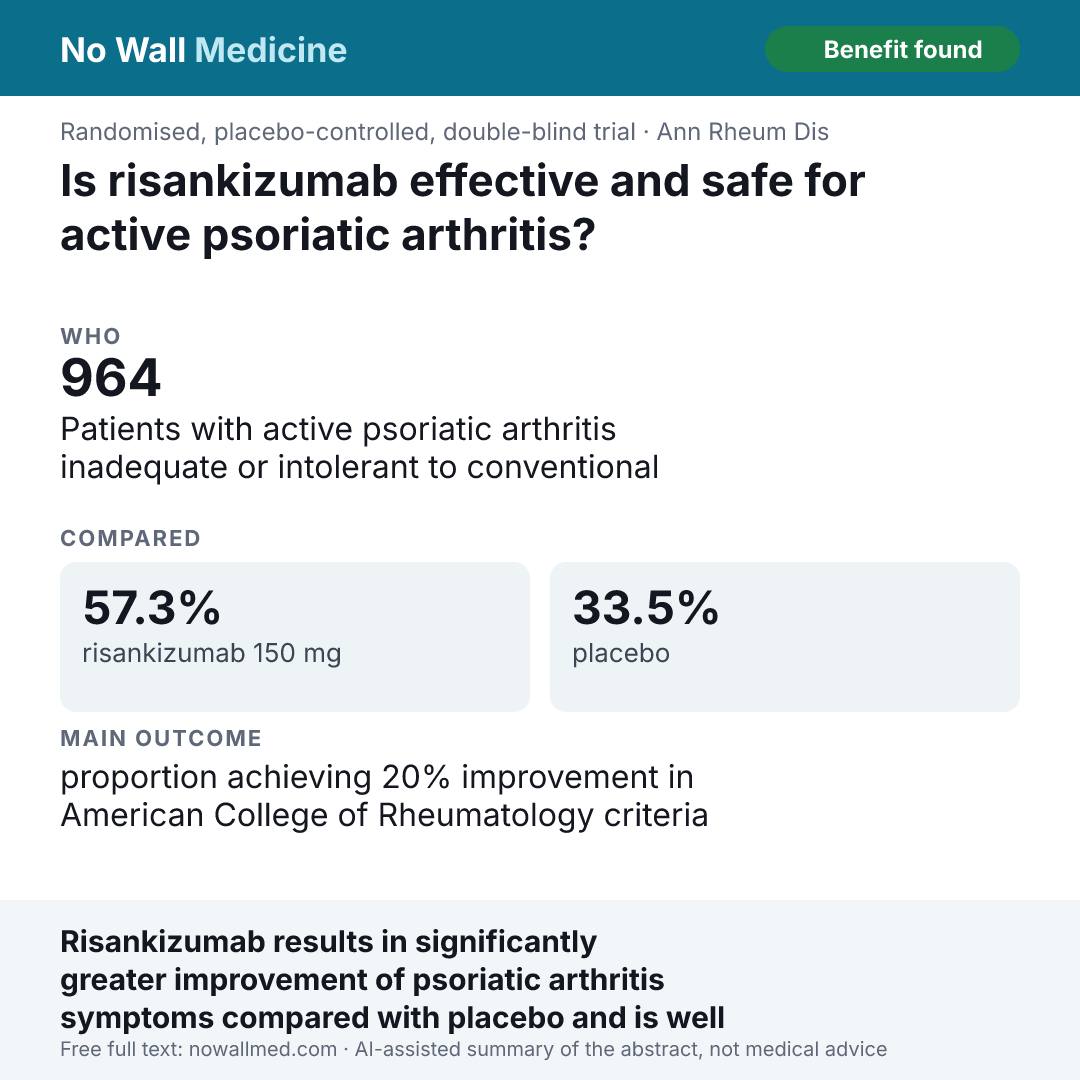
Is risankizumab effective and safe for active psoriatic arthritis?
Who
964
Patients with active psoriatic arthritis inadequate or intolerant to conventional synthetic disease-modifying antirheumatic drugs
Compared
57.3%risankizumab 150 mg
33.5%placebo
Main outcome
proportion achieving 20% improvement in American College of Rheumatology criteria
Bottom line: Risankizumab results in significantly greater improvement of psoriatic arthritis symptoms compared with placebo and is well tolerated.
Ann Rheum Dis · 2021-12-15 · Save PNG
Same trial (NCT03675308)
Papers we list that report this registered trial, oldest first. Read a secondary analysis alongside the main results.
- Main results Benefit found
This paper Ann Rheum Dis 2021-12 - Related analysis Benefit found
Risankizumab improved quality of life, fatigue, pain, and work productivity in psoriatic arthritis patients Rheumatology 2022-07 - Related analysis
Risankizumab showed long-term efficacy for patients with active psoriatic arthritis at 52 weeks Rheumatology 2022-10 - Secondary analysis Benefit found
Risankizumab effective across five psoriatic arthritis phenotypes in long-term trial data Arthritis Res Ther 2025-11
Clinical question: Is risankizumab effective and safe for active psoriatic arthritis?
In absolute numbers
risankizumab 150 mg: 57.3% · placebo: 33.5% → a difference of 23.8 percentage points, so about 5 people would need the treatment for 1 more to benefit (number needed to treat) over the trial’s follow-up.
Worked out by us from the two group results above, not reported by the authors. Check the paper for the exact outcome and timing.
Key points
- The KEEPsAKE 1 trial studied 964 patients with active psoriatic arthritis who had an inadequate response or intolerance to at least one conventional synthetic disease-modifying antirheumatic drug.
- At week 24, 57.3% of patients receiving 150 mg of risankizumab achieved at least 20% improvement in American College of Rheumatology criteria compared to 33.5% for the placebo group.
- Serious infections occurred in 1.0% of the risankizumab group and 1.2% of the placebo group, with adverse events reported at similar rates between both groups.
Headline and key points written with AI from the paper’s abstract, with every number checked against it. Read the paper before relying on them.
Was this summary helpful?
Abstract
Objective
To evaluate risankizumab, a biological therapy that inhibits interleukin 23, in patients with active psoriatic arthritis (PsA) who have responded inadequately or are intolerant to ≥1 conventional synthetic disease-modifying antirheumatic drug (csDMARD). Methods
In the randomised, placebo-controlled, double-blind KEEPsAKE 1 trial, 964 patients with active PsA were randomised (1:1) to receive risankizumab 150 mg or placebo at weeks 0, 4 and 16. The primary endpoint was the proportion of patients achieving ≥20% improvement in American College of Rheumatology criteria (ACR20) at week 24. Here, we report the results from the 24-week double-blind period; the open-label period with all patients receiving risankizumab is ongoing. Results
At week 24, a significantly greater proportion of patients receiving risankizumab achieved the primary endpoint of ACR20 (57.3% vs placebo, 33.5%; p<0.001). Significant differences were also observed for risankizumab versus placebo for the first eight ranked secondary endpoints, including skin and nail psoriasis endpoints, minimal disease activity and resolution of enthesitis and dactylitis (p<0.001). Adverse events and serious adverse events were reported at similar rates in the risankizumab and placebo groups. Serious infections were reported for 1.0% and 1.2% of patients receiving risankizumab and placebo, respectively. There was one death in the risankizumab group (urosepsis deemed unrelated to the study drug). Conclusions
Risankizumab treatment results in significantly greater improvement of signs and symptoms of PsA compared with placebo and is well tolerated in patients with active PsA who have responded inadequately or are intolerant to ≥1 csDMARD. Trial registration number
NCT03675308.
Abstract reproduced under the article’s CC BY NC licence.
Subject terms
Headline, design, result, key points, caveat and citation as plain text.
Cite this article
Kristensen LE, Keiserman M, Papp K, et al. Efficacy and safety of risankizumab for active psoriatic arthritis: 24-week results from the randomised, double-blind, phase 3 KEEPsAKE 1 trial. Ann Rheum Dis. 2022;81(2):225-231. doi:10.1136/annrheumdis-2021-221019
Spotted a mistake? Suggest a correction