Sequential belimumab and rituximab therapy showed no superiority over belimumab and placebo for lupus disease control
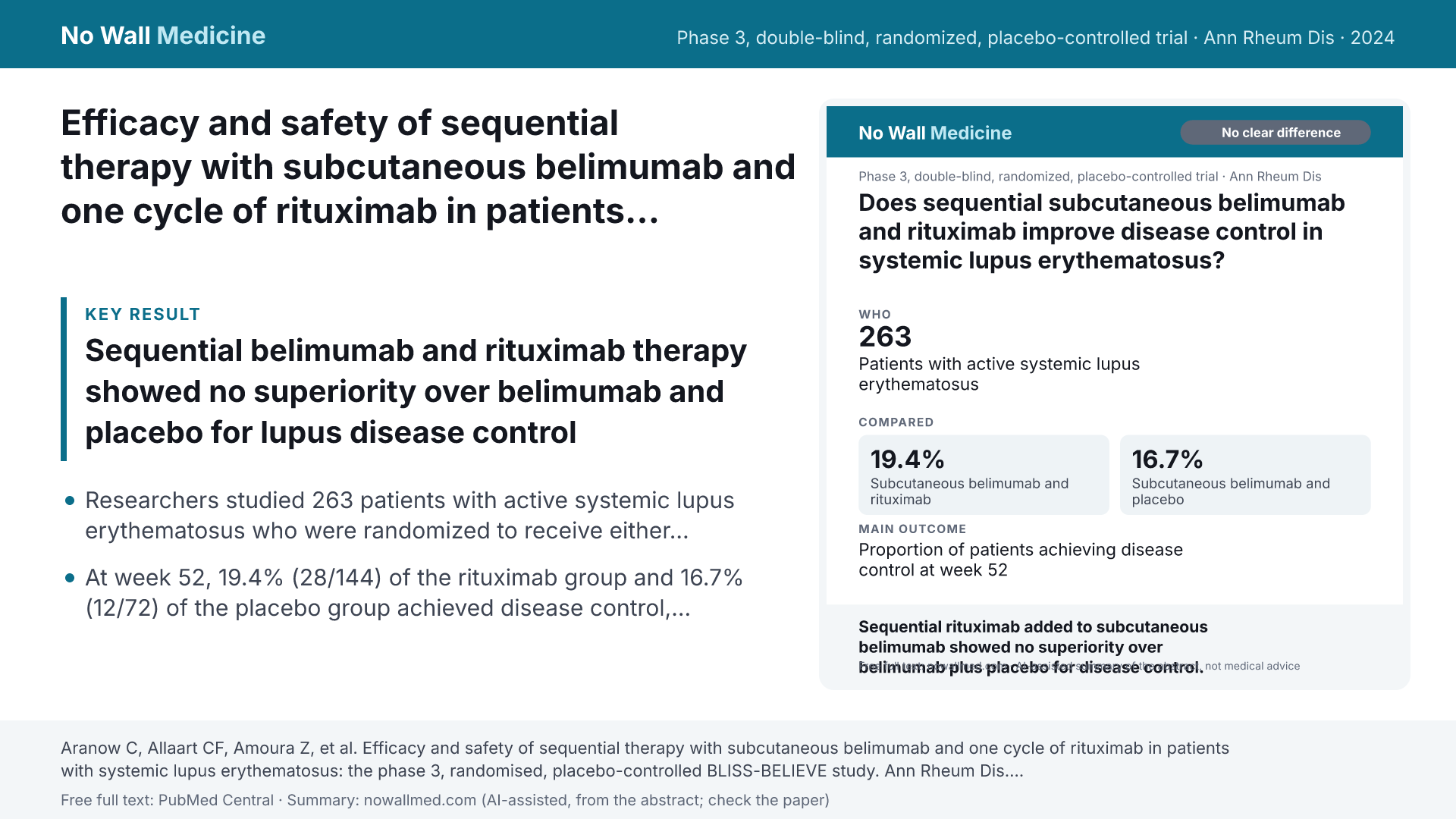
Efficacy and safety of sequential therapy with subcutaneous belimumab and one cycle of rituximab in patients with systemic lupus erythematosus: the phase 3, randomised, placebo-controlled BLISS-BELIEVE study
Phase 3, double-blind, randomized, placebo-controlled trialNo clear difference
Does sequential subcutaneous belimumab and rituximab improve disease control in systemic lupus erythematosus?
Who
263
Patients with active systemic lupus erythematosus
Compared
19.4%Subcutaneous belimumab and rituximab (28/144)
16.7%Subcutaneous belimumab and placebo (12/72)
Main outcome
Proportion of patients achieving disease control at week 52
Result: odds ratio 1.27 (95% CI 0.60 to 2.71)
Bottom line: Sequential rituximab added to subcutaneous belimumab showed no superiority over belimumab plus placebo for disease control.
Ann Rheum Dis · 2024-10-21Download image
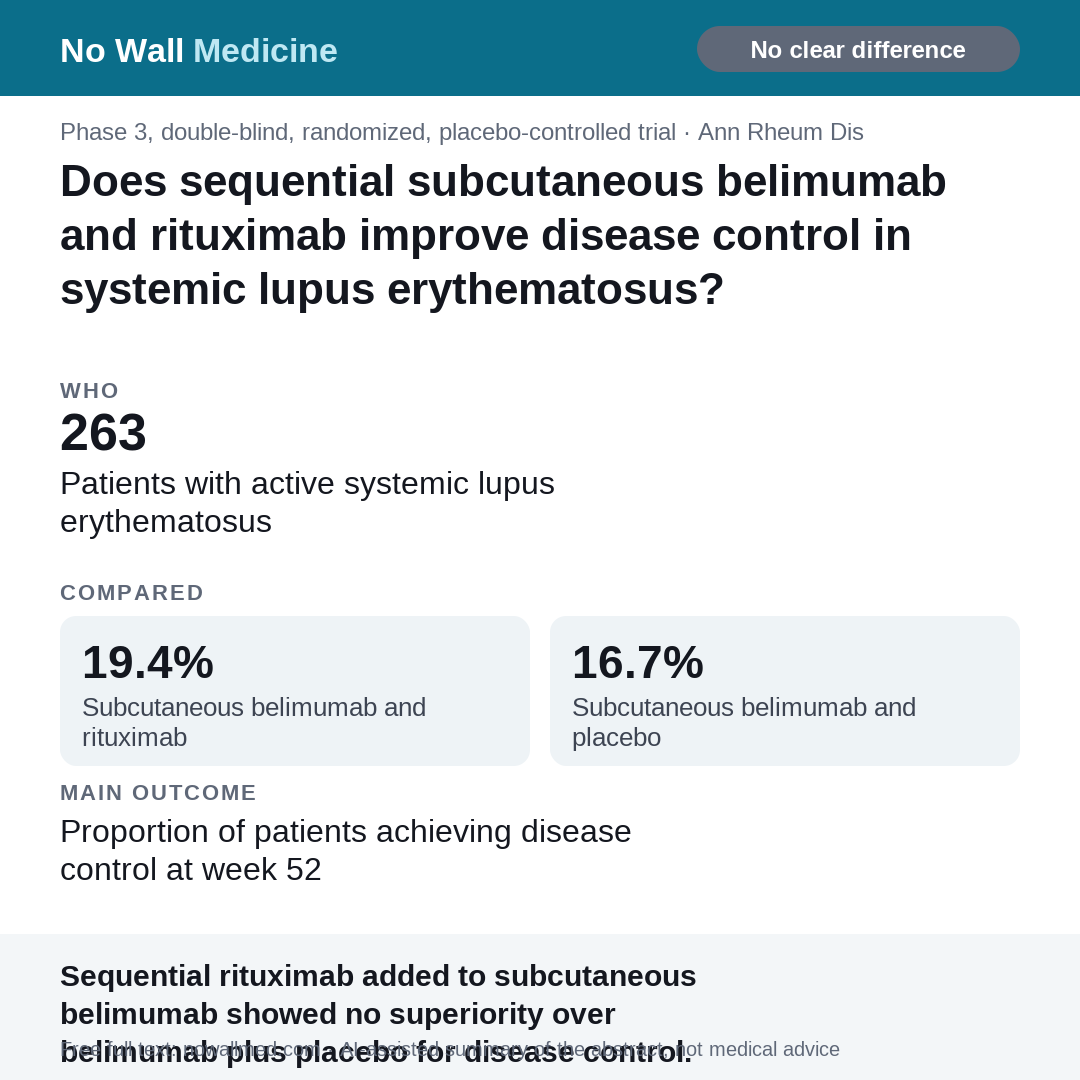
Clinical question: Does sequential subcutaneous belimumab and rituximab improve disease control in systemic lupus erythematosus?
Why it matters: It is unknown if adding one cycle of rituximab to subcutaneous belimumab allows patients with systemic lupus erythematosus to stop using immunosuppressants and steroids.
Key points
- Researchers studied 263 patients with active systemic lupus erythematosus who were randomized to receive either rituximab or a placebo alongside subcutaneous belimumab.
- At week 52, 19.4% (28/144) of the rituximab group and 16.7% (12/72) of the placebo group achieved disease control, which was not a statistically significant difference.
- The rituximab group had lower anti-dsDNA antibodies and most assessed B cells, which are specific white blood cells, compared to the placebo group.
Headline and key points written with AI from the paper’s abstract, with every number checked against it. Read the paper before relying on them.
Was this summary helpful?
Abstract
Objectives
Disease activity control in patients with systemic lupus erythematosus (SLE) with corticosteroid and immunosuppressant withdrawal is a treatment goal. We evaluated whether this could be attained with sequential subcutaneous belimumab (BEL) and one cycle of rituximab (RTX). Methods
In this phase 3, double-blind BLISS-BELIEVE trial (GSK Study 205646), patients with active SLE initiating subcutaneous BEL 200 mg/week for 52 weeks were randomised to intravenous placebo (BEL/PBO) or intravenous RTX 1000 mg (BEL/RTX) at weeks 4 and 6 while stopping concomitant immunosuppressants/tapering corticosteroids; standard therapy for 104 weeks (BEL/ST; reference arm) was included. Primary endpoint
proportion of patients achieving disease control (SLE Disease Activity Index-2000 (SLEDAI-2K) ≤2; without immunosuppressants; prednisone equivalent ≤5 mg/day) at week 52 with BEL/RTX versus BEL/PBO. Major (alpha-controlled) secondary endpoints: proportion of patients with clinical remission (week 64; clinical SLEDAI-2K=0, without immunosuppressants/corticosteroids); proportion of patients with disease control (week 104). Other assessments: disease control duration, anti-dsDNA antibody, C3/C4 and B cells/B-cell subsets. Results
The modified intention-to-treat population included 263 patients. Overall, 16.7% (12/72) of BEL/PBO and 19.4% (28/144) of BEL/RTX patients achieved disease control (OR (95% CI) 1.27 (0.60 to 2.71); p=0.5342) at week 52. For major secondary endpoints, differences between BEL/RTX and BEL/PBO were not statistically significant. Anti-dsDNA antibodies and most assessed B cells/B-cell subsets were lower with BEL/RTX versus BEL/PBO. Mean disease control duration through 52 weeks was significantly greater with BEL/RTX versus BEL/PBO. Conclusions
BEL/RTX showed no superiority over BEL/PBO for most endpoints analysed; however, it led to significant improvements in disease activity markers compared with BEL/PBO. Further investigation of combination treatment is warranted. Trial registration number
NCT03312907.
Abstract reproduced under the article’s CC BY NC licence.
Subject terms
Cite this article
Aranow C, Allaart CF, Amoura Z, et al. Efficacy and safety of sequential therapy with subcutaneous belimumab and one cycle of rituximab in patients with systemic lupus erythematosus: the phase 3, randomised, placebo-controlled BLISS-BELIEVE study. Ann Rheum Dis. 2024. doi:10.1136/ard-2024-225686
Spotted a mistake? Suggest a correction