Brain stimulation did not improve upper extremity recovery after ischemic stroke in a randomized trial
Efficacy and safety of transcranial direct current stimulation to the ipsilesional motor cortex in subacute stroke (NETS): a multicenter, randomized, double-blind, placebo-controlled trial
Randomized, double-blind, placebo-controlled trialNo clear difference
Does transcranial direct current stimulation improve upper extremity motor recovery after ischemic stroke?
Who
123
Patients in the subacute phase after ischemic stroke · Multicenter
Compared
Control: 8.9 (SD 7.7) UEFMA points
Transcranial direct current stimulation: 9.0 (8.8) points
Main outcome
Upper extremity impairment measured by Fugl-Meyer Assessment
Bottom line: Transcranial direct current stimulation to the motor cortex is safe but does not improve upper extremity recovery.
Funded by: Deutsche Forschungsgemeinschaft
Lancet Reg Health Eur · 2024-01-02 · Save PNG
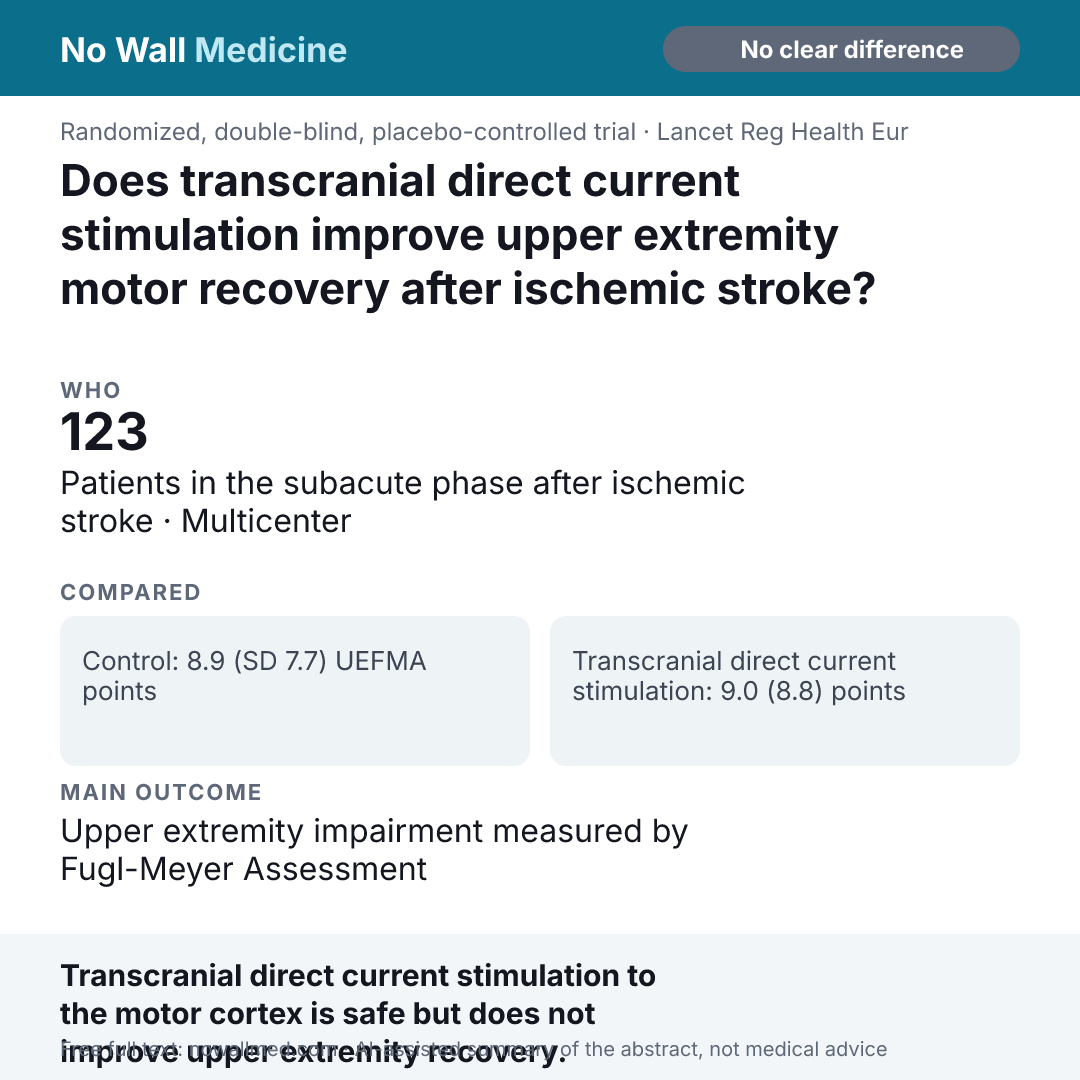
Clinical question: Does transcranial direct current stimulation improve upper extremity motor recovery after ischemic stroke?
Why it matters: Large, randomized multicenter trials are lacking regarding whether non-invasive brain stimulation can enhance motor recovery after an ischemic stroke.
Key points
- Researchers studied 123 patients receiving either anodal transcranial direct current stimulation (a type of non-invasive brain stimulation) or a placebo alongside rehabilitation.
- The stimulation group improved by 9.0 (8.8) points on the Fugl-Meyer Assessment for upper extremity, while the control group improved by 8.9 (7.7) points.
- The study found no difference in upper extremity impairment between the active stimulation and placebo groups, though the stimulation was safe with no seizures.
Headline and key points written with AI from the paper’s abstract, with every number checked against it. Read the paper before relying on them.
Was this summary helpful?
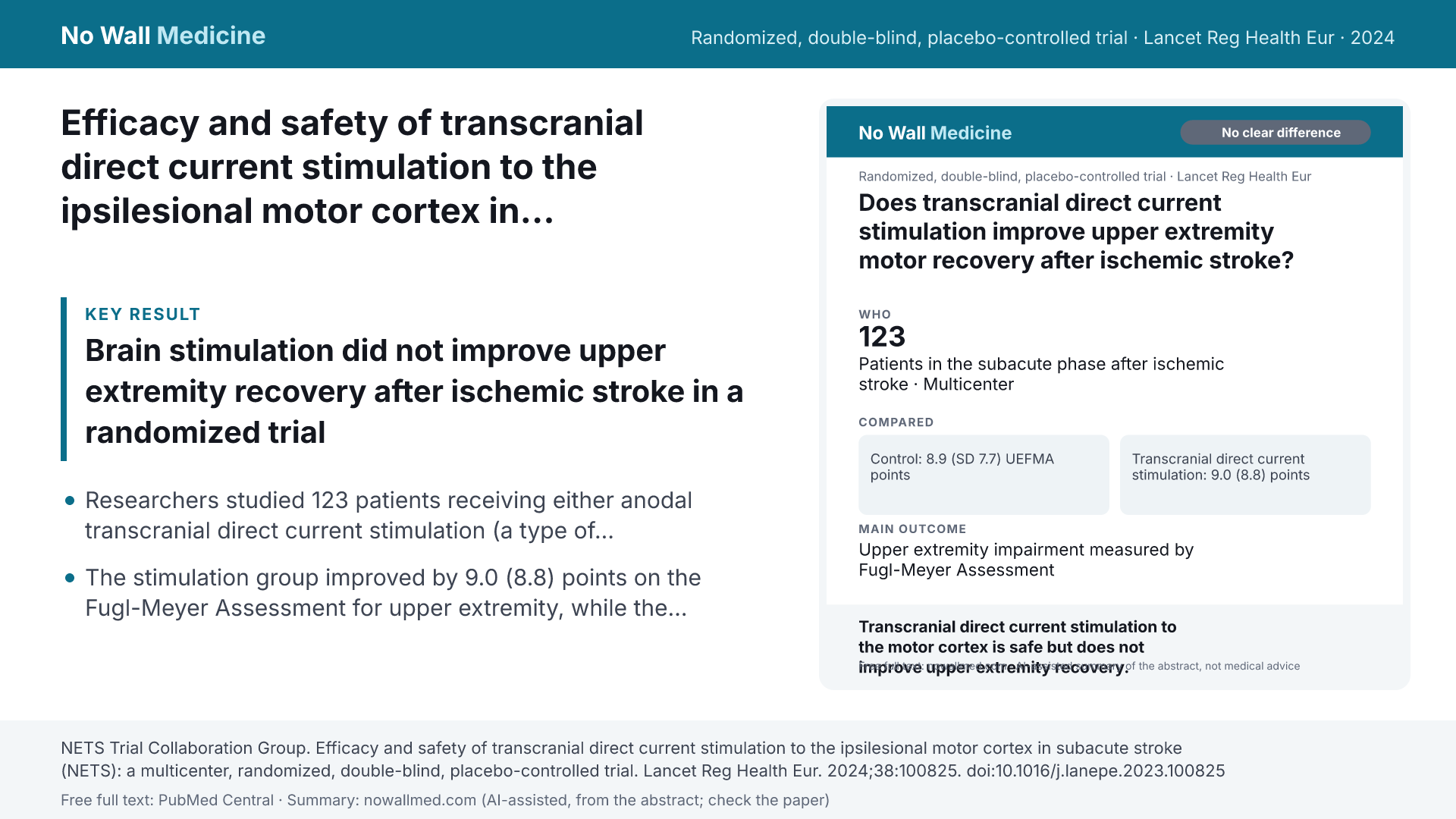
Headline, design, result, key points, caveat and citation as plain text.
Cite this article
NETS Trial Collaboration Group. Efficacy and safety of transcranial direct current stimulation to the ipsilesional motor cortex in subacute stroke (NETS): a multicenter, randomized, double-blind, placebo-controlled trial. Lancet Reg Health Eur. 2024;38:100825. doi:10.1016/j.lanepe.2023.100825
Spotted a mistake? Suggest a correction