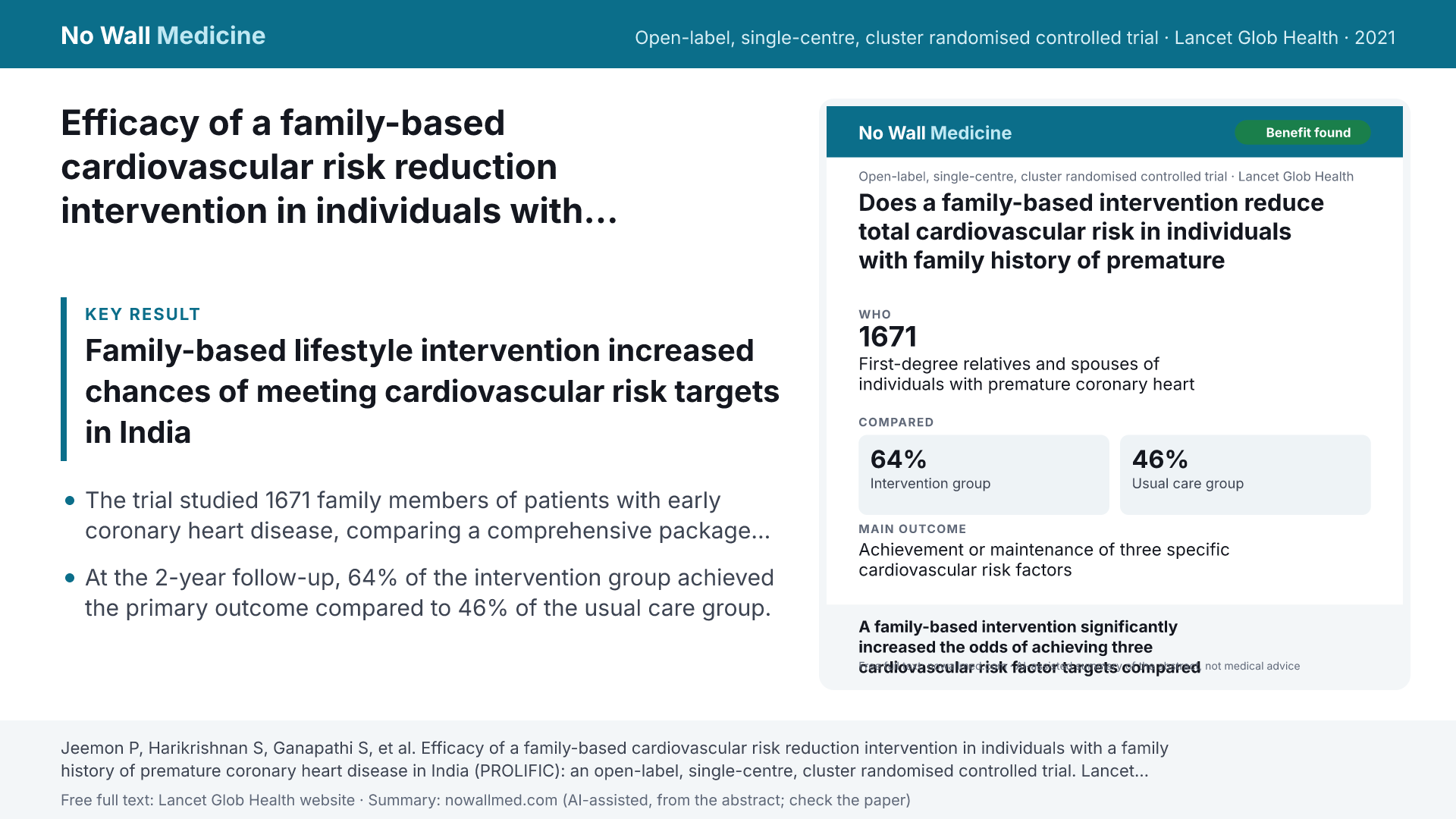
Family-based lifestyle intervention increased chances of meeting cardiovascular risk targets in India
Efficacy of a family-based cardiovascular risk reduction intervention in individuals with a family history of premature coronary heart disease in India (PROLIFIC): an open-label, single-centre, cluster randomised controlled trial
Open-label, single-centre, cluster randomised controlled trialBenefit found
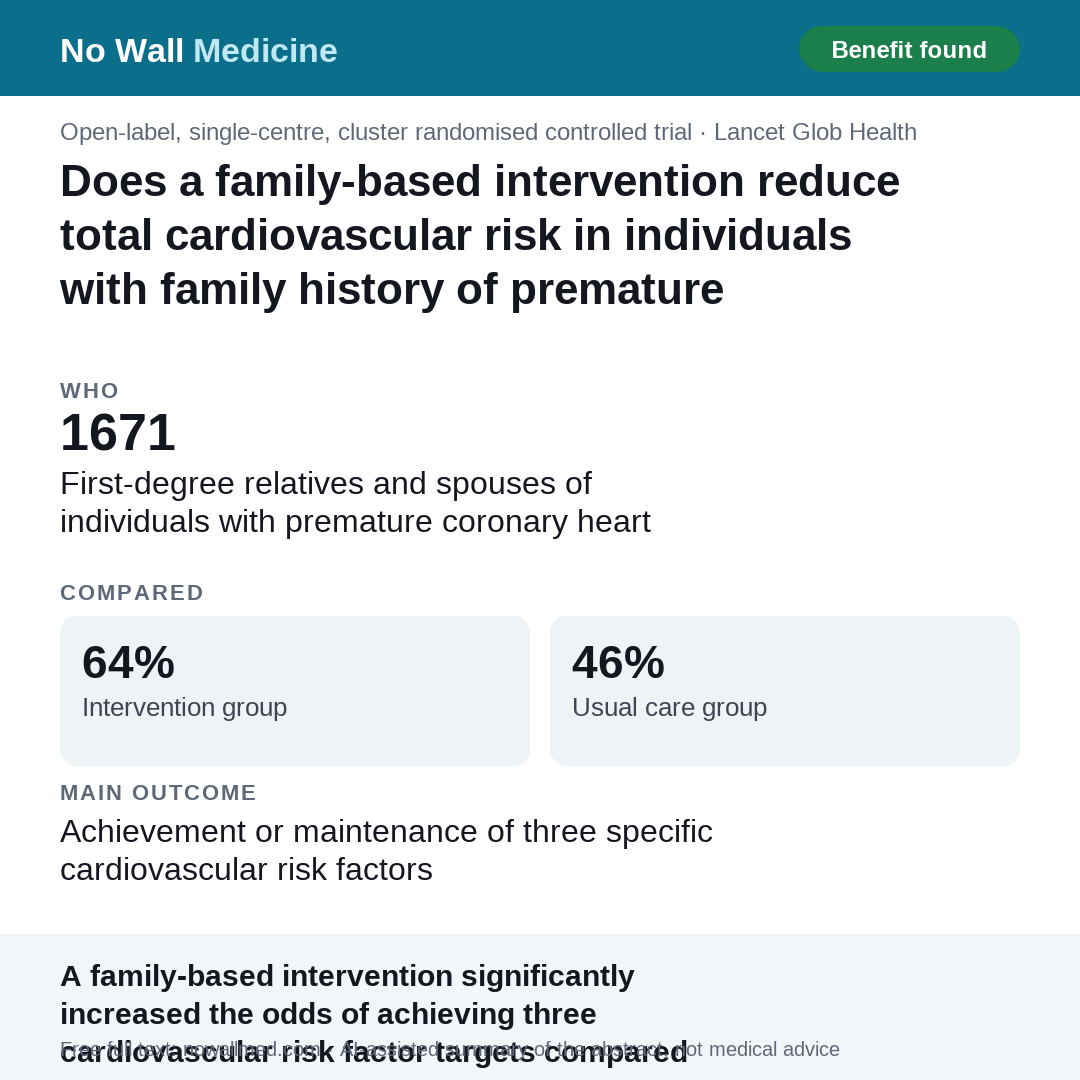
Does a family-based intervention reduce total cardiovascular risk in individuals with family history of premature coronary heart disease?
Who
1671
First-degree relatives and spouses of individuals with premature coronary heart disease · Tertiary care speciality hospital in Kerala, India
Compared
64%Intervention group (514/803)
46%Usual care group (379/819)
Main outcome
Achievement or maintenance of three specific cardiovascular risk factors
Result: odds ratio 2·2 (95% CI 1·7-2·7)
Bottom line: A family-based intervention significantly increased the odds of achieving three cardiovascular risk factor targets compared to usual care.
Funded by: Wellcome Trust, Department of Biotechnology, Government of India, and India Alliance
Lancet Glob Health · 2021-09-17Download image
Clinical question: Does a family-based intervention reduce total cardiovascular risk in individuals with family history of premature coronary heart disease?
Why it matters: It was unknown if a targeted family-based intervention could effectively reduce total cardiovascular risk in relatives of individuals with premature coronary heart disease.
In absolute numbers
Intervention group: 64% · Usual care group: 46% → a difference of 18 percentage points, so about 6 people would need the treatment for 1 more to benefit (number needed to treat) over the trial’s follow-up.
Worked out by us from the two group results above, not reported by the authors. Check the paper for the exact outcome and timing.
Key points
- The trial studied 1671 family members of patients with early coronary heart disease, comparing a comprehensive package led by health workers to usual care.
- At the 2-year follow-up, 64% of the intervention group achieved the primary outcome compared to 46% of the usual care group.
- After adjusting for baseline factors, the odds of achieving the primary outcome were 2.2 times higher in the intervention group than in the usual care group.
Headline and key points written with AI from the paper’s abstract, with every number checked against it. Read the paper before relying on them.
Was this summary helpful?
Abstract
Background
Coronary heart disease, a leading cause of death globally, is amenable to lifestyle interventions. The family environment can affect the ability or willingness of individuals to make lifestyle changes. We aimed to investigate the efficacy of a targeted family-based intervention for reduction of total cardiovascular risk in individuals with a family history of premature coronary heart disease. Methods
We did an open-label, cluster randomised controlled trial (PROLIFIC) in the families (first-degree relatives and spouses, older than age 18 years) of individuals with coronary heart disease who had been diagnosed before age 55 years. Patients with coronary heart disease diagnosed within the past year were selected from a tertiary care speciality hospital that provides care for patients from Kerala, India. Family members of selected patients who were bedridden or terminally ill, and individuals with a history of established cardiovascular heart disease and stroke were excluded, as were families with fewer than two eligible family members. Simple randomisation with computer-generated random numbers was used to randomly assign families to intervention and usual care groups (1:1). Participants in the intervention group received a comprehensive package of interventions facilitated by non-physician health workers, consisting of: screening for cardiovascular risk factors; structured lifestyle interventions; linkage to a primary health-care facility for individuals with established chronic disease risk factors or conditions; and active follow-up for adherence. The usual care group received one-time counselling and annual screening for risk factors. We obtained data on lifestyle, clinical, and biochemical characteristics at baseline and annually during the 2-year follow-up. The primary outcome was achievement or maintenance of any three of the following: blood pressure lower than 140/90 mm Hg, fasting plasma glucose lower than 110 mg/dL, low-density lipoprotein cholesterol lower than 100 mg/dL, and abstinence from tobacco. The primary outcome was analysed in all participants available for follow-up at the relevant timepoint. This trial is registered with Clinicaltrials.gov, NCT02771873. Findings
From Jan 1, 2015, to April 30, 2017, 980 patients with coronary heart disease were assessed for eligibility and 230 were excluded primarily due to lack of evidence of coronary artery disease (n=199), or a diagnosis of coronary heart disease more than 1 year previously (n=29). Of the 750 remaining families, 368 (with 825 participants) were assigned to the intervention group and 382 (with 846 participants) were assigned to the usual care group. At the 2-year follow-up, data from 803 (97%) of 825 participants in the intervention group and 819 (97%) of 846 participants in the usual care group were available. Of the 1671 participants, 1111 (66·5%) were women, and 560 (33·5%) were men. The mean age of the study population was 40·8 years (SD 14·2). At the 2-year follow-up, the primary outcome was achieved by 514 (64%) of 803 participants in the intervention group and 379 (46%) of 819 in the usual care group. After adjustment for clustering and baseline risk factors, the odds of achieving the primary outcome at the 2-year timepoint was two times higher in the intervention group than in the usual care group (odds ratio 2·2, 95% CI 1·7-2·7; p<0·0001). Interpretation
The reduction of total cardiovascular risk observed after the intervention could have a substantial public health impact by preventing future cardiovascular events. Funding
The Wellcome Trust and Department of Biotechnology, Government of India, and India Alliance.
Abstract reproduced under the article’s CC BY licence.
Subject terms
Cite this article
Jeemon P, Harikrishnan S, Ganapathi S, et al. Efficacy of a family-based cardiovascular risk reduction intervention in individuals with a family history of premature coronary heart disease in India (PROLIFIC): an open-label, single-centre, cluster randomised controlled trial. Lancet Glob Health. 2021. doi:10.1016/S2214-109X(21)00319-3
Spotted a mistake? Suggest a correction