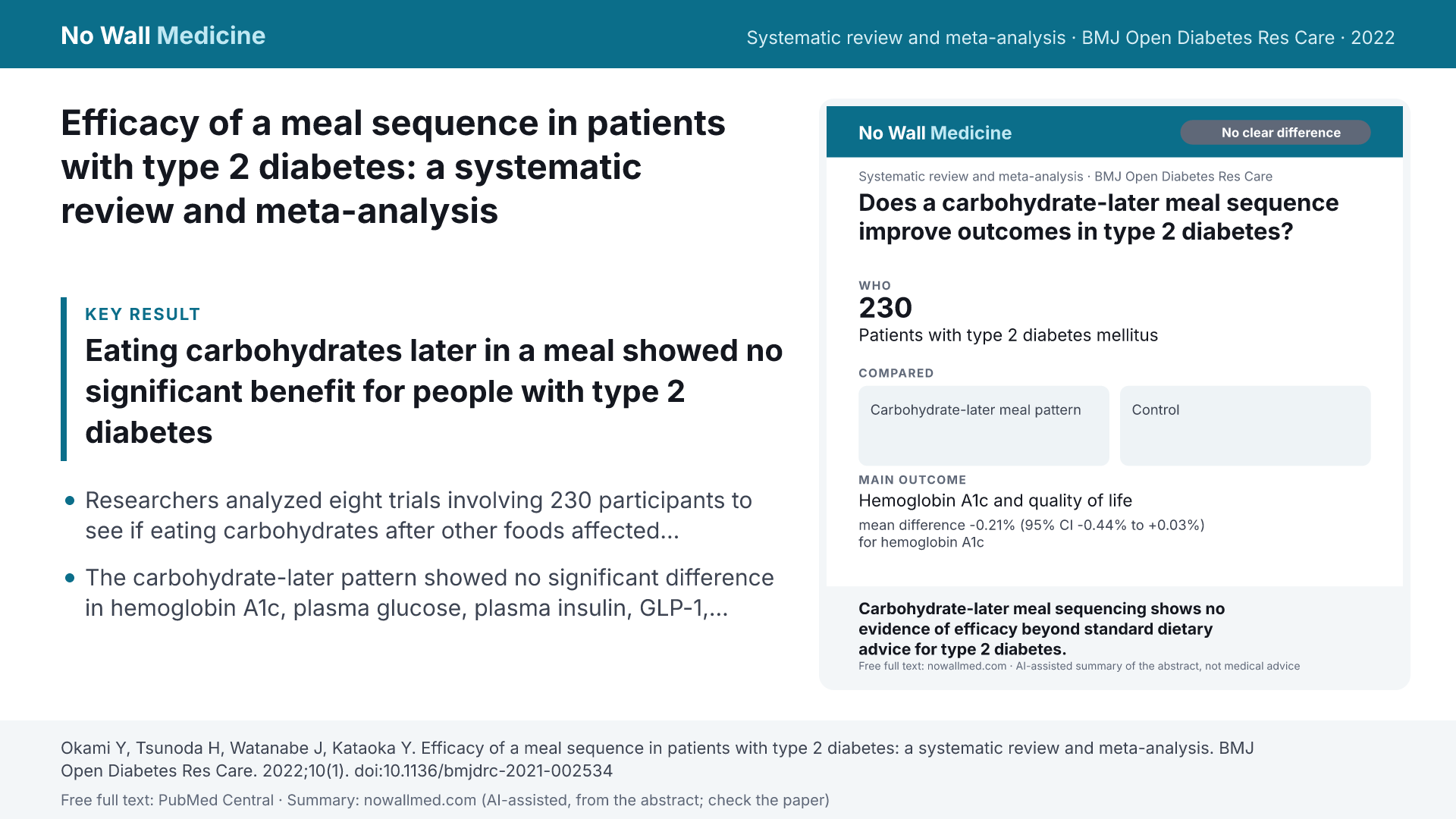
Eating carbohydrates later in a meal showed no significant benefit for people with type 2 diabetes
Efficacy of a meal sequence in patients with type 2 diabetes: a systematic review and meta-analysis
Systematic review and meta-analysisNo clear difference
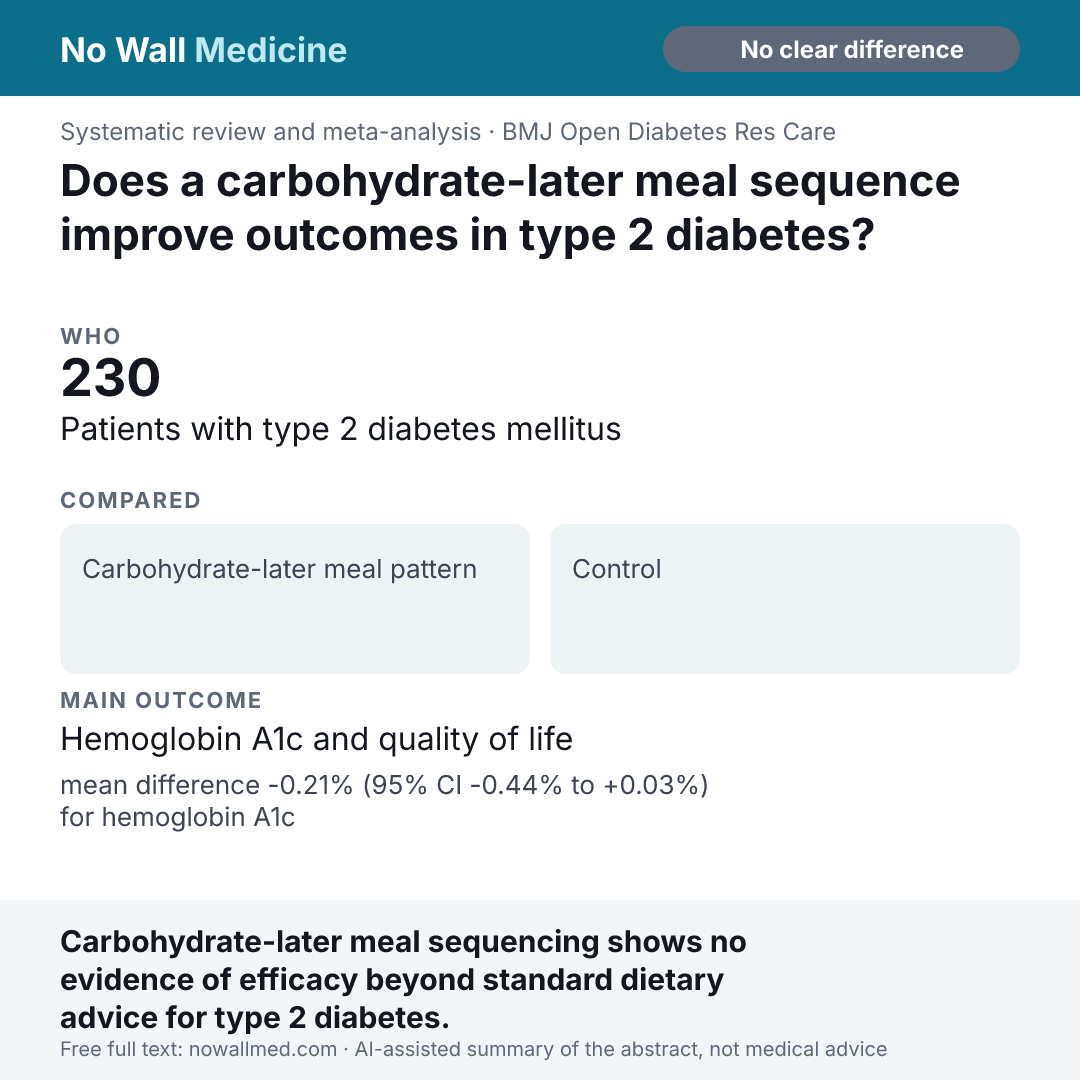
Does a carbohydrate-later meal sequence improve outcomes in type 2 diabetes?
Who
230
Patients with type 2 diabetes mellitus
Compared
Carbohydrate-later meal pattern
Control
Main outcome
Hemoglobin A1c and quality of life
Result: mean difference -0.21% (95% CI -0.44% to +0.03%) for hemoglobin A1c
Bottom line: Carbohydrate-later meal sequencing shows no evidence of efficacy beyond standard dietary advice for type 2 diabetes.
Limitation: All outcomes were of low-certainty or very low-certainty evidence.
BMJ Open Diabetes Res Care · 2022-02-25
Headline and visual abstract written with AI from the paper’s abstract, with every number checked against it. Read the paper before relying on them.
Was this summary helpful?
Abstract
Introduction
This systematic review investigated the efficacy of a meal sequence, the carbohydrate-later meal pattern (CL), on type 2 diabetes mellitus (T2DM). Research design and methods
We searched the Cochrane Central Register of Controlled Trials, MEDLINE, Embase, WHO International Clinical Trials Registry Platform, and ClinicalTrials.gov until April 2020 to perform meta-analyses using random-effects models. Primary outcomes were hemoglobin A1c (HbA1c) and quality of life. Secondary outcomes were plasma concentrations of glucose, insulin and incretin 120 min after a meal, and any adverse outcomes. The revised Cochrane risk-of-bias tool and Grading of Recommendations, Assessment, Development, and Evaluation approach were used to assess the quality of individual studies and the body of evidence, respectively. The present study was registered in the UMIN Clinical Trials Registry. Results
We included 230 participants in eight trials, including both trials that examined long-term changes (more than 2 months and less than 2 years) and short-term changes (in 2-hour postprandial values). CL resulted in a slight to no difference in HbA1c (mean difference (MD), -0.21% in the intervention group; 95% CI -0.44% to+0.03%), plasma glucose (MD,+4.94 mg/dL; 95% CI -8.34 mg/dL to +18.22 mg/dL), plasma insulin (MD, -3.63 μIU/mL; 95% CI -11.88 μIU/mL to +4.61 μIU/mL), plasma GLP-1 (MD, +0.43 pmol/L; 95% CI -0.69 pmol/L to +1.56 pmol/L), and plasma GIP (MD, -2.02 pmol/L; 95% CI -12.34 pmol/L to +8.31 pmol/L). All of these outcomes were of low-certainty evidence or very low-certainty evidence. None of the trials evaluated quality of life or adverse events. Conclusions
There was no evidence for the potential efficacy of recommending CL beyond standard dietary advice on T2DM. Trial registration number
UMIN000039979.
Abstract reproduced under the article’s CC BY NC licence.
Subject terms
Cite this article
Okami Y, Tsunoda H, Watanabe J, Kataoka Y. Efficacy of a meal sequence in patients with type 2 diabetes: a systematic review and meta-analysis. BMJ Open Diabetes Res Care. 2022;10(1). doi:10.1136/bmjdrc-2021-002534
Spotted a mistake? Suggest a correction