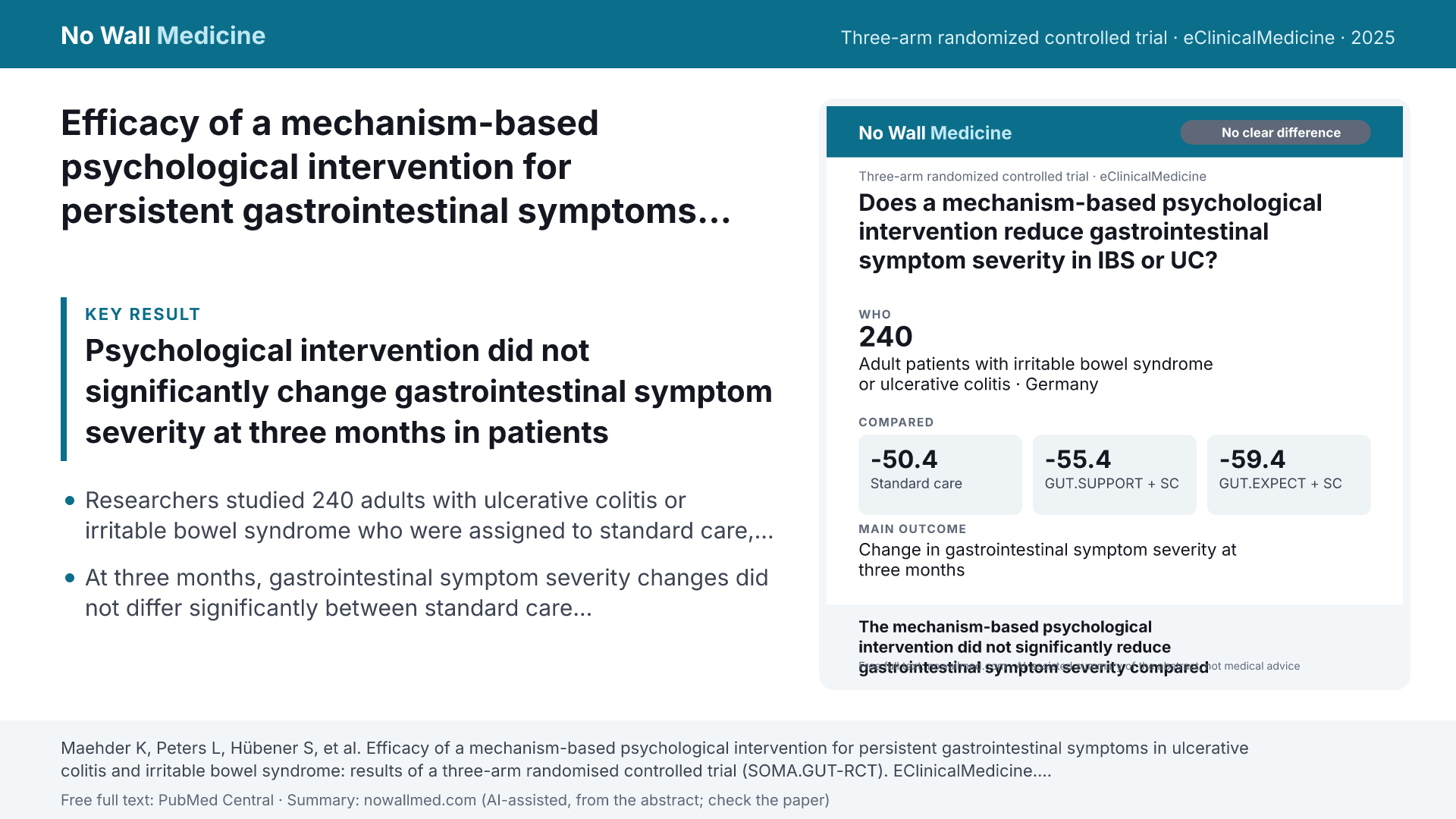
Psychological intervention did not significantly change gastrointestinal symptom severity at three months in patients
Efficacy of a mechanism-based psychological intervention for persistent gastrointestinal symptoms in ulcerative colitis and irritable bowel syndrome: results of a three-arm randomised controlled trial (SOMA.GUT-RCT)
Three-arm randomized controlled trialNo clear difference
Does a mechanism-based psychological intervention reduce gastrointestinal symptom severity in IBS or UC?
Who
240
Adult patients with irritable bowel syndrome or ulcerative colitis · Germany
Compared
-50.4Standard care (95% CI -70.7 to -30.1)
-55.4GUT.SUPPORT + SC (-75.0 to -35.9)
-59.4GUT.EXPECT + SC (-79.4 to -39.4)
Main outcome
Change in gastrointestinal symptom severity at three months
Bottom line: The mechanism-based psychological intervention did not significantly reduce gastrointestinal symptom severity compared to standard care at three months.
Limitation: Higher treatment intensity and broader biopsychosocial targeting may be required for immediate relief.
Funded by: German Research Foundation
eClinicalMedicine · 2025-11-28Download image
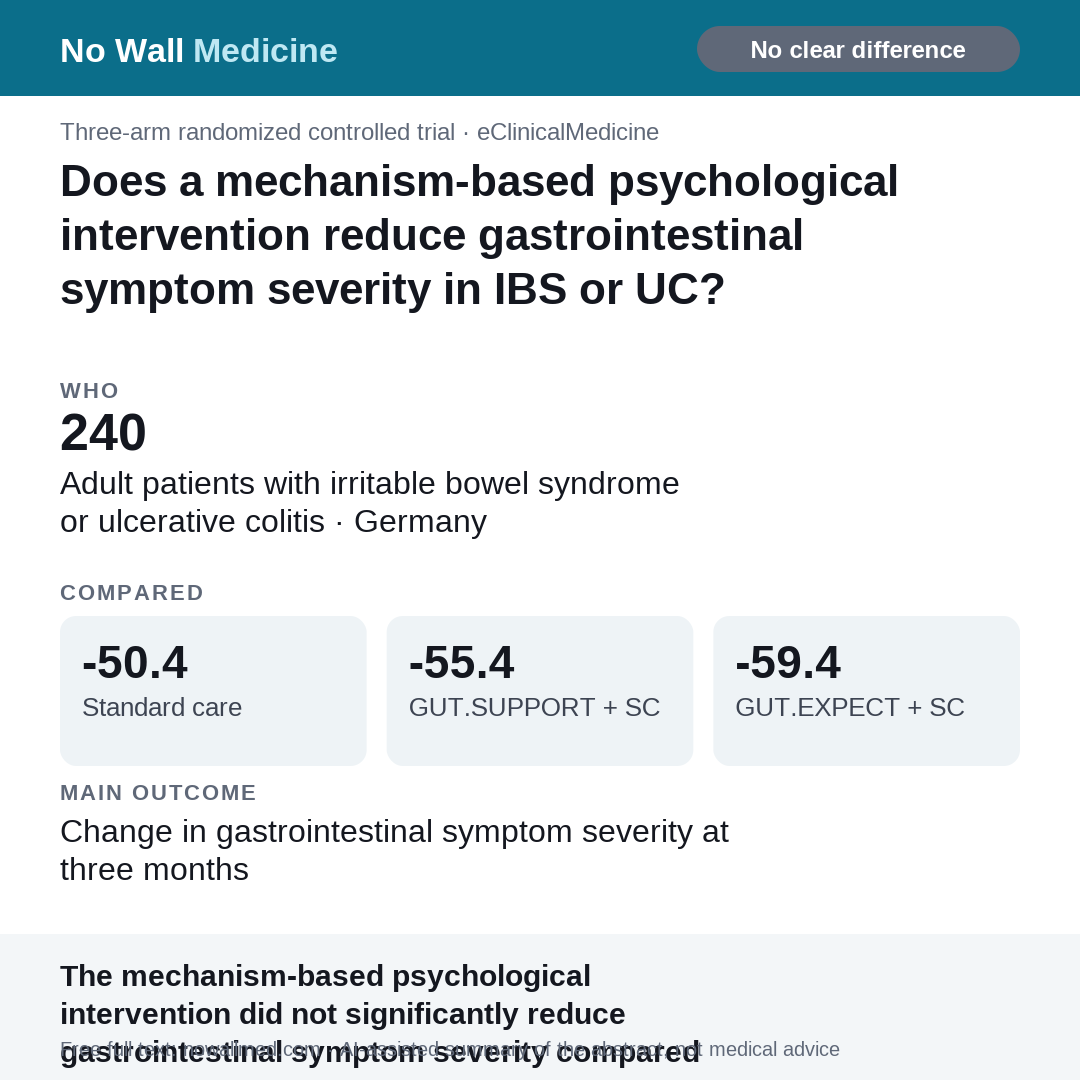
Clinical question: Does a mechanism-based psychological intervention reduce gastrointestinal symptom severity in IBS or UC?
Why it matters: It is unknown if a psychological intervention targeting illness-related anxiety and dysfunctional symptom expectations can reduce gastrointestinal symptom severity in people with ulcerative colitis or irritable bowel syndrome.
Key points
- Researchers studied 240 adults with ulcerative colitis or irritable bowel syndrome who were assigned to standard care, a supportive intervention, or a targeted psychological intervention.
- At three months, gastrointestinal symptom severity changes did not differ significantly between standard care (-50.4), supportive intervention (-55.4), and targeted psychological intervention (-59.4).
- In exploratory analyses, the targeted psychological intervention group showed improvements in illness-related anxiety and symptom coping at three months and symptom severity at 12 months.
Headline and key points written with AI from the paper’s abstract, with every number checked against it. Read the paper before relying on them.
Was this summary helpful?
Cite this article
Maehder K, Peters L, Hübener S, et al. Efficacy of a mechanism-based psychological intervention for persistent gastrointestinal symptoms in ulcerative colitis and irritable bowel syndrome: results of a three-arm randomised controlled trial (SOMA.GUT-RCT). eClinicalMedicine. 2025. doi:10.1016/j.eclinm.2025.103663
Spotted a mistake? Suggest a correction