Randomized trialJournal of NeuroEngineering and Rehabilitation · Sep 10, 2026

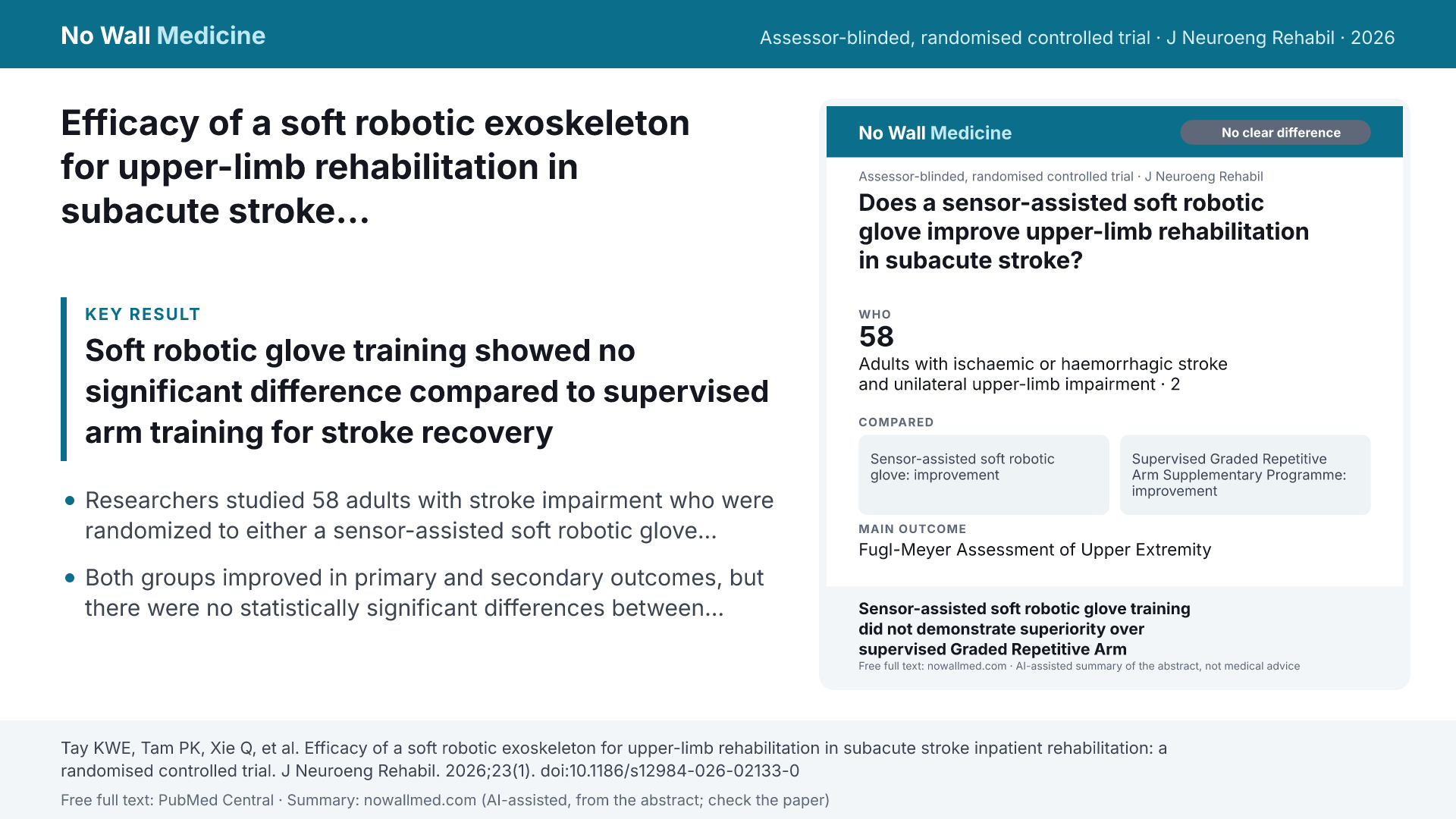
Soft robotic glove training showed no significant difference compared to supervised arm training for stroke recovery

Efficacy of a soft robotic exoskeleton for upper-limb rehabilitation in subacute stroke inpatient rehabilitation: a randomised controlled trial

Tay KWE, Tam PK, Xie Q, Lai HS, Yuen WK, Lim XML, et al
Physical Medicine & RehabilitationCardiologyAdult
Assessor-blinded, randomised controlled trialNo clear difference
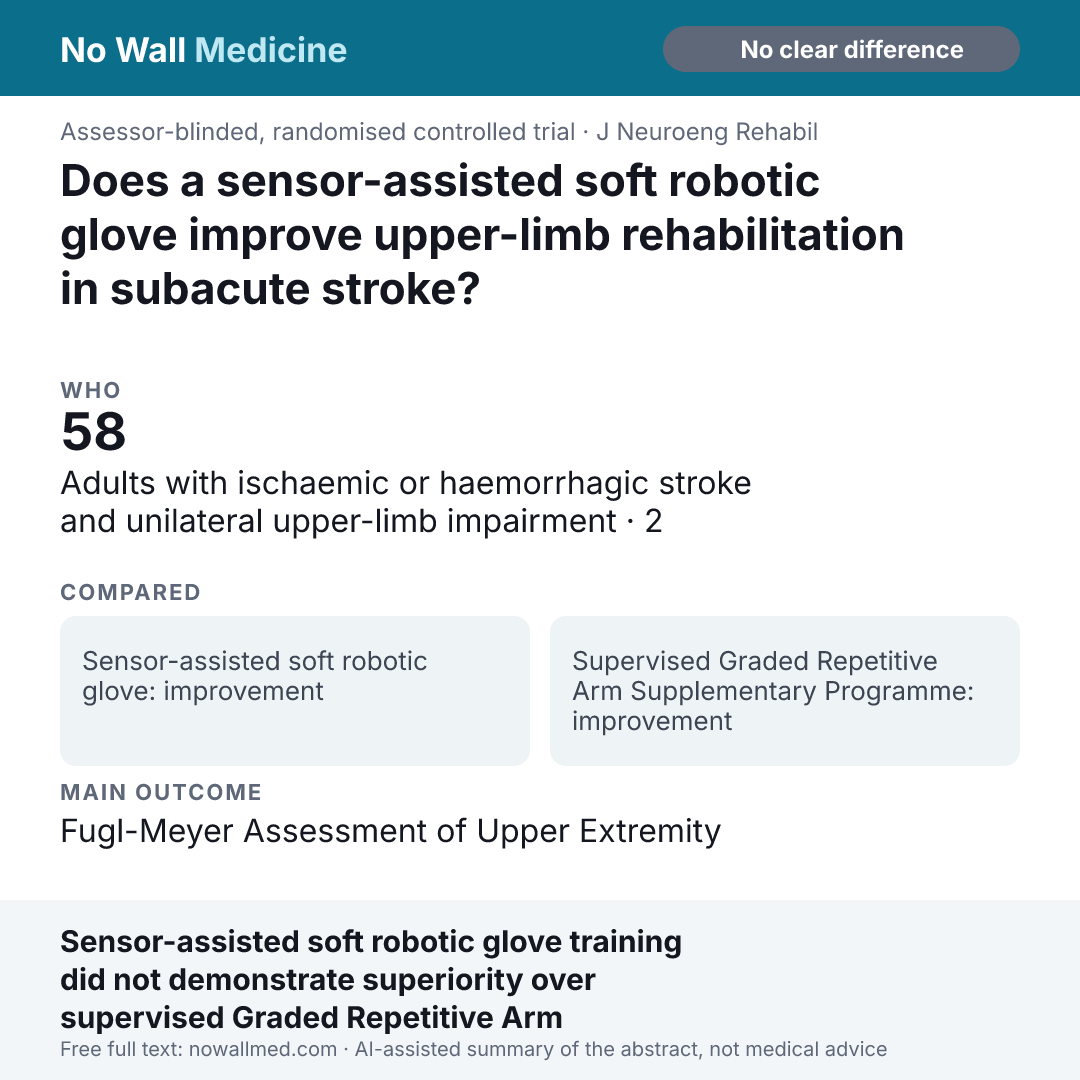
Does a sensor-assisted soft robotic glove improve upper-limb rehabilitation in subacute stroke?
Who
58
Adults with ischaemic or haemorrhagic stroke and unilateral upper-limb impairment · 2 inpatient rehabilitation units
Compared
Sensor-assisted soft robotic glove: improvement
Supervised Graded Repetitive Arm Supplementary Programme: improvement
Main outcome
Fugl-Meyer Assessment of Upper Extremity
Bottom line: Sensor-assisted soft robotic glove training did not demonstrate superiority over supervised Graded Repetitive Arm Supplementary Programme for upper limb function.
J Neuroeng Rehabil · 2026-09-10
Read the full paper free at PubMed Central ↗
Save PNG⬇ Slide🖨 Handout

Why it matters: Soft robotic devices may provide higher intensity training and more comfort than rigid exoskeletons, but their efficacy in inpatient stroke rehabilitation remains to be evaluated.

Headline and visual abstract written with AI from the paper’s abstract, with every number checked against it. Read the paper before relying on them.

Was this summary helpful?

Subject terms

Humans; Stroke Rehabilitation; Upper Extremity; Aged; Exoskeleton Device; Middle Aged; Female; Adult; Male; Aged, 80 and over; Stroke; Robotics

DOI: 10.1186/s12984-026-02133-0 · PubMed: 42763409

Cite this article

Tay KWE, Tam PK, Xie Q, et al. Efficacy of a soft robotic exoskeleton for upper-limb rehabilitation in subacute stroke inpatient rehabilitation: a randomised controlled trial. J Neuroeng Rehabil. 2026;23(1). doi:10.1186/s12984-026-02133-0

RIS (EndNote, Zotero, Mendeley)BibTeX

Spotted a mistake? Suggest a correction

Top Physical Medicine & Rehabilitation studies every Monday

The week’s key trials and guidelines, free to read, in one short email. No account; unsubscribe in one click.

Choose specialties and topics

Similar articles

Randomized trial n = 82 · Stroke · Mar 12, 2026 · Neurology, Cardiology

Exoskeleton-assisted robotic therapy improved upper limb motor scores more than conventional rehabilitation in stroke patients

Randomized trial · J Neuroeng Rehabil · May 10, 2026 · Physical Medicine & Rehabilitation, Cardiology

Wrist-hand robotic assistance improved motor function and reduced therapist workload in subacute stroke patients

Meta-analysis n = 617 · Arch Phys Med Rehabil · Apr 4, 2024 · Physical Medicine & Rehabilitation, Neurology

Neural interface rehabilitation was associated with modest improvements in upper limb function after stroke

Secondary analysis of a trial · J Rehabil Med · Jun 17, 2026 · Physical Medicine & Rehabilitation, Cardiology

Initial cognitive function and leg power predict success with robot-assisted gait training after stroke

Systematic review · J Neuroeng Rehabil · May 8, 2026 · Physical Medicine & Rehabilitation, Cardiology

Robotic gait training improved walking speed and symmetry more than traditional training after stroke